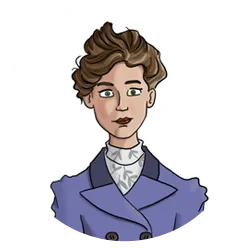
Agnes Wild was born in Macclesfield, Cheshire, England, in 1893, one of five children of James Higson and Mary Elizabeth Wild (née Barnett). The family home was originally 'Brook Bank', Chestergate, in Macclesfield. Her father was a designer and card cutter in the manufacture of silk goods, which played a prominent part in the local textile industry.
In 1894, the family immigrated to Paterson, New Jersey, in the United States of America. This was the centre of the silk trade in America and it was not long before James Wild had used his skills to become a very successful and prosperous businessman, which enabled the family members to make frequent trips back home to Macclesfield. The family home in Paterson was at 446, Fifteenth Avenue.
In the spring of 1915, Agnes Wild and her older sister Evelyn decided to make another journey to Macclesfield, although they had both only returned from a previous visit in November 1914. This time, however, they intended to stay in England and offer their services to the war effort. As a result, they booked themselves as second cabin passengers on the Lusitania's scheduled sailing for 1st May 1915. Leaving Paterson by
rail at the end of April, they joined the liner at Pier 54 in New York harbour before she sailed from there at 12.27 p.m. on that date.
Six day later and only about fourteen hours steaming time away from her Liverpool home port, the liner was torpedoed and sunk by the German submarine U-20, but both sisters managed to survive, although Agnes was injured during the course of her escape! Having been rescued from the sea they were both landed at Queenstown.
Agnes later gave an account of the sinking, which stated: -
We were eating lunch with our friends when the torpedo struck. We immediately rushed on deck and clung to each other, determined not to be separated in the crush of people scrambling around, even if it meant us going to the bottom.
We were then immediately picked up from behind and thrown into a lifeboat. I suffered a broken arm as a result of my being pitched in. Besides us, there were thirty-six others in the lifeboat with us. After several hours we were picked up by a fishing boat. The four fishermen towed us for several hours, intending to take us to Kinsale, but before we arrived, a government boat picked us up and took us to Queenstown. Of course we were drenched to the skin, cold and penniless. We went into the shops of Queenstown and were fitted with new clothes.
Agnes Wild was also given medical attention in the town, for what turned out to be a badly broken arm and shoulder.
When they were ready to leave, Cunard in Queenstown gave each sister a boat and rail ticket to Manchester, Lancashire - the nearest city to Macclesfield and travel expenses of £0-10s-0d., (£0.50p.). With this help, the sisters eventually made it back to Macclesfield on the evening of Sunday 9th May, where they were interviewed by a reporter from The Macclesfield Courier and Herald at the Queen's Hotel there. Agnes then gave a longer account of the sinking, which appeared in the newspaper on Saturday 15th May 1915 and stated: -
Throughout the voyage the threat of the Germans to blow up the Lusitania had been the common topic of conversation among the passengers, but no one seemed to take the matter seriously. Only half an hour before the thing actually occurred she was chatting with one of the officers and three of the engineers of the boat, about the same matter, and they simply laughed at the idea of the vessel coming to any harm, as they were then in sight of the Irish coast and steaming at the rate of 17 knots an hour.
The sea was beautiful, bright and clear, and no one dreamed of anything untoward happening at that time. Shortly after conversing with the officers, the ladies referred to went down to the saloon to lunch and whilst they were thus engaged, they heard a tremendous explosion, which caused the ship to stop dead and give a kind of a stagger.
When this occurred, every one of the passengers seated at the tables looked at each other as if asking what it all meant and then a cry went round that they had been torpedoed and this was a signal for a regular stampede towards the main stairway. The two sisters Wild were not far from the main stairway, but
before they could reach it, there was a wild rush which prevented anyone from getting clear away.
Miss Wild said that she heard someone say that the ship had been struck and then the commotion became something awful, and those wedged in the rush about the main staircase could scarcely move. Fortunately, she was acquainted with the stairway leading by a back way from the saloon along by the cabins to the main deck, and along this she dragged her sister, urging her on all the time to keep cool.
Along the passage, they did not meet a soul and they were able to gain the main staircase a long way ahead of those who were in the saloon with them at the time the boat was struck. When they reached the stairway it was a scene of terrible confusion, where everyone was trying to get first. By dint of struggling, they managed to get up on the main deck, and although only a few minutes had elapsed since the first alarm, the boat was beginning to list fearfully.
On reaching the deck, they found that all the people were rushing towards the part that was the furthest from the water, but she saw that they were unable to get the boats into the water from that side, so she and her sister made for the lower side of the vessel which at that time was very near to the water, and there they found that there were very few people.
Among the few that were there were Mr. Ernest Cowper a well known American journalist with whom they were acquainted. As there appeared to be no prospect of getting away from the boat at that side, Miss Wild dragged her sister toward the first class deck, and as she did so, the vessel gave a still greater list and she fell almost into the sea. She had just about given herself up as lost when she was rescued by a stoker who was standing near, and she was put into a lifeboat, although she had no distinct recollection of it at the time. The next that she remembered was that her sister was handed into the same boat and that her sister was wearing a lifebelt. She had time to notice that she had no lifebelt herself, that it did not matter as she was safely in the boat then.
There were about 28 in the lifeboat but there was no one in command and the utmost confusion seemed to reign on the decks above. The vessel was then rapidly sinking and when most of the other lifeboats had cleared away, it seemed to strike someone in the boat that they were still attached to the vessel by means of the painter, which nobody had thought of cutting away. It was only at the last moment that someone in the boat seemed to have the presence of mind to cut away the rope which held them still bound to the Lusitania, and they just managed to get clear before she sank.
Miss Wild said that there seemed to be considerable misapprehension as to the time which elapsed between the vessel being struck and sinking. As a matter of fact, she said, it was not more than a quarter of an hour. She said that she was wearing her wristlet watch at the time, and when the first shock was felt she looked at her watch and she did the same when the Lusitania settled down and sank, and she found that there was exactly a quarter of a hour between the two times.
Agnes Wild was mistaken in this, as the general consensus of opinion concludes that the vessel took between 18 and 20 minutes to sink. However, as her gold wristlet watch was broken at some time during her ordeal and remained a pathetic souvenir of the events of the afternoon of 7th May 1915 for the rest of her life, it is possible that when she looked at it for the second time, she did not realise that it had stopped!
The Macclesfield Courier account continued: -
Theirs was the last boat to leave the side of the ill-fated vessel and as they cut away, she could plainly see people clinging to the ropes at the stern of the vessel as she settled, and their boat was only a short distance away when the Lusitania heeled over and took a dive, bow first into the depths.
The sea was perfectly calm at the time and their boat hovered round the spot to try to rescue anyone they could see. They picked up one old lady about 75 years of age who was being kept afloat by means of a lifebelt which she was wearing. They afterwards picked up several others, and then they began to row away. There were very few of those in the boat who were able to give any assistance with the rowing, and the sisters Wild both rendered assistance in this direction.
After about three hours rowing, they came across an Irish fishing boat with four men aboard and they took them in tow until they were picked up by the Government boat "Stormcock", by which they were taken to Queenstown harbour. In Queenstown they saw many of the rescued who had been landed and also many of the dead whose bodies had been recovered, and she said that it was a dreadful sight to see people visiting the morgue to identify the dead.
After visiting the Cunard Offices and reporting themselves, they resumed their journey and landed in Macclesfield on Sunday night. They lost all their belongings except the clothes they were attired in at the time the vessel was struck.
After ..... reporting themselves involved sending a cable to their brother John in Paterson, which simply stated: -
BOTH SAVED, WE ARE HERE.
Fortunately for the family their time of anxiety was short lived as they had only just heard that the liner had gone down, when the received the cable.
After spending some time with relatives in Macclesfield, Agnes and Evelyn Wild also visited friends in the Isle of Man.
In the summer of 1915, while in Macclesfield, Agnes Wild applied to The Lusitania Relief Fund, for financial help. This fund had been set up immediately after the liner had gone down, by The Lord Mayor of Liverpool and other local business dignitaries to help second and third class passenger survivors and the relatives of those who had perished, who had come upon financial difficulties as a result of the sinking. It was thought at the time that the saloon passengers would not need financial help!
There is no record of any award being made to her, but surviving records state that at the time of the application, Agnes was occupied in photography’, suggest
On the 14th February 1917, Agnes married Francis George “Frank” Jowers, an English actor whom she had first met when he was performing in a play in Paterson. He had joined the British Army in January 1915 and having been wounded by a bullet in the head in May 1915, he had developed rheumatism and rheumatic fever which resulted in damage to his heart. In January 1918, he was discharged as being permanently unfit for service as a result of valvular disease of the heart. He was serving as a private in the Army Pay Corps when he was discharged as he was deemed unfit for front line service from 1916. He died in Birstall, Leicestershire, on the 21st July 1920.
Despite the ordeal suffered by the two sisters in the waters off Ireland, they continued to travel back and forth across the Atlantic after the war, until, in 1928; they decided to settle in Paterson for good. Their father had died there in 1922.
On the 2nd June 1928, Agnes Jowers was married for the second time, to a Mr. John P. Stewart, who was divorced, and the associate editor of a Paterson trade journal, named The Packer. In the years that followed, neither sister spoke very often about their Lusitania experiences and did not like to be reminded of them.
Agnes Stewart died in Paterson, on 30th May 1950, aged 56 years; just over 35 years after the sinking and only three months after her sister had died! Like Eveline, she was buried in Laurel Grove Memorial Park, Paterson, and the inscription on her headstone does not bear any mention of her experiences on the Lusitania. Nor does that of her sister!
Cunard records spell the family name Wilde, but all other contemporary records show it without the final 'e'.
Register of Births, Marriages and Deaths, Manchester England Church of England Marriages and Banns 1754 – 1930, New York U.S. Extracted Marriage Index 1866 – 1937, U.S. Presbyterian Church Records 1701 – 1970, New Jersey U.S. Death Index 1901 – 2007, 1895 New Jersey State Census, 1900 U.S. Federal Census, 1901 Census of England & Wales, 1911 Census of England & Wales, 1940 U.S. Federal Census, 1950 U.S. Federal Census, New York Passenger Lists 1820 – 1957, Cunard Records, Liverpool Record Office, Daily News, Leicester Daily Mercury, Macclesfield Courier, PRO BT 100/345, UniLiv.D92/1/1, Graham Maddocks, Michael A. Findley, Geoff Whitfield, Michael Poirier, Jim Kalafus, Cliff Barry, Paul Latimer, Norman Gray.
Copyright © Peter Kelly.