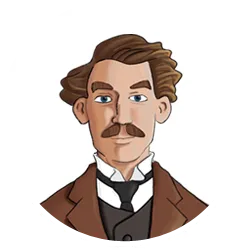
Albert Norriss Perry – always known as Norriss - was born in Holloway, London, England, in May 1889, the son of Charles and Julia Frances Perry (née Norris). He was the youngest of eight children, and as his father was a prison warder at Wormwood Scrubs, he was brought up with his family residing in the married quarters reserved for the staff at the prison.
He was an engineer and in 1903, he joined Messrs. D. Napier and Sons, Motor Manufacturers of New Burlington Street, London, and Acton Vale. Then, in 1909, he had travelled to Boston, Massachusetts, in the United States of America, where he became involved in the automobile business.
It is not known when he returned to England, but on the 15th June 1912, he married Jessie Cowper at St. Dunstan’s Church, East Acton, London. They established their home at 51. Grafton Road, Acton, London.
In April 1915, he crossed the Atlantic Ocean on the Baltic to take up an appointment as European representative for the Commercial Vehicles Section of Pierce-Arrow Automobiles, of Buffalo, New York, in the United States of America.
Having agreed terms with his new employers, he intended to return to Acton to put his affairs in order, and then go back across the Atlantic, on Saturday 15th May 1915, to take up permanent residence in America. He booked both of these passages at saloon class, on the Lusitania, from Buffalo, New York and for his outward journey to Liverpool, he joined the liner at Pier 54 in New York, for her scheduled sailing at 10.00 a.m. on 1st May. Once on board, - with ticket number 46152 - he was allotted room D38, which was the personal responsibility of First Class Bedroom Steward William Barnes who came from New Brighton, a district of Wallasey in Cheshire, on the opposite side of the River Mersey from Liverpool
Along the corridor in room D28, was his brother Frederick 'Fred' Perry, who also worked for Messrs. D. Napier and Sons, and had been travelling for the firm in the United States of America. He presumably also booked passage on what became the Lusitania's final voyage so that he might travel home with his brother.
The liner’s departure was then delayed until the afternoon as she had to embark passengers, crew and cargo from the Anchor Liner Cameronia, which had been requisitioned by the British Admiralty for war service as a troop ship, at the end of April. The Lusitania finally left port just after mid-day and just six days later, on the afternoon of 7th May, she was torpedoed and sunk by the German submarine U-20. At that point, she was off The Old Head of Kinsale in southern Ireland and only 250 miles hours away from her Liverpool home port destination. Although Fred Perry survived this action, Albert Perry was killed. He was aged 26 years.
Having got back to Acton, Fred Perry gave an interview to the local newspaper, The Middlesex County Times, about his survival, which also told of his brother Albert. The interview, published on 15th May 1915, stated: -
Both my brother and I were returning from the States together. Before we left New York, we read in the papers the notice issued by the German Ambassador, and, as everybody else did, we pooh-poohed the idea of the vessel being torpedoed. There was a general discussion of the matter throughout the whole of the morning.
There was a great crowd at New York to see us all off, and as the ship began to move away from the landing stage, the splendid Welsh Choir which had been touring the States, sang to their friends on shore. That and all the following days, up to the day of the disaster were beautifully sunny. We had a very good voyage over.
On the Thursday evening before the sinking of the vessel, we had the usual weekly concert amongst the first-class passengers, and after a splendid entertainment by the Welsh Choir, the chairman, who was one of the directors of Messrs. Vickers, made a splendid appeal for the Liverpool Sailors' Orphanage, and referred to the dangers through which we were passing. He said that he was quite sure that every man, from the captain down to the stokers, would be willing, to lay down their lives, for the passengers, if need be. This resulted in a record collection at these concerts for the Liverpool Orphanage.
On the following morning, quite early, before anyone was about, the fog horn was sounding and it continued sounding right up until 12 noon. It certainly was misty, but in view of the danger zone we were in, it seemed a trifle absurd to blow the foghorn furiously as they were doing.
At noon it cleared, the sun shone beautifully and you could see for miles. The south coast of Ireland was well in sight. At one o' clock, the lunch bugle was sounded, and everyone went down to lunch.
My brother and an American friend who was travelling with us for his health, and who intended to return with my brother on the Lusitania next Saturday, (as my brother was taking up a permanent position with the Pierce-Arrow Co.), were lunching with me, and as we were finished quite early, we went up several decks to the lounge for a smoke. It was then ten minutes to two.
Shortly after two o' clock, just before the people began to get up into the saloon, there was a terrible impact, marked not so much by the noise, as the force of the explosion. It shook the vessel from stem to stern, as though we had struck a rock or collided with another vessel. We immediately realised that we had been hit by a torpedo.
Our American friend was not with us at the time, but my brother and I
walked through the lounge to get down to the boat deck. We were met at the entrance to the lounge with a fearful volume of smoke and steam, caused by the explosion, which apparently had reduced the speed of the ship very suddenly.
Before we could realise the position, there was a second shock, which came within a minute or two of the first. By this time, there were many people coming up the stairs from the lower decks and the dining-saloon. We managed to get out onto the boat deck, which was then very crowded, considering the majority of people had been in the dining saloon. Most of the people appeared to have come from the second saloon over the communicating bridge.
My brother and I then got separated, nor did I see our American friend, Mr. Brown, who had gone down into the library after dinner to write his last letters before landing.
Although it is unlikely that Fred Perry could have mistaken the name of his American friend, there was no American citizen named Brown travelling saloon class on the Lusitania's last voyage. The only saloon passenger named Brown was British subject William H.H. Brown. As he, like the Perry brothers, was travelling from Buffalo, New York, however, it is likely that it was he to whom Fred Perry was referring and maybe Fred Perry just assumed he was an American from his accent, picked up after long years in the United States. William Brown, like Albert Perry, was killed in the course of the disaster! Fred Perry's account continued: -
I walked to the starboard side and helped people to get into the boats. One boat was being lowered, but when it was nearly half way down, one end seemed suddenly to stop, and the other end continued, with the result that the people - between fifty and seventy of them - were simply shot out, like coals out of a sack, into the water. The boat then followed them, stern foremost, and thus immediately began to fill with water. The bows seemed to be held fast by the ropes, which were still over the davits. The boat thus lay useless alongside the ship.
This was almost certainly Lifeboat No. 17.
Another boat farther along towards the captain's bridge was lowered a few seconds afterwards, and when nearly down to the water, it appeared as if it was going to behave as the first had done, but righted itself and reached the water safely. There were not more than half a dozen people out of the previous boat in reach of the second. They were told not to catch hold of the second boat, but I did not see whether any managed to get in; or if I did see, I don't remember it. I remember that one of the difficulties of lowering the first boat was that an iron ring had jammed round a staple, and one of the crew could not release it.
I jumped into one boat to help in releasing the ropes preparatory to filling it with the women who were round, when I suddenly heard a cry "All out of the boats." Looking round I saw an officer on the very top deck of all but
could not hear his orders distinctly.
This officer was almost certainly Staff Captain James Anderson, who believed at that time that the vessel would right herself, and that there was no immediate danger.
Immediately we jumped out on to the boat deck, and then it appeared that the ship was simply righting herself, probably through the water finding its own level: and I suppose the water-tight doors were closed.
I then saw my brother for the last time, away towards the captain's bridge and near the lounge entrance. I noticed he was, like myself, fully dressed and had on a lifebelt of the type supplied in each cabin. I asked him where he obtained it, and he said "Inside the main entrance”.
Despite wearing a lifebelt, Albert Perry did not survive when the liner went down!
On 9th May, his body was recovered from the sea by a fishing vessel, about eight miles south west of Castletownshend, which was itself about 30 miles from where the Lusitania had gone down. It was landed at Castletownshend from where it was then transported to Queenstown, and taken to one of the temporary mortuaries there, where it was given the reference number 162, before being formally identified.
It was identified as: -
Male aged 26, A.N. Perry, Saloon Passenger, 5’9” brown hair, clean shaven, greyish clothes, dent on side of right eye.
Property discovered on the body was also described as: -
1 Gold diamond ring, 1 gold ring with initials A.N.P 2 gold sleeve links, gold watch and chain, 2 sovereigns in leather purse. 1 10/- (0.50p.), Treasury Note, 3 single pound notes, 1 £5 Bank of England note, 8 $10 bills, 5 $20 bills, 1 linen handkerchief, 1 key, 1 penknife, 2 letters with addresses, 1 silver cigarette case with engraving inside, 1 3d., 1 pencil holder, a railway ticket first class Liverpool to London.
Local newspaper The Cork Examiner described the body more fully as that of: -
A well dressed gentleman, 30 to 35 years of age, 5ft. 10ins., clean shaven, auburn hair and rather stout, whose name from the papers etc., found on him, must be A. Perry Norris.
He was dressed in a pale green suit, white shirt with black stripes, and wore a pair of brown golf shoes. His eyes were closed and swollen and looked as if they had been injured. He had a diamond ring on one of his fingers, and in his vest pocket was a gold half-hunter keyless watch which stopped at 2.35, attached to a gold kerb chain, small links, and a leather sovereign purse, containing 2 sovereigns. He also had £8 10s in English notes, 8 American 10 dollar bills, and five 20 dollar bills.
Some letters were found on him, one addressed to Mr. G. H. Heath, Heath’s Garage Ltd., John Bright Street, Birmingham, and another Gerald Dugdale Esq., 8 Market Place, Manchester. On his passenger ticket was written - Perry Albert Norris. He had two first-class railway tickets from Liverpool to Euston, a cigarette case (silver), bearing an inscription showing it was presented to him by “a few colleagues of Messrs. D. Napier and Son, Ltd.,” and dated Xmas. 1914.
This latter cigarette case must have been presented to him on leaving Napier’s to take up his appointment with Pierce-Arrow Automobiles.
Apart from this documentary evidence, a positive identification of the body itself was then made by another brother, Harry Perry, who had travelled to Queenstown, once news of the disaster had reached Acton, to search for both of his brothers, dead or alive. Having discovered the body of Albert Perry, he later found Fred Perry in a local hospital, alive and tolerably well, apart a broken collar bone.
On 14th May 1915, Albert Perry's body was sent to London for burial in Acton Cemetery. This took place on the afternoon of 15th May, following a funeral service at St. Dunstan’s Church, Acton. His remains lie there to this day, in the family grave and his memorial takes the form of a large stone block, upon which is placed a Christian cross bearing the letters IHS.
The inscription which applies to him is carved on that face and states: -
In Loving Memory of
My Dear Husband
ALBERT NORRISS PERRY,
WHO LOST HIS LIFE
IN THE TERRIBLE “LUSITANIA” DISASTER
MAY 7TH 1915.
AGED 26 YEARS.
____
THE SOULS OF THE RIGHTEOUS ARE IN THE HANDS OF GOD
AND THERE SHALL NO TORMENT TOUCH THEM.
On 4th June 1915, property recovered from the body was sent to Fred Perry, (who was a joint executor of Albert Perry's will, with his widow Jessie), at his home, 41, Allison Road, Acton. He left an estate of £10,493-14s.-4d. (£10,493.71p.).
Bedroom Steward Barnes, who had looked after Albert Perry in room D38, survived the sinking and eventually returned home to New Brighton.
Register of Births, Marriages and Deaths, London England Church of England Births and Baptisms 1813 – 1917, London England Church of England Marriages and Banns 1754 – 1932, 1891 Census of England & Wales, 1901 Census of England & Wales, 1910 U.S. Federal Census, New York Passenger Lists 1820 – 1957, Cunard Records, Cork Examiner, Middlesex County Times, Probate records, PRO 22/71, PRO BT 100/345, UniLiv.D92/1/8-10, UniLiv D92/2/113, Deaths at Sea 1871 – 1968, Graham Maddocks, Paul Courtney, Geoff Whitfield, Michael Poirier, Jim Kalafus, Cliff Barry, Paul Latimer, Norman Gray.
Copyright © Peter Kelly.