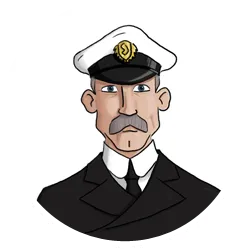
Arthur Rowland Jones was born in Liverpool, Lancashire, England, on the 22nd August 1879, the son of Rowland and Margaret Jones (née Ellis). Rowland Jones was a master mariner, and the family home for many years was at 31. Beaconsfield Street, Toxteth Park, Liverpool. Arthur was one of eight children in the family.
After formal education, Arthur Jones decided to make his career at sea and having qualified as a deck officer, worked his way up from the lowest grade.
He was married to Elizabeth Lunn in Liverpool on the 12th September 1907 and the family home in 1915 was at ‘Thornhill’ Pennyffordd, Ffynnongroew, near Prestatyn in Flintshire, north Wales. They had a son, also named Rowland, who was born in 1910.
On the 12th April 1915 at the Water Street offices of The Cunard Steam Ship Company in Liverpool, he engaged as First Officer in the Deck Department on board the Lusitania at a monthly wage of £16-0s.-0d. He reported for duty five days later, on the morning of the 17th April, just before the liner left Princes Landing Stage for the last time.
It was not the first time that he had served on the Lusitania and when he engaged on the 12th April, he gave his address as 31. Beaconsfield Street, Toxteth, Liverpool, which was where he was residing. Having helped the Lusitania to reach New York, he was serving on board in the same capacity on the 1st May 1915, when the liner left there for the return leg of her voyage, back to Liverpool.
She never made it, however, for six days later, on the afternoon of the 7th May 1915, she was torpedoed and sunk by the German submarine U-20, off the coast of southern Ireland, only hours away from her home port. First Officer Jones played a significant part in the rescue of many passengers.
He was in the dining saloon when the torpedo struck and he rushed to the after part of the starboard side of the ship, where, in the case of an emergency he was to command the launching the lifeboats numbers 11, 13, 15, 17 and 19. In the event this was the only side on which it was possible to launch any boats at all!
He personally supervised the lowering of Lifeboat No. 15 which reached the sea successfully under his command, with over 80 people on board. As it was being rowed away from where the ship had foundered, he saw Lifeboat No. 1, floating empty nearby and transferring half of the passengers from No. 15 to it, he then took both lifeboats back to the area of the sinking to pick up swimming and floating survivors.
Stewardess May Bird who was successfully got away in Lifeboat No. 13, reported her experiences of the sinking in The Birkenhead News and Advertiser for the 15th May 1915, in which it was stated: -
Miss Bird paid a high tribute to the splendid behaviour of Chief Officer (sic) Jones who, she said, was instrumental in saving hundreds of lives. He helped to launch the boats and saw to the safety of the children.
In the 10th May 1915 edition of The Cheshire Daily Echo, First Class Bedroom Steward Percy Penny told of being rescued from the sea by Arthur Jones, having first been sucked down under the surface and then shot back again: -
When I reached it (the surface) I swam about among wreckage and dead bodies and fellow survivors until - an hour and a half afterwards - I had the good fortune to fall in with a lifeboat which already had about eighty souls.
This boat was under the charge of Mr. Jones, the first officer who conducted it to a fishing smack, and then returned with about ten men and succeeded in picking up about 35 more survivors. Eventually we were picked up by a patrol boat and taken to Queenstown.
On his eventual return to Liverpool, he was required, (as were all crew survivors), to give a deposition of his experiences of the sinking. Very few of these depositions survive today, but that written by the former First Officer still does. Signed on the 11th May 1915, it states: -
On Friday 7th May, Deponent was in the First Class Saloon at lunch when at about 2.10 p.m. an explosion occurred. The ship on the instant commenced to list to starboard. Deponent arose and in company with the (about) 150 passengers at lunch. went on to the boat deck “A”. On leaving the saloon, Deponent ordered all starboard ports to be closed if not already closed and reached the boat deck from 3 - 4 minutes after rising from his seat. The ship then had a list of at least 30 degrees which made it impossible to walk without holding on to the rails.
Deponent then went to his appointed boat, ‘No 15’ starboard side immediately behind the after funnel. The boats had been swung out on Thursday at 6 a.m.. By this time most of the passengers had assembled on the boat deck. The list increased until it reached about 40 degrees. The ship recovered slightly and reduced the list to about 20 degrees, at the same time sinking rapidly by the head.
Deponent loaded No. 15 boat with about 80 souls with great difficulty owing to the great distance between the ship’s side and gunwhale and lowered in safety into the water. The falls were cast off and the boat commenced to drift astern close to the ship‘s side. The forward part of the ship was submerged and the forward bridge awash and people were slipping down the deck into the water.
The people in No 15 boat asked Deponent if he was coming down. He looked round and seeing it was impossible to do anything more, he went down the falls and was pulled into the boat.
Three minutes after, the ship disappeared very suddenly. In the final moments, she was almost vertical. The Marconi aerial wire caught across the stern of the boat, but luckily parted. The boat was caught in the violently agitated water and it was impossible to get her out. The people were urged to keep quiet in their places and the boat escaped.
Deponent observed an empty boat about 600 yards away. On reaching her, men were found who had swum off to her. Thirty passengers and sufficient seamen and stewards to form a crew were transferred. Both boats returned to the scene of the wreck picking up survivors until both boats had a full complement. Deponent then put his passengers onto a smack five miles distant and returned once more.
The smack
Captain John Thompson, which later landed 47 survivors and 10 dead at Queenstown. Arthur Jones’ deposition continued: -
A waterlogged collapsible boat was picked up and the 35 occupants transferred.
Shortly after these were put on to a trawler which towed Deponents’ boat to the scene of the wreck where she picked up about 10 more drowning people who were transferred to the tender “Flying Fox”. Plenty of other help being on hand and Deponent’s crew exhausted, all returned to Queenstown on the “Flying Fox”, arriving at 11 p.m..
The “Flying Fox” was in fact the Queenstown harbour tender the Flying Fish, which was instrumental in saving the lives of many people. Arthur Jones had obviously confused the name, which was hardly surprising, given the circumstances surrounding the sinking.
Soon after his return to Liverpool, First Officer Jones was paid the balance of wages due to him in respect of his service on the Lusitania from the 17th April until the 8th May 1915, 24 hours after the liner had foundered. This balance amounted to £13-0s.-0d.
After the sinking, he returned to sea and eventually achieved the rank of Master. However, on the 2nd February 1918, he was in command of the 2,128 ton Lambert Brothers ship Avanti, carrying iron ore from Bilbao to West Hartlepool. Whilst passing through the English Channel and off the Isle of Wight, his vessel was torpedoed and sunk by the German submarine UB-59 and he and 22 of his crew were killed. What the U-20 had failed to achieve, in May 1915 the UB-59 managed to accomplish, nearly three years later!
His body was recovered from the Channel, however, and not long afterwards was sent back to his wife in Prestatyn. Then, on Friday, the 25th February 1918, it was buried in the churchyard of Christ Church, The Parish Church of Prestatyn, in grave D. 194, where it lies to this day. The funeral service was conducted by The Reverend Meredith J. Hughes, assisted by The Reverend W. Armon Ellis.
The inscription on the headstone, subsequently erected by his widow, states: -
SACRED TO THE MEMORY OF
MY BELOVED HUSBAND
ARTHUR ROWLAND JONES
FIRST OFFICER OF THE “LUSITANIA”
WHEN SUNK, AFTERWARDS
CAPTAIN OF THE “AVANTI”,
TORPEDOED IN THE ENGLISH CHANNEL
FEB. 2ND 1918, WHEN HE LOST HIS LIFE,
AGED 38 YEARS.
“I HOPE TO SEE MY PILOT FACE TO FACE
WHEN I HAVE CROSSED THE BAR..”
The latter inscription is from the famous poem by Sir John Masefield.
Captain Jones is also commemorated on one of the bronze panels of the parish war memorial situated just inside the main gates of the church.
The feeling of the local populace towards the enemy in 1918, is obvious in the simple entry taken from the burial register from Christ Church, Prestatyn for Arthur Jones’ committal (No. 774), which states: -
Master of a vessel torpedoed off the Isle of Wight by the Huns.
In an article following his death, published in The Prestatyn Weekly on Saturday, the 16th February 1918, it was said of him: -
Since the outbreak of hostilities he has been unceasingly at his post, facing the many perils which continuously beset our sailors on the sea, and although his loss is greatly to be deplored, we are proud to think that he has passed away whilst doing his duty in the interest of liberty and justice.
He was only 38 years of age, held his extra master’s certificate of competency since the early age of 25, and had every prospect of a brilliant future before him.
He leaves a wife and little son to mourn his loss.
After her husband‘s death, his widow Elizabeth moved to ‘The Nook’, Chapel Road, Prestatyn, Flintshire. She died in April 1940, aged 64 years and their son Rowland died in January 1952, aged 42 years. They both lie in the same grave as Captain Jones.
Register of Births, Marriages, and Deaths, Liverpool England Church of England Marriages and Banns 1754 – 1935, Flintshire Wales Anglican Baptisms, Marriages, and Burials 1538 – 1994, 1881 Census of England, 1891 Census of England, 1901 Census of England, 1911 Census of England, Birkenhead News, Cunard Records, Commonwealth War Graves Commission, UK and Ireland Masters and Mates Certificates 1850 – 1927, Cheshire Daily Echo, Prestatyn Weekly, Wallasey News, Lusitania, Merchant Fleet at War, Merchant Ships Sunk by U Boats, PRO ADM 137/1058, PRO BT 334, PRO BT 351/1/71990, Deaths at Sea 1871 – 1968, Graham Maddocks, Jerard Bone, Geoff Whitfield, Michael Poirier, Jim Kalafus, Cliff Barry, Paul Latimer, Norman Gray.
Copyright © Peter Kelly.
Revised & Updated – 24th January 2024.