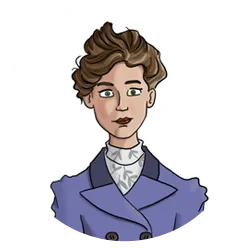
Cecelia Mildred Smith was born in Llanelli, Carmarthenshire, Wales, on the 13th January 1879, the daughter of William Facey and Mary Ellen Smith (née Davies). She was the second youngest of four known children and her father was a mariner. While she was still a child, her family moved to Swansea, Glamorganshire. Her mother died in 1882, shortly after the birth of her fourth child, and her father re-married in 1895.
In 1902, she married Herbert Isaacs Owens in Swansea. Her husband was a commercial traveller for a brewery, and they set up their home in Mumbles, not far from Swansea. Their son, Ronald Hubert, was born there in late 1904.
In June 1905, Herbert Owens had travelled to Quebec, Canada, with the intention of finding work in Montreal; however, he must have changed his mind very quickly as he continued south to Greenville, Mercer County, Pennsylvania, in the United States of America, and found work as a clerk there. Once he had established himself in Greenville, he sent for Cecelia and their son to join him, which they did in early November 1905.
On the 23rd April 1907, Cecelia gave birth to another son, they named Reginald Arthur Edward, and at that time the family were residing at 78. Shenango Street, in Greenville.
By 1910, the family were living in Perry, Lawrence County, Pennsylvania, and October of that year, Cecelia travelled back to Wales with her two sons for a holiday. It was in July 1911 that they returned to Pennsylvania, but by now Herbert Owens was living and working in Ellwood City.
On the 25th July 1912, Cecelia gave birth to her third child, a son, who died within 30 minutes of his birth and who was un-named. Their home was at 215. Springfield Avenue, and Herbert Owens was employed as a cashier at The Shelby Tube Works in
the city. Members of Cecelia’s family were also residing and working in Ellwood City at this time.
In the spring of 1915, Cecelia’s brother, Alfred Smith, decided to return to Swansea, taking his wife, Elizabeth, and their two children, Helen, aged six years of age and Elizabeth, who was an infant, having been born in January 1915. Cecelia Owens decided to accompany them with her own children, Ronald and Reginald, for another holiday in Swansea. Consequently, they all booked second cabin accommodation on the Lusitania due to sail on 1st May 1915 and at the end of April, they left Ellwood for New York.
Having boarded the ship before she left New York harbour for the last time, both families enjoyed the opulence of their surroundings until the liner was destroyed, just six day later and only hours from her Liverpool destination. With the sinking of the vessel, both families were similarly destroyed, for from the Owens family members, only Cecelia Owens survived, and from the Smith family, only Helen.
Having been rescued from the sea and landed at Queenstown, she was given a boat and rail ticket for herself and Helen Smith to Birmingham, and travelling expenses of £0-15s-0d., (£0.75p.). She eventually made it back to Swansea and related her ordeal to a reporter of the local newspaper The Cambria Leader. The account, which refers to Mrs. Owens as Mrs. Owen, was published on Tuesday 11th May 1915 and also refers to Ronald Owens as Hubert. It states: -
The party were (sic) travelling second class and their cabins were opposite each other. On Friday afternoon, Hubert and Reginald and Helen Smith were playing on deck and having a glorious time. Everybody on board was anticipating the end of the voyage and none had the slightest idea that a catastrophe was near.
Mrs. Owen, leaving the children at play, telling them to come down in half an hour, went below to pack and dress in anticipation of landing. Mr and Mrs. Smith were in their own cabin with the five months’ old child. They had not been below five minutes when the crash came.
The first care was, of course, for the children and while Mrs. Owen dashed up in search of her boys, she assumed that Mr. and Mrs. Smith tried to find Helen. Mrs. Owen did not see a single of the little party again, neither did little Helen till she recognised her auntie in a Queenstown hotel some hours after.
Standing on deck, almost distracted at her loss, with the great liner listing over, Mrs. Owen somehow had a lifebelt places around her, and at length she was pushed or thrown into a boat waiting below. But this later overturned and she, with the other occupants was thrown into the sea. Fortunately, she could swim, and to this fact and the support which the lifebelt gave her, she considers she owes her life. She was quite near the liner as she slid quietly into the depths.
She dropped almost like a stone, Mrs. Owen said, she felt no suction, and there were no bubbles - no disturbance of any kind - after the Lusitania had gone. But it was horrible to see the hundreds of people struggling in the water.
A lovely little baby came floating past her and she gathered it into her arms, only to find that it dead. At length she was picked up in a boat, transferred to others and eventually got to Queenstown.
It was in one of the hotels here that she found she was not the sole survivor of the party, for with a shout of “There’s my auntie!” Helen Smith came running up to her. She had been picked up on deck by Mr. Ernest Cowper, a Toronto journalist, and got to a boat. Fortunately she had seen nothing of her lost parents and cousins and she was as happy as possible.
Mrs. Owen viewed the dead bodies brought ashore without finding any of the party, and her sister-in-law and one of Mrs. Smith’s brothers have since done the same. Mr. Owen was cabled last night that his wife had arrived, but that news was awaited of the children.
No trace of them dead or alive, or Mr. and Mrs. Smith and baby Elizabeth, was ever found again.
Once safely back in South Wales, Mrs. Owens later accompanied her niece, Helen, to Liverpool, to hand her over to her maternal grandparents.
One fellow second cabin passenger who was killed and whose body was never recovered from the sea and identified afterwards was Richard Preston Pritchard, who originally came from Ramsgate in Kent. In an attempt to learn more of his fate, his brother Mostyn first went to Queenstown to search in vain for him or his body. Then, his mother wrote to many surviving passengers and crew members seeking any information about him.
One of these was Cecelia Owens, and on 27th October 1915, she replied to the letter she had received from Mrs. Pritchard. She wrote: -
10. Gore Terrace
Swansea
October 27th
Dear Mrs. Prichard,
Received your letter & enclosure this morning & glad to know of another, heart broken mother if I can help you in any way, I shall do all I can. I remember your son very well & saw him almost every day, never got into conversation with him, but my two dear boys who I have lost did, they made friends with every young fellow they could. Your son seemed to be enjoying the trip & was with other young men on board at different games they were playing on deck. I am sorry to think I cannot tell you anything
much, how I wish I could. I was not in that boat of Parry’s, I was picked up on a raft, which we had 35 of us all told, we had to break the canvas to open it up & then try & pull the sides up. I went into a fishing trawler from there & then into a paddle steamer (I don’t know the name) we picked up several boats of people, but really I was in such a dreadful condition after swimming for my life as I did, I can't recollect a great deal after it happened. Altho’ I was conscious all the time, oh’ how I suffer my nerves are completely shattered, & I have lost all I ever possessed and my dear boys ages 11 yrs. & 8 yrs.. Also my dear brother & family, I found his one little girl in Queenstown, Helen Smith. Some Mr. Cooper (sic.) had put her in a boat, I was thankful for that. It’s very hard for us to bear but “God” has been good to spare me & I have been getting along slowly. Now another gentleman & boy (who was lost with mine) lives in Kent a Mr. Tijou. I will enclose his address may be he can help you more than I can. Hoping you will find out something yet. I will surely let you know of any survivor if I hear from any more
Yours sincerely
C. M. Owens.
Sometime later, Herbert Owens travelled to be re-united in Wales, and on the 8th July 1916, they boarded the St. Louis at Liverpool on the first leg of their journey back to Pennsylvania.
They couple returned to Wales on holiday on a number of occasions in the 1920’s before deciding to return permanently to Swansea. Herbert Owens worked as a clerk at a local steel works, and the couple had no further children. They resided at 213. St. Helen’s Avenue, Swansea.
Cecelia Owens died in Swansea on the 19th July 1966, aged 87 years. Herbert Owens died less than a year later in 1967.
Register of Births, Marriages and Deaths, 1881 Census of England & Wales, 1891 Census of England & Wales, 1901 Census of England & Wales, 1910 U.S. Federal Census, 1911 Census of England & Wales, 1920 U.S. Federal Census, 1939 Register, Pennsylvania Passenger Lists 1800 – 1962, UK Incoming Passenger Lists 1878 – 1960, New York Passenger Lists 1820 – 1957, Cunard Records, Cambria Leader, Western Mail, PRO BT 100/345, UniLiv.D92/1/1, UniLiv D92/2/225, Deaths at Sea 1871 – 1968, Graham Maddocks, Geoff Whitfield, Michael Poirier, Jim Kalafus, Cliff Barry, Paul Latimer, Norman Gray.
Copyright © Peter Kelly.