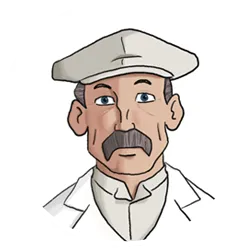
Cornelius Horrigan was born in Bootle, near Liverpool, Lancashire, England, on the 4th January 1900, and lived with his parents, Thomas and Bridget Horrigan (née Riley), at 8, Johnstone Street, Bootle. He was the youngest of five children and his father was a mariner and later a dock labourer.
He engaged as a steward's boy in the Stewards' Department on the Lusitania at Liverpool on the 12th April 1915, at a monthly wage of £2-10s.-0d. (£2.50p.), and reported for duty at 7 a.m. on the 17th, before the liner left the River Mersey for the last time. It was not his first voyage on the liner.
Having completed the journey to New York without mishap, he left there on board on the early afternoon of the 1st May 1915 and survived the liner’s sinking six days later in the afternoon of the 7th May, by the German submarine U-20. At that stage of the voyage, the Lusitania was only about fourteen hours steaming time away from the safety of her home port.
Despite his youth, Cornelius Horrigan was called as one of the first witnesses at the inquest into those dead which had been brought into Kinsale, County Cork. This began on the evening of Saturday, the 8th May 1915, in Kinsale courthouse, presided over by Coroner John Horgan. Horrigan’s deposition stated: -
I was acting as first class waiter on the R.M.S. Lusitania. I was serving puddings in the top saloon about 2.15 p.m. on yesterday May 7th. I heard a loud thud. I dropped the dishes I had in my hand and ran to the top deck. There was confusion, passengers were running here and there. The ship was heeled over to the starboard side. We tried to push the boats out but it was impossible to get the port boats out, owing to the heel of the ship.
The ship started to sink in a few minutes' time. I stood on the top deck until the ship went down and I was washed into the water. I went down a bit and then came to the surface. When I came up I saw a capsized boat. The ship's bugler, Mr Livermore helped me to get on board. I was almost two hours on the boat when we were rescued by the H.M.S. Heron.
The sea was calm, the sun was shining and the land was in sight. I saw the dead bodies of the two ladies on the HMS Heron. They are the same bodies in the military mortuary. I assisted to pull them into the capsized boat. I think the man's body with a light grey moustache is that of George Cranston a steward. He was a man of almost 45. I do not know the names of any of the other bodies.
The dead bodies of the two ladies were those of saloon passenger Ida Campbell-Johnson and second cabin passenger Margaret Shineman and the man's body with a light grey moustache was that of crew member Night Watchman George Cranston, although he was later incorrectly buried in Kinsale, under the name of George Craduck!
The other survivors landed at Kinsale were second cabin passengers Stanley Critchison, John Preston Smith, and Mrs. Julia Sullivan, third class passengers Fred Bottomley, Michael Doyle and Joseph Thompson and crew members First Class Waiter Charles Hotchkiss, the previously mentioned First Class Waiter Vernon Livermore, Second Class Waiter Harold Rowbotham and Fireman Frank Toner. The other two dead were second cabin passenger Lieutenant Robert Matthews and Night Watchman Richard Chamberlain.
On Sunday, the 9th May, Cornelius Horrigan took a train from Queenstown to Dublin and then sailed to Holyhead in Wales, after which he took another train to Birkenhead on the opposite side of the River Mersey from Liverpool. He finally arrived in Liverpool by Mersey ferry in the early hours of the 10th May.
After the sinking, the balance of wages owing to Stewards' Boy Horrigan was £1-17s.-6d. (£1.87½p.) and this was eventually paid to him at the Cunard office in Water Street, Liverpool, after which he was officially discharged from the Lusitania’s final voyage. The Steam Ship Company paid all crew members until the 8th May, 24 hours after the sinking, irrespective of whether they had survived or not.
Cornelius Horrigan continued to serve in the merchant navy for many years. He alternated between working as a trimmer and fireman to steward and storekeeper.
In late 1926, he married Caroline Rogers in Liverpool, and they had four children. They lived for many years at 6. Johnstone Street, Bootle.
Cornelius Horrigan died in Bootle on the 4th January 1954, aged exactly 54 years as he was both born and also died on the 4th January! He was laid to rest in Bootle Cemetery.
Register of Births, Marriages, and Deaths, 1901 Census of England, 1911 Census of England, 1921 Census of England, 1939 Register, Cunard Records, Imperial War Museum, Bootle Times, White Star Journal, UniLiv.D921/16, PRO BT 100/345, PRO BT 348, PRO BT 349, PRO BT 350, Graham Maddocks, Geoff Whitfield, Michael Poirier, Jim Kalafus, Cliff Barry, Paul Latimer, Norman Gray.
Copyright © Peter Kelly.
Revised & Updated – 13th January 2024.