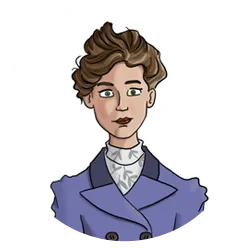
Elizabeth Ann Smith was born in Blackburn, Lancashire, England, in 1863, the daughter of John and Elizabeth Smith (née Hall). Her father was an engine smith, and later as a smith or mechanic, at a cotton mill. During her childhood, the family resided at a number of addresses at Whalley Road, Blackburn. On completion of her education, Elizabeth worked as a domestic servant, and then as a cotton weaver in one of the local cotton mills.
In 1886, she married Thomas Rushworth, who was also a cotton weaver, in Blackburn, and the couple had one child, a daughter named Ellen, who was born in 1889. The family home was 55, Bastwell Road, Blackburn. In early 1905, Thomas Rushworth died in Blackburn, aged 40 years.
Sometime after the death of her husband, but before the middle of 1910, Elizabeth had left Lancashire and gone to Lowell, Massachusetts, in the United States of America, where she was joined in May 1910 by her daughter, Ellen. Ellen was married to a man named William Smith, who, like Ellen and Elizabeth, was a cotton weaver.
On the 29th September 1910, Elizabeth married again, this time to an Englishman named Alfred Duckworth, who was a fireman who had emigrated to the United States of America in 1906, and was a widower. By 1915, she was living in the mill town of Taftville, Connecticut, where she continued to work in the textile trade at the Ponomah Mills.
However, by the spring of 1915, she had become homesick for her native Blackburn and decided to leave her daughter and son-in-law in Taftville and return home to her native Blackburn. It is not known whether or not her husband had died by this time, or whether they had become estranged.
As a result, she bought a third class ticket for herself from New York to Liverpool on the
Lusitania and having taken the train to New York, via New London, she joined the vessel at Pier 54 in time for her sailing just after mid-day on 1st May. Once on board, she was allocated a cabin with fellow Lancastrian passengers Alice Scott and her little boy Arthur, who were travelling from North Adams, Massachusetts, to their home town of Nelson, Lancashire, which was about fifteen miles from Blackburn.
A friendship grew up between the three of them on the voyage - albeit brief, - and when Kapitänleutnant Schwieger’s torpedo struck the vessel, on the afternoon of 7th May, they were on the deck together, having just finished lunch. At this time, the vessel was within sight of the coast of southern Ireland and only hours away from her Liverpool, destination.
Immediately consumed by panic, the three of them swiftly made for the foremast and rapidly began to ascend the rigging, only being persuaded down by a ship’s officer with the promise of places in one of the lifeboats. Arthur Scott was placed in one of the boats about to be launched, but there was not enough room for his mother or Elizabeth Duckworth, so they had to seek places in another. Having finally got into one, the sailors trying to lower it into the sea seemed to be having so much difficulty that Mrs. Duckworth decided to get out again onto the now sloping deck and take her chances elsewhere.
It proved to be the correct decision for her, for as the lifeboat was finally launched, it tipped up, throwing its occupants, including Alice Scott, into the sea. Elizabeth Duckworth watched helplessly as her cabin-mate disappeared beneath the frothing waters never to come to the surface again!
Uttering words from the 23rd psalm, Mrs. Duckworth eventually managed to get into a lifeboat which had been successfully launched and looking around her, was appalled at the sights she saw in the water. Adolph and Mary Hoehling in their book
The Last Voyage of the Lusitania told of what she saw: -
The sea was filled with bodies as well as an indescribable mass of debris, and it was “a terrible sight”. To see dead men and women was one thing. When there were children, even infants - that was something for which she was prepared neither by faith nor training. Nor did she dare to think about the many more who must still be trapped in the deep now-flooded world of steerage.
As the lifeboat pulled away from the stricken ship, Elizabeth Duckworth saw a man struggling in the water and asked the crew member in charge of the boat to stop and pick him up. At first he was unwilling, - but by determined persistence, she managed to persuade him to row over to the man and pluck him out of the sea - a measure which undoubtedly saved his life!
As the lifeboat made for the Irish coast, its occupants spotted the fishing boat
Peel 12 of Glasgow and changed course to reach her, clambering over its sides with relief at their rescue. However, then, as the Hoehling’s describe: -
Elizabeth had no sooner stepped aboard the craft - immensely large after the lifeboat - than another lifeboat, with but three persons in it drifted within hailing distance. The petty officer of her boat asked what had happened.
The answer came back that the boat had capsized and all the others were in the water somewhere. The voice asked for help to row back. “I can’t spare anyone,” Elizabeth heard the officer call with a shake of his head.
Now the two craft, lifeboat, and The Peel 12, had drifted close together. Elizabeth kept measuring the distance. “You can spare me!”, she suddenly blurted to the petty officer. She held up her skirts and jumped across the few feet of water separating her from the lifeboat. She landed in it, and it bobbed under the impact but did not capsize. Once again she rolled up the sleeves of her blouse and reached for an oar.
Together with the three men left in the lifeboat, she was able to reach the spot where the some of the original occupants of the boat were still struggling in the water, and rescue about 40 of them. Not long afterwards, two ships were spotted and all in the lifeboat thought that they were safe, until the ships unaccountably turned and steamed away.
These two ships were probably the Leyland Liner S.S. Etonian and the Hall Liner S.S. City of Exeter, who having first picked up the
Lusitania’s distress call were making towards the wreck scene, when both spotted what they believed to be U-Boats and both turned westwards, making speed for safety. Strangely, the
Etonian was herself torpedoed and sunk by the U-61, in March 1918, not far away from where the
Lusitania had foundered.
Eventually, the lifeboat arrived back at The Peel 12, where the fishermen lined the rails to give Elizabeth Duckworth and the other three rescuers a great cheer, before taking the new set of survivors on board. In due time, the naval tug
H.M.S. Stormcock arrived alongside and took everyone off the fishing smack, before landing them at Queenstown.
It was only then that Elizabeth Duckworth realised that she was suffering from exposure and having been given medical treatment, she was taken to The Westbourne Hotel, where she was put to bed. Whilst at The Westbourne, she came across young Arthur Scott, whom she had last seen being put into a lifeboat. She later learned that he was going to be taken to Nelson by a missionary, specially appointed for the task. Soon after, his mother’s body was recovered from the sea and Elizabeth Duckworth took charge of property taken from it, to deliver it personally to the Scott family, on her return to Lancashire.
In fact, she and Arthur Scott were present together at the funeral of fellow third class passenger Clara Hebden, in Barnoldswick, Yorkshire, on 13th May 1915. Presumably they had both met Mrs. Hebden on the Atlantic crossing and it must have been quite an ordeal for little Arthur, for not only was he only eight years old, but he had lost his mother in the sinking, only six days previously!
Badly affected by the ordeal of the sinking and its aftermath, Elizabeth Duckworth did not recover fully for some months, but long before then, she had got back to Blackburn and her family there. Some time after this safe arrival home, she had delivered the pathetic belongings taken from Alice Scott’s body, to the home of the lady’s in-law’s in Appleby Street, Nelson.
She also applied for financial help to The Lusitania Relief Fund set up by The Lord Mayor of Liverpool and other local businessmen to give aid to those survivors or relatives of the dead who were experiencing financial difficulties as a result of the sinking. She was awarded a single payment of £5-0s-0d.
Never one for moping, however, once she felt she had recovered sufficiently, she obtained a job at a munitions factory in Blackburn and ‘did her bit’ there, for the rest of the war.
She eventually returned to her family in the United States of America and died there, in Taftville, Massachusetts, on the 20th February 1955, aged 92 years.
The Westbourne Hotel in Queenstown, (now renamed Cobh), still exists today, but is now a night club named The Cellar.
Register of Births, Marriages and Deaths, Massachusetts Marriage Records 1840 – 1915, Connecticut Death Index 1949 – 2012, 1871 Census of England & Wales, 1881 Census of England & Wales, 1891 Census of England & Wales, 1901 Census of England & Wales, 1930 U.S. Federal Census, 1940 U.S. Federal Census, Cunard Records, Hartford Courant, Norwich Bulletin, Last Voyage of the Lusitania, White Star Journal, Liverpool Record Office, PRO BT 100/345, UniLiv D92/2/11, Graham Maddocks, Geoff Whitfield, Michael Poirier, Jim Kalafus, Cliff Barry, Paul Latimer, Norman Gray.
Copyright © Peter Kelly.