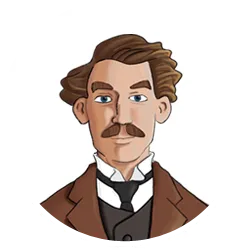
George Alexander Kessler was born in Mobile, Alabama, in the United States of America, on the 23rd January 1863, the son of Adolph and Charlotte “Lottie” Kessler (née Schlesinger). His parents had emigrated from Germany in 1858, and his father was a physician.
George became a businessman, importing champagne into the United States of America, and was the North American representative for Moët and Chandon. His company – George Kessler & Company, had a business premises at 20, Beaver Street, New York, N.Y.. He made frequent trips to Great Britain and he also had a British address at New York Lodge, Bourne End, Maidenhead, Berkshire. On the 16th June 1907, he married Cora Parsons in Manhattan, New York City. They had no children.
Having booked saloon passage on what became the Lusitania’s last voyage - his ticket was numbered 46162 - he joined the liner at the Cunard berth at Pier 54 in New York on the morning of 1st May 1915. He was allocated room A23, with First Class Bedroom Steward Charles Randall - who came from Gateacre, on the outskirts of Liverpool, looking after his needs. George Kessler was renowned for his extravagance, being generally known, in the United States, as The Champagne King.
It was said of him that he used to lie awake at night thinking of novel ways to spend his
vast fortune and he earned the reputation of the champion freak dinner giver of the world. One of these dinners, for 80 guests, was held at The Savoy Hotel, London, and had old Venice as its theme. This involved flooding the hotel courtyard to a depth of some feet, surrounding it with scenery built and painted by 120 electricians, carpenters and scene painters and serving dinner in a giant gondola flanked by three dolphins sculptured from ice, holding vast quantities of iced fruits in their tails. On another occasion, Kessler turned The Savoy's Winter Garden into a realistic representation of the North Pole complete with icebergs of silver foil and plaster snow for a dinner for 34 guests during which gifts worth at least £100 were distributed.
On another occasion at New York Lodge, Bourne End, Maidenhead, which was set on the River Thames, he had both banks of the river illuminated with over 50,000 electric lights.
Adolph and Mary Hoehling in The Last Voyage of the Lusitania, described him thus: -
George A. Kessler, New York wine merchant, distinguished by a bushy black beard, was carrying 2,000,000 dollars in stocks and securities. While he had some transactions in mind which might demand fast financing, he was the kind of person who always preferred to keep his possessions in sight or close by.
He survived the sinking despite being pitched in and out of the sea many times and after being landed at Queenstown, he described his ordeal to a reporter of the Daily Chronicle at Cork. This account was later syndicated across the world. It stated: -
Before the sailing of the vessel passengers received telegrams which were signed 'John Smith' or 'John Jones' which signatures were of course fictitious. The passengers who were thus thought to be dissuaded from making the voyage laughed at the warning. There had been talk of submarines and the dramatic advertisement issued from the German Embassy at Washington had been read in the newspapers in a general way.
All this was regarded as a rather crazy sort of business and the vessel sailed with all her passengers, including quite a sprinkling of German- Americans, or wealthy Americans of German origin.
So far as these are concerned, not one would be in sympathy with Germans in this world war: rather would they be in favour of the Allies.
On Wednesday I saw the crew taking the tarpaulins from the boats, and I went up to the purser and said: “It's all right drilling your crew but why don't you drill your passengers?” The purser said he thought it was a good idea, and added “Why not tell Captain Turner, sir?”
The next day I had a conversation with the captain and to him suggested that the passengers should be given tickets with a number denoting the number of the boat they should make for in case anything untoward happened. In fact this detail would minimise difficulties in the event of trouble.
The captain replied that the suggestion was made after the disaster to the
Titanic. The Cunard people had thought it over and considered it impracticable. He added that, of course, he could not act on the advice given, because he should first have the authority of the Board of Trade.
I talked with the captain generally, about the torpedo scare, which neither of us regarded as of any moment. The captain, (you understand of course that we were smoking and chatting) explained his plans to me. He said they were then slowing down -in fact, were going only 18 knots - and that the ship would be slowed down until they had got somewhere farther on the voyage, and then would go at all speed and get over the war-zone.
I asked what the war-zone was, and he said “500 miles from Liverpool.” According to the next day's run, about two hours before the mishap occurred, we were about 380 or 390 miles from Liverpool, so we were in the war-zone, and we were only going at a speed of 18 miles at the crucial moment.
For the two days previous, as well as I remember, the mileage was 506 and 501, and on Thursday the mileage was 488. On Friday I was playing bridge when a pool was put up on the day's run and I heard 20 numbers go, as from 480 to 499. I thought it would be a grand speculation to buy the lowest number as we were going so slowly. I did buy it and paid £20.
Shortly after the steward had left me, I was on the upper deck and looking out to sea. I saw all at once the wash of a torpedo, indicated by the snake-like churn of the surface of the water. It may have been about 30 feet away, and then thud!
It hit the side of the ship, and instantly there was a great splash in front of me, where the concussion had taken place. I didn't think for one minute that the ship would sink, or at all had been vitally injured. I went to my room, which was on the upper deck, and put on my overcoat and cap. I also put a flask of brandy in my pocket.
Then I walked around the upper deck - about a round and half a round again. Passengers were in different parts of the ship, which did not list in any degree worth speaking of. There was alarm and I did my best to calm as many as I could.
Mr. Berth and his wife from New York, first class passengers, were the last that I spoke to. I should say that about this time, all the passengers in the dining saloon had come up on deck.
Mr. Berth was trying to persuade his wife to get into the boat. She said she would not do so without him. He said “Oh, come along, my darling. It will be all right” and I added to the persuasions.
I saw him help her into the boat with the ropes. The davits suddenly slid through. I fell into the same boat and we were shipped down into the water over the side of the liner, which was bulging out, the list being the other way.
Then the boat struck the water, and, after some seconds - it may have been a minute - I looked up and cried out, “My God! the Lusitania is gone!”
We saw the entire hulk, which had been almost upright just a few seconds before, suddenly lurch over away from us; then she seemed to stand upright in the water and, the next instant the keel of the vessel caught the keel of the boat on which we were floating and we were thrown into the water.
There were only about 30 people in the boat and I should say that they were all stokers or third class passengers. There may have been one or two first class - I cannot recall who they were.
When the boat was overturned I sank 15 or 20 ft., and I thought I was a “goner”. However, I had my lifebelt around me, and I managed to rise again to the surface. There I floated for possibly 10 or 15 minutes, when I saw and made a grab at a collapsible lifeboat, at which other passengers were also grabbing, and we managed to get it ship shape and to clamber in.
It was partially filled with water and in the scramble which occurred the boat overturned and once more we were pitched into the water. This occurred, I should say, eight times, the boat righting itself usually.
The Last Voyage of the Lusitania describes Kessler's situation after this and just before he was taken from the sea: -
Kessler, his bushy black beard sodden and salt-caked, was one of three survivors from one collapsible. It had sprung a leak and foundered until it was awash, then bobbed to the surface again. Originally there had been some fifty men and women in it. After at least seven swampings the number had dwindled to the three who somehow mustered strength to swim back each time.
Kessler continued his account for the Daily Chronicle by answering, with evident emotion, what he thought the effect of the sinking would have on America: -
My God, what can America do? Nothing will bring back those people to life. It was cold blooded deliberate murder and nothing else - the greatest murder that the world has ever known. How will going to war mend that?
The reporter then asked Mr. Kessler if the disaster could have been avoided, and he paused and then replied slowly: -
That is a very serious question, and I hesitate to give an opinion on matters which are purely technical, but still, it seems to me, as a landsman and one who has crossed the ocean a great many times, that the safety of the Lusitania lay in speed. We were in the war zone by 140 or 150 miles, and every moment that we dawdled at 15 or 18 knots was an increase to out risk or being torpedoed.
By the way, about Mr. Vanderbilt. It is, I see, stated that there were two Mr. Vanderbilts on the liner. There was only one - Mr. Alfred Vanderbilt. I knew him as a friend. He has, I deeply regret to learn, been drowned.
It is not certain to whom Mr. Kessler was referring when he spoke of Mr. and Mrs. Berth from New York, as there was no couple of that name on the ship. It is possible that he had mistaken their names or possibly they were mis-spelled by the press.
He was eventually rescued by the Royal Naval trawler H.M.S. Bluebell under the command of Captain John Thompson and having been landed at Queenstown; he eventually reached his original intended destination in England and later returned to America.
Charles Randall, who had looked after George Kessler in room A23, also survived the sinking and eventually made it back home to Gateacre.
When first landed in England, George Kessler needed hospitalisation, and whilst there, he met Sir Arthur Pearson, a blind English newspaper publisher, who told him about St. Dunstan's, a centre he had founded, to help men blinded by the war. Whilst on the collapsible boat, Kessler had resolved that if he survived he would devote his energy and his resources to helping victims of the war and meeting Pearson gave him an idea which would put his resolution into reality.
George Kessler and his wife between them founded The Permanent Blind Relief War Fund and Kessler appointed his former secretary, a French war veteran named Georges Raverat, in charge of European operations. Returning to America, the Kessler’s then met the renowned blind deaf person, Helen Keller, who gave her support and publicity to the cause.
After George Kessler’s death from enlargement of the liver in Paris, France, at the age of 57 years, on 13th September 1920, the Fund continued to perform excellent work and following the Second World War, which brought new challenges, it is still in existence in a different form, today as Helen Keller Worldwide.
The Mixed Claims Commission later awarded George’s estate the sum of $35,000.00. His remains were buried in Pierre la Chaise Cemetery in Paris, where they lie today.
New York Marriage Index 1866 – 1937, 1870 U.S. Federal Census, 1880 U.S. Federal Census, 1910 U.S. Federal Census, 1911 Census of England & Wales, U.S. Passport Applications 1795 – 1925, New York Passenger Lists 1820 – 1957, Cunard Records, Mixed Claims Commission Docket No. 2492, Daily Chronicle, Isle of Axholme and Gainsborough News, Maidenhead Advertiser, San Francisco Examiner, The Salt Lake Tribune, Helen Keller Worldwide, Last Voyage of the Lusitania, PRO. 22/71, UniLiv.D92/1/1, Graham Maddocks, Geoff Whitfield, Michael Poirier, Jim Kalafus, Cliff Barry, Paul Latimer, Norman Gray.
Copyright © Peter Kelly.