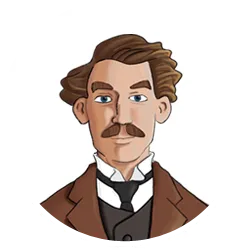
Gustaf Adolf Nyblom was born in Katarina, Stockholm, Sweden, on the 14th May 1885, the son of Klaes Johan Anderson and Beata Pyk. His father was a master tailor, operating his business at Storkyrkobrinken 12, Stockholm. Beata Pyk was his father’s second wife, and Gustav had eleven siblings, at least three being as a result of his father’s first marriage. His home was at 8. Mosebacketorg, Stockholm.
Gustaf qualified as an engineer, and worked for a time at the Geological Bureau in Stockholm, before he boarded the Oscar II at Christiania, (now known as Oslo), Norway, on the 12th August 1910, bound for New York City in the United States of America. He travelled to the home of his brother, Joseph Nyblom, at 304. North
Terrace Avenue, Mount Vernon, New York. On his arrival in New York City, he stated that he was a mining engineer.
In April 1915, he had been working for Algonia Steel Corporation Limited in Sault, Ste. Marie, Ontario, Canada, when he decided to return to Stockholm. He booked saloon passage on the Lusitania from New York to Liverpool through the firm of Maitland, Coppell & Co. of Wall Street, New York.
Having left Montreal at the end of April, he boarded the liner (with ticket number 46073) at Pier 54 in New York harbour, on the morning of 1st May 1915 and was escorted to room D33, which was the personal responsibility of First Class Bedroom Steward William McLeod, who came from Birkenhead, Cheshire, on the opposite side of the River Mersey from Liverpool.
The liner actually left her moorings at Pier 54 in New York harbour just after mid-day and just six days later, Gustaf Nyblom was dead, killed after the Lusitania was torpedoed and sunk off the Old Head of Kinsale in southern Ireland, by the German submarine U-20. At that point in her voyage, she was only hours away from her Liverpool destination and home port. Nyblom was one week shy of his 30th birthday!
His body was recovered from the sea, however, and having been landed at Queenstown; it was taken to one of the temporary mortuaries there and given the reference number 142. Once it was positively identified, it was embalmed and on the instruction of the Swedish Consul, on 24th May 1915, it was repatriated to his homeland, being despatched to his home at 8, Mosebacketorg, Stockholm. While being shipped home, the crate containing his body was marked as being “Natural History Specimens”. It would appear that this was an efficient way of getting human remains through international borders! He was buried in Sandsborgs Cemetery in Stockholm.
William McLeod who looked after Gustaf Nyblom in room D33 was also killed in the sinking. He normally served as Chief First Class Bedroom Steward and was in fact a long serving employee of The Cunard Steam Ship Company, but on the Lusitania‘s last ever voyage, he was serving as an ordinary first class bedroom steward.
On 22nd November 1915, letters of administration were produced on Gustaf Nyblom’s behalf, by Messrs. Kearsey, Hawes, and Wilkinson, Solicitors, of Canon Street, London E.C., and property recovered from his body, which may have aided its identification, was sent to the Swedish Consul in London, for despatch to his relatives.
This property consisted of 18 gold sovereigns, some American and British coinage, a bankers’ draft for £85-4s-9d., (£89.27p.), a gold watch inscribed with the initials G.N., a bracelet watch, a penknife, a stud, a ring inscribed with Nyblom’s name and a pair of cuff links.
He left an estate in England of £112-13s.-10d. (£122.69p.), administration of which was granted to his father Klaes Johan Anderson in London on the 16th November 1915. He also had an unmarried sister named Marta, who resided at 21. Havelock Square, Sheffield, England.
Sweden Indexed Birth Records 1859 – 1947, Sweden Indexed Death Records 1840 – 1947, New York Passenger Lists 1820 – 1957, Cunard Records, Probate Records, PRO 22/71, PRO BT 100/345, UniLiv D92/2/88, Deaths at Sea 1871 – 1968, Graham Maddocks, Geoff Whitfield, Michael Poirier, Jim Kalafus, Cliff Barry, Paul Latimer, Norman Gray.
Copyright © Peter Kelly.