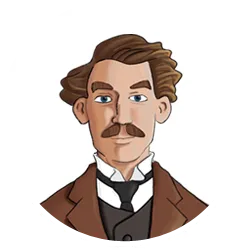
Hugh Carlton Syddall Morris was born in Heaton, near Bolton, Lancashire, England, on the 2nd November 1882, the son of Adam and Elizabeth Morris (née Syddall). He was one of eight children, and his father was employed as an inspector of nuisances and a building inspector, presumably by the local council authority.
The family moved to The Square, Melrose, Roxburghshire, Scotland and Hugh was educated privately, and at classes at Edinburgh University, and then he worked in a solicitor's office from 1898 until 1901. Thereafter, he attended Keble College Oxford from which he obtained a first class honours degree in Theology in 1908, and later an M.A., in 1920. He also attended Cuddleston College Oxford in 1909.
He was ordained a deacon in the Diocese of Brechin, Angus, and a priest in the Diocese of Aberdeen for Brechin in 1911, and was subsequently appointed Curate of St. Paul's Church, Dundee, which he held from 1909 until 1913. After leaving St. Paul's, he was Curate of St. John’s Episcopal Church in Forres, Morayshire, until 1914, when he was appointed Lecturer in Divinity at Trinity College, Toronto, Ontario, Canada, specialising in Hebrew.
In early 1915, he decided to return to Britain and consequently booked a second cabin passage on what turned out to be the Lusitania’s final voyage across the Atlantic. He joined the liner on the morning of 1st May 1915 in New York, before she left the Cunard berth at Pier 54, just after mid-day. Her departure had been delayed because she had to wait to embark passengers, crew, and cargo from the Anchor Lines vessel Cameronia which the British Admiralty had requisitioned for war service as a troop ship. Six days out of New York on the afternoon of 7th May, and within sight of the coast of southern Ireland, the Lusitania was torpedoed and sunk by the German submarine U-20. At that time, she was only about 250 miles away from her Liverpool home port and destination.
When she went down, The Reverend Morris was pitched into the sea and only survived because he was a strong swimmer. Despite being immersed for three and a half hours, he survived to be rescued and landed at Queenstown. Although he was bruised, he was not seriously hurt and according to The Yorkshire Post of May 1915, he was able to send a cable to his brother, in Wellington Street, Leeds, which simply stated: -
Recovering; only slightly bruised; returning in a few days.
There does seem to be some confusion about why he had decided to return to his native land, however, because whilst The Yorkshire Post for 10th May 1915 and The Dundee Advertiser for the same date both stated that he was returning to England to get married, The Bootle Times for 21st May, stated that he was travelling to England to spend the summer vacation with his sister and brother-in-law, a Mr. and Mrs. R. Williams of Menai Dale, Merton Road, Bootle, Lancashire!
On his eventual repatriation to England, he made his way to Bootle and affected a good recovery from his ordeal, so much so, that he married his fiancée, Sarah Ann Brayley Dunnett at the Cathedral Church of St. Mary, Palmerston Place, Edinburgh, Midlothian, Scotland.
On 29th September 1915, his pocket book, containing 4 dollars bills and a Cunard receipt for $10 was given back to him. They had been recovered from the sea and handed in to the Cunard offices at Queenstown.
Despite his sea ordeal in 1915, he went back to Toronto after the war and served as Professor of Ecclesiastical History at Trinity College from 1921 until 1934. On his return, he filed a claim with the Canadian Commission seeking compensation for the loss of his personal effects and valuable manuscript that he had gathered over a number of years. He claimed $1,094 for the loss of his wearing apparel and personal belongings, and $2,000 for the loss of the manuscript which were his lecture notes.
By the time he gave evidence to the Commission in May 1924, he stated that he wished to amend the claim for his lecture notes up to $5,000 as he initially did not realise how valuable they were to him in his work. The Commission refused his application to amend his claim and awarded him his initial full amount of $3,094.
In 1934, he returned to England to take up the post of Chaplain and Lecturer in Divinity at Sarum Diocesan Training College in Salisbury, Wiltshire, a position he held until 1944. He also served as Assistant Librarian of Salisbury Cathedral from 1936 to 1944.
In that year, he became Vicar of Holwell with Westwell, Oxfordshire, until his retirement five years later, after which he moved back up to Scotland and officiated within the diocese of Brechin, Aberdeen and Orkney. He was also a Fellow of the Society of Antiquaries of Scotland and a Fellow of the Royal Historical Society.
He died at Kirkwall, Orkney, on 20th January 1962, aged 79 years.
Register of Births, Marriages and Deaths, Manchester England Church of England Births and Baptisms 1813 – 1915, 1891 Census of England & Wales, 1901 Census of Scotland, 1939 Register, New York Passenger Lists 1820 – 1957, Cunard Records, Keble College Centenary Register 1870-1970, Register of the Alumni of Keble College Oxford, Crockford's Clerical Directory, Canadian Claims Case No. 782, Aberdeen Daily Journal, Bootle Herald, Dundee Advertiser, Forres News and Advertiser, Yorkshire Post, Graham Maddocks, James Maggs, Geoff Whitfield, Michael Poirier, Jim Kalafus, Cliff Barry, Paul Latimer, Norman Gray.
Copyright © Peter Kelly.