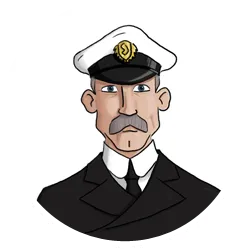
James Clarke Anderson was born in Liverpool, Lancashire, England, on the 2nd February 1865, the son of Thomas William P. and Mary Anderson (née King) of 57. Aspinall Street, Kirkdale, Liverpool. His father was an engineer and James was one of at least ten children in the family.
On the 11th April 1881, he commenced his career in the Mercantile Marine when he was indentured as an apprentice on board the S.S. Baroda at Liverpool.
In the summer of 1889, he married Louisa Margaret Weir in Liverpool and in 1915, they lived at 'Ailsa Craig', 32, Fazakerley Road, Walton, Liverpool, with their five children. He was always known as ‘Jock’ Anderson to his friends, presumably because of his Scottish origins.
His father, Thomas Anderson (who was renowned in Kilmarnock as an expert angler), had joined The Cunard Steam Ship Company in the 1850’s as an engineer officer and
had served the company thereafter for many years. When he retired, he held the position of Commodore Chief Engineer of the company and was chief engineer of the liner Lucania.
Jock Anderson followed his father’s lead by joining Cunard in 1897, but in the Deck Department, as third officer on the Aleppo and only six years later, in 1903, he was appointed chief officer of the Saragossa. He then continued to serve in this rank on board the Carmania, the Caronia, the Ivernia, the Slavonia, the Umbria, and the Ultonia, before being given command of the Caria in 1911. He held command of this ship until he was appointed staff captain on the Lusitania.
The rank of staff captain was a special rank inaugurated by the chairman of Cunard, Alfred A. Booth, after the loss of the White Star Liner, Titanic, in 1912, to ease the burden of work suffered by large liner captains at that time. It basically covered areas such as cargo stowage, discipline, and even socialising with passengers, which would leave the actual captain free to concentrate on navigating and sailing the ship!
Anderson was appointed staff captain on board the vessel at Liverpool on the 12th April 1915 and joined her at 7 a.m. on 17th April, before she left the River Mersey for the last time.
After the liner was struck, three weeks later and six days out of New York, Anderson was of the opinion that she would not sink and that a landfall could be made. As a result, he halted the launching of the lifeboats and ordered their occupants back onto the decks. This lapse of professional judgement undoubtedly led to many lives being lost, but it is likely that Anderson had also realised that any lifeboats launched whilst the liner was making headway would have no chance of getting into the sea without being seriously damaged!
Second cabin passenger H.G. Burgess, from Shipley in Yorkshire reported in The Shipley Times and Observer after the sinking: -
The sea was perfectly calm and the sun was shining brightly. After looking on for a time, I was rather astonished to hear the staff captain give an order for the people to be taken out of the boats which had then been partially filled, as the ship was holding.
In an article published after the sinking, in The Yorkshire Post of the 11th May, the following extract dictated by Fireman Jacob Chadwick mentioned Captain Anderson after the liner had gone down: -
Fortunately, I am a good swimmer - I was taught to swim as a boy at Kirkstall Road Baths - and I got first to one collapsible boat, which, however, overturned, and then to another one, where Staff Captain Anderson and I were able to rest on the canvas. This boat could not be opened properly, and it began to sink, so the Captain asked those who could swim to leave it.
It is possible that Fireman Chadwick may have been one of the last to see Staff Captain Anderson alive as he must have drowned some time after this, as his body was later recovered from the sea. It was taken to the temporary mortuary set up in the yard of the Cunard offices at Lynch’s Quay, where it was given the reference number
48, before being positively identified. It is a coincidence that he was also aged 50 years.
In the book The Last Voyage of the Lusitania, Saloon Passenger Oliver Bernard described seeing Anderson's corpse in one of three mortuaries he visited in Queenstown after the disaster. He stated: -
In the second shelter, sunlight filtering through grimy windows glinted on some gold braid that was little clue to the identity of one whose bloated features were smeared with bloody mucous; Staff Captain Anderson had stuck to his job, and had not drowned without a hard struggle.
Others who also saw his corpse testified to the same contorted features of his death struggle. In an article entitled Final Voyage, written by Brian R. Meister a similar view was expressed: -
Many survivors, prevailed upon to view the bodies, speedily recognised staff captain John C. Anderson. Clearly he had put up a great fight with the sea, but had lost.
Anderson's body was eventually despatched to Messrs. R. McDougall and Co. Ltd., of St. Anne Street, Liverpool for burial in Kirkdale Cemetery there. This took place at 3.00 p.m. on the 14th May 1915, in Non-Conformist Section 7, Grave No. 1692, the burial service being conducted by The Reverend Stanley Rogers, who officiated in the church and at the graveside. The coffin was draped in a union flag and carried to the grave by six quartermasters of the Cunard Steam Ship Company and the chairman of the company, Mr. A.A. Booth, who had initiated the rank of staff captain, three years earlier, and the general manager, Mr. A.D. Mearns were present amongst the many mourners.
His remains still lie there today, under a standard Commonwealth War Graves Commission headstone carved from sandstone. It bears the private inscription: -
A PERFECT MANLY LIFE
COMPLETED
JUSTLY, AND WELL SPENT
The Liverpool Echo for Monday the 10th May 1915, in an obituary for him stated: -
Captain Anderson was extremely popular in maritime circles. He was a man of presence and had a fund of genial anecdotes which was apparently inexhaustible.
All the property that was recovered from his body was sent on to his widow, Louisa, on the 9th June 1915. It consisted of four £10 notes, one stud, one key, a $1 piece, £0-3s-0d., (£0.15p.), in British silver coinage, a gold pencil with a small gold coin attached to it. The balance of his salary due to him in respect of his sea service from the 17th April to the 8th May 1915, (24 hours after the ship had sunk), was also sent to her in August 1915.
The Liverpool and London War Risks Insurance Association Limited granted an annual pension to Louisa Anderson to compensate her for the loss of her husband which amounted to £118-0s-0d. (£118.00p.), payable at the rate of £9-16s-8d. (£9.84p.) per month.
The Anderson family suffered an extra loss with the sinking, as Staff Captain Anderson’s nephew; Second Electrician George Edward Latham was also lost in the disaster. His body was never recovered and identified.
Register of Births, Marriages and Deaths, Lancashire England Church of England Births and Baptisms 1813 – 1911, Liverpool England Church of England Baptisms 1813 – 1919, Kirkdale Cemetery Burial Register, 1871 Census of England, 1881 Census of England, Liverpool England Crew Lists 1861 – 1919, Cunard Records, Commonwealth War Graves Commission, UK and Ireland Masters and Mates Certificates 1850 – 1927, UK Campaign Medals Awarded to World War I Merchant Seamen 1914 – 1925, Kilmarnock Herald, Kilmarnock Standard, Liverpool Echo, Liverpool Post and Mercury, Last Voyage of the Lusitania, Lusitania Saga and Myth, PRO BT 100/345, PRO BT 334, PRO BT 351/1/3094, UniLiv.D92/1/8-10, UniLiv. PR. 13/24, Deaths at Sea 1871 – 1968, Graham Maddocks, Brian R. Meister, Robert O'Brien, Michael Poirier, Jim Kalafus, Cliff Barry, Paul Latimer, Norman Gray.
Copyright © Peter Kelly.
Revised & Updated – 5th December 2022.