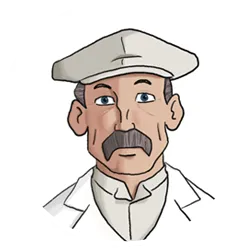
James Collins was born in Liverpool, Lancashire, England, in 1875, the youngest child of William and Bridget Collins (née Maloney). His father was a labourer and James had three older brothers and two older sisters. Having lived in Liverpool for most of his life, the family had moved to 22, Rosemary Lane, Formby, Lancashire in early 1915.
James Collins was a professional seaman in the Mercantile Marine, having served on the Cunarder Caronia until early 1914. On the 12th April 1915, he engaged as a first class bedroom steward in the Stewards' Department on board the Lusitania, at a monthly rate of pay of £4-5s.-0d. (£4.25p). He then reported for duty on the morning of the 17th April in time for the liner’s last ever departure from the River Mersey on her way to New York. It was not the first time that he had served on the liner.
Having successfully completed that passage looking after saloon passengers, he was on board the liner in the same capacity when she left New York for the return leg of the voyage just after mid-day on the 1st May. Then, his particular sphere of duty was to look after the nine saloon passengers in rooms B75, B77, B85, B87, B89 and B91 and this included the famous theatrical impresario Charles Frohman who occupied room B75.
Six days out of New York, on the afternoon of the 7th May, the liner was torpedoed and sunk by the German submarine, U-20, within sight of the southern Irish coast and only hours away from her Liverpool home port.
Bedroom Steward Collins survived the sinking and having been saved from the sea, he was landed at Queenstown, from where he was able to telephone his family on the morning of Saturday, the 8th May, with the news that he was safe. He then managed to get back home to Crosby on the morning of Sunday, the 9th May 1915. Of his saloon cabin charges, seven out of the nine unfortunately perished as a result of the torpedoing, theatrical impresario Charles Frohman being one of those who did not survive.
Once home, he gave an interview with a representative of local newspaper, The Formby Times, which told of his experiences after the ship had gone down and stated: -
A good swimmer, he was able to reach some wreckage, a part of a boat and here he was joined by three others. It kept turning over and after about an hour, he let go of it, and swam in the direction of a boat, but it got further away and he could not get to it.
He was getting spent when he noticed a dead body with a lifebelt around it. This he took and put around himself until he found refuge at a raft with the stern end gone. There were two passengers and two of the crew clinging to it and he remained at the raft about four and a half hours
before he was picked up by a boat.
The boat was nearly half full and kept on picking people up until it had as many as it could take. These were landed, and then it went back for others, members of the Lusitania crew remaining on it to render assistance
After his return home, he went to the Cunard offices in Water Street, Liverpool, where he was officially paid off from the Lusitania’s last voyage and given the residue of wages owed to him, which amounted to £4-9s.-6d. (£4.37½p.). This was in respect of his service on board from the 17th April 1915 until the 8th May; 24 hours after the liner had foundered.
No information has been found about him after his survival.
Register of Births, Marriages, and Deaths, 1881 Census of England, 1891 Census of England, Liverpool Crew Lists 1861 – 1919, Cunard Records, Crosby Herald, Formby Times, PRO 22/71, PRO BT 100/345, Graham Maddocks, Lawrence Evans, Geoff Whitfield, Michael Poirier, Jim Kalafus, Cliff Barry, Paul Latimer, Norman Gray.
Copyright © Peter Kelly.
Revised & Updated – 12th January 2023.