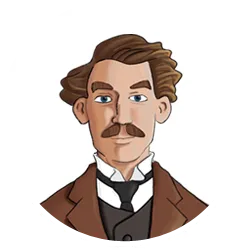
James Tilly Houghton was born on 23rd July 1885 in Saratoga Springs, New York, in the United States of America. He was the son of Supreme Court Justice James Warren Houghton, and his wife, Elizabeth (née Smith). He had a younger sister, named Elizabeth, and he graduated as a surgeon from the Medical School of Harvard University, and also held a diploma from Boston City Hospital. He lived in Saratoga Springs, New York, with his family.
In early 1915, in an attempt to aid the wounded of the war in Europe, he decided to travel to Belgium, and offer his services as a surgeon to Doctor Antoine Depage who had established a hospital for wounded soldiers at La Panne, on the Belgian coast. It is probable that he decided to do this after persuasion by Doctor Depage’s wife Marie, who had been in America as an official representative of the Belgian Red Cross, to raise funds for both Belgian War Relief and her husband’s hospital.
Consequently, he booked saloon passage for himself on what proved to be the Lusitania’s last ever trans-Atlantic crossing and having boarded, (with ticket number 46167), he was allocated room E64, which he shared with merchant Frederick Hawkins from New Brighton in Cheshire. The room was under the personal supervision of First Class Bedroom Steward David Critchley who came from Bootle in Lancashire, which was not far from Liverpool.
Dr. Houghton brought on board with him surgical instruments and apparatus to be used in Belgium, and these, together with his other personal effects, amounted to the value of $3,372.00.
At the last moment, Marie Depage changed her schedule to travel on the same crossing as Doctor Houghton and they were on board together when the liner left her berth at Pier 54 in New York harbour on the early afternoon of 1st May. The sailing had been delayed until then as the Lusitania had to embark cargo, passengers and crew from the Anchor Liner the S.S.
Cameronia, which had been requisitioned by the British Admiralty for war work, at the end of April.
They then met frequently on the voyage across the Atlantic and in fact, they were together when the ship was struck. After helping Madame Depage to assist others into lifeboats, Houghton had fastened a lifebelt around her and they had then jumped into the sea, holding on to each other. In their book The Last Voyage of the Lusitania, the authors Adolph and Mary Hoehling describe what happened next: -
Doctor Houghton remembered hitting his head as he went underneath. The force of the water separated him from Marie de Page
(sic). He looked back for a moment, saw her struggling, then she was swept away. He lost sight of her.
Although Doctor Houghton survived to be rescued from the sea, Madame Depage did not and was killed.
After being rescued and landed at Queenstown, Houghton was able to identify her body (which was one of the first to be recovered), and arrange for it to be embalmed. Later, he was to meet her husband Antoine, who had initially travelled to England to welcome his wife and Doctor Houghton, and accompany them both to La Panne, but on hearing of the sinking, travelled to Queenstown.
Houghton was later interviewed by representatives of the press at the United States Consulate in Queenstown, although still bleeding from a flesh wound under the right eye, received in falling upon a piece of wreckage. Parts of the interview were syndicated throughout the world’s newspapers. The original text was first published in local newspaper
The Cork Examiner, and stated: -
I was in my state room at 2.15 p.m. when the ship was struck a violent blow on the starboard side, which had the effect of stopping the engines.
Dr. Houghton was mistaken about this, as the engines were still running almost up until the time the vessel sank!
I at once rushed up the companion way, and jostled in my hurry, several other passengers, who were quite as eager as I to get on deck to ascertain what had taken place. In truth I may say I had a dread foreboding that we would be torpedoed, and was not surprised when I got on deck to be informed by an officer that we had been attacked by a German submarine.
By the time I reached the deck, the vessel had a decided list to starboard. I remained standing on the deck for a moment or two, and was joined by Madame de Page. The boats were by this time being lowered. It was not easy to do much in the lowering of the boats owing to the fact that those on the port side alone were available.
Once again, Dr. Houghton is mistaken here. Because of the list to starboard, it was impossible to lower any boats on the port side and even on the starboard side; there was great difficulty, as the boats there had swung away from the side of the
Lusitania because of the angle of list, which made it very difficult for anyone to get into them! It is possible that Houghton merely confused the names
port and starboard for it is unlikely that he could have forgotten the scene so soon after the sinking!
An officer told us there was no reason to fear any danger. The vessel would be headed for Queenstown, and would be beached there if necessary.
Meanwhile, other boats were being got ready for any emergency. Then the liner was again struck - this time forward the main bridge, the second attack was evidently of a more deadly character than the first, as quite suddenly the big steamer began to settle by the head. Orders quickly came from the bridge to lower all boats. This work was at once commenced.
Once more, Dr. Houghton is mistaken about this explosion and its position. Many passengers heard two explosions, and assumed there were two torpedoes, but most agree that the two explosions occurred within a minute or so of each other. What Houghton heard, probably five to ten minutes after the ship was first struck, is not known, but it was certainly not a second attack!
Almost a panic then took possession of the women, who were terror-stricken and they commenced to cry piteously. Children were clinging to parents and the whole scene was too bad to witness. The women and children were being rushed into the boats which were being lowered, some of them successfully, others not so, and many people were thrown into the sea.
In the book, The Tragedy of the Lusitania, written by Captain Frederick D. Ellis shortly after the sinking, Dr. Houghton continues to tell what happened next, which contrast slightly with the account given by the Hoehlings: -
I met Mme, de Page (sic), and as she had no lifebelt, I gave her mine. When the deck on which we stood was about twenty-five feet above the water, I advised that we should jump together and we did. I told her to cling to me, but I was stunned by a blow from the wreckage and was sucked down by the whirlpool. I never saw Mme. de Page
(sic) again.
He must also have been in the company of fellow saloon passenger Richard Freeman Junior from Boston, Massachusetts, when he jumped into the sea for on 11th May 1915, the Cunard office in Queenstown received the following cable from Freeman‘s relatives in Boston: -
ASK DR. HOUGHTON SURVIVOR WHEN HE LAST SAW RICHARD FREEMAN AND IF FREEMAN LEFT STEAMER UNINJURED.
Dr. Houghton must still have been in Queenstown on 11th May, for the reply to the cable which was sent to Boston on 13th May said: -
DR. HOUGHTON STATES THAT HE AND FREEMAN JUMPED INTO THE SEA TOGETHER WERE SEPARATED. FREEMAN WAS UNINJURED THEN BUT REGRET THERE IS NO TRACE OF HIM.
Neither room companion Frederick Hawkins nor Bedroom Steward Critchley who had looked after them both in room E64, survived the sinking either. James Houghton was aged 29 years at the time of the sinking.
Dr. Houghton abandoned his journey to Belgium, as he later claimed that as a result of exposure and shock, he was unable to practice his profession for about two years. He returned to New York on board the
Cameronia on the 29th May 1915.
The Mixed Claims Commission awarded Dr. Houghton the sum of $9,000.00 for personal injuries and a further $3,372.00 for the loss of his medical equipment and personal belongings which were lost as a result of the sinking.
On the 5th August 1917, James Houghton was drafted into the United States Army and commissioned as a 1st Lieutenant. He was attached to the 165th Infantry Regiment (previously the 69th Infantry Regiment, known as the “Fighting Irish”), attached to the 42nd “Rainbow” Division, serving on the Western Front from the 31st October 1917. He was promoted to the rank of Captain on the 28th June 1918, and from the 24th March 1919, until his honourable discharge on the 31st October 1919; he was attached to the No. 65 Base Hospital, which was situated near Brest, France.
On the 30th December 1916, Dr. Houghton married Mabel Greer Parsons in Manhattan, New York City, and their son, James Tilly, was born on the 30th January 1917. Their marriage ended in divorce.
In 1919, Dr. Houghton travelled to France to study further in medicine, briefly returning home before travelling again to England and France to further study. He got involved with the Red Cross and accompanied the Haskell Mission of the Red Cross to Greece in 1922 as medical director.
On the 21st November 1929, he married Caroline Perot Pritchett (née Howard) in South Orange, New Jersey. Caroline was a widow, and had four children from her first marriage. Dr. Houghton moved to South Orange to live with his wife and her children.
Dr Houghton died, aged only 45 years, on 25th March 1931, at St. Luke’s Hospital, New York City. His remains were interred in Greenridge Cemetery, Saratoga Springs.
New York State Birth Index 1881 – 1942, New York Marriage Index 1866 – 1937, New York Death Index 1862 – 1948, 1892 New York State Census, 1900 U.S. Federal Census, 1905 New York State Census, 1910 U.S. Federal Census, 1930 U.S. Federal Census, U.S. Passport Applications 1795 – 1925, New York Passenger Lists 1820 – 1957, Cunard Records, Mixed Claims Commission Docket No. 434, New York Abstracts of National Guard Service in WWI 1917 – 1919, New York Abstracts of World War I Military Service 1917 – 1919, Cork Examiner, New York Times, New York Evening Post, Troy Times, The Saratogian, Last Voyage of the Lusitania, Tragedy of the Lusitania, NGMM D/Lus/4/3, PRO 22/71, UniLiv. PR13/6, Graham Maddocks, Stuart Williamson, Geoff Whitfield, Michael Poirier, Jim Kalafus, Cliff Barry, Paul Latimer, Norman Gray.
Copyright © Peter Kelly.