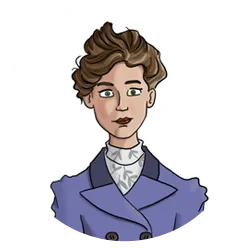
Jane Marshall Morris was born in Liverpool, Lancashire, England, on the 6th October 1881, the daughter of John Joseph and Mary Morris (née Marshall). Her father was a plumber, and the family home was at 57. Bowring Street, Toxteth Park, Liverpool.
On leaving school, Jane entered domestic service, and then, on the 22nd September 1908, she married John Lewis, who was a cotton buyer. By 1915, their family home was at 10. Elm Road, Wood Hey, Rock Ferry, Birkenhead, Cheshire, England where they lived with their daughter Edith, who was born in September 1909.
John Lewis was involved in the cotton trade and this necessitated him making frequent visits to the southern states of the United States of America. In the spring of 1915, John and Jane Lewis, together with young Edith, were returning to England from one of these ventures and had booked second cabin passage on the Lusitania which was scheduled to sail from New York to Liverpool, on 1st May 1915. Having arrived at the liner’s berth at Pier 54 in New York harbour, for the liner’s scheduled 10.00 a.m. sailing the family had to wait until the afternoon before the liner left New York because she had to embark passengers crew and cargo from the Anchor Liner Cameronia, which had been requisitioned by the British Admiralty for war service, at the end of April. At the time of her journey, Jane Lewis was actually pregnant with her second child.
The Lusitania finally left harbour just after noon and six days later, she was torpedoed and sunk by the German submarine U-20 within sight of the coast of southern Ireland and only hours away from Liverpool. In October 1984, Jane Lewis was interviewed by a representative of The Imperial War Museum for its Sound Archive section, described the following from her Lusitania experience: -.
Our reason for being in America was my husband's business. We'd finished the business. We always came home, then back again when the cotton started again. ..... We used to go down to the southern states. ..... I only had one daughter then and she was with me. She was five, just five.
We were on the deck. We were on the deck and it was just on the lunchtime, and we had just come down to lunch, and we were just inside the dining room, just inside the door so we could get out quickly, because we had heard rumours something might happen. So that we could get out quickly we took a dining room table by the door, and then when the awful noise came we could just get round the door and onto the landing and down the staircase.
But the people came pouring through the dining room from the other part of the ship, people fell down, people walked over them but you couldn't do anything because the boat was going sideways. We got out luckily because we were near the door otherwise we would never have got out because of the people.
Then we went down the stairs and instead of going up they went down and I fell down but we got down on to the lower deck and then we stayed there and we didn‘t go down on the ship any further and we were standing by a lifeboat on the ship waiting to see what we could do. There was nobody about where we were, hardly, but there were plenty in the water. And then my husband said that he had better go down to the cabin and get lifebelts and I said “No - you're not going down,” because I said “if you go down there, you'll never get up again.”, and then I said “If you are going we are all going together.”
Well we stayed there and there was a lifeboat, a small boat in the water and it was tied or fastened or something and we got in the boat but we couldn’t get away and not one of the men could find a penknife on them - they seemed to have lost them all. So we got away eventually and I was thrown into the boat because we had to be quick. So we went away from the ship for a time and the people were in the water everywhere. .....
And I was in the little ship, the little boat on the water. My husband said to me, he said, “Look round now,” he said, “she’s going down now.” And I said, “No, I won’t.” I didn’t want to see her go down, but I thought I’d better look and I looked and just before - she was just going down, down into the water. The end of it like that was the last I saw of her. And I was in the little boat. Never saw her again, down she went! And we sailed on the water for a time and they took us off onto a fishing smack.
That wasn’t right after a time and we got off onto another boat. One of the (people on board) was leaning over the side. And I knew him because I'd gone to school with him when I was a child. And he said he was very, very glad to see us - he was very relieved. Well they helped us on board. People very kindly gave us a cup of tea, which was very nice.
And then we went on to Queenstown. We never stopped again. When we got to Queenstown there was a howling mob there. To get off took us some time. But when we were on the boat, there was a little Frenchman on the boat and he had his five children, and his wife with him. And he kept them all by a lifeboat on board the deck. He never let them get away from him. They always had him. So then we all got off at Queenstown and the people gave us a good, good welcome, but it was terrible, terrible.
And when I was walking into the lobby of the hotel, the Frenchman popped up before me with his five children and his wife. He'd saved them all. And I never saw him again. And he was carrying his lifebelt in his hands still. He hadn’t dropped it.
This was certainly Professor Joseph Marichal and his wife and three children, travelling from Kingston, Ontario, Canada to take up an appointment at Birmingham University in Warwickshire, England.
So then we came (in). It was night time then. And we all had to try and get shifts on, to get to sleep. So we were given a bedroom, my daughter and I and my husband - he was helping with different things. And we were in bed. My daughter she was sick. It had upset her, the shock, I think. And we were wondering where my husband was. He’d gone off to do something when a steward walked into the (room). He said was there anything we wanted, and I said “No, there wasn’t“, we didn’t want anything. “Only some brandy would be very useful”, because my daughter was so poorly.
So he went down to get the brandy. And he came back again and he put the things on the table, in the bedroom. And then I went to see what it was and he’d brought brandy and washing soda! So that was no good. Poor man, I expect he was rattled, you know.
And then a woman came in wrapped up in a bath sheet to see if she could
get into my bed with me. And I said I was very sorry, but I said I was expecting my husband back. He’d gone to do some work, something for the ship. She was a stewardess. So I was very, very sorry but I couldn't do anything for her. There was nowhere else where she could sleep. I never saw her again. .....
At this time, Jane Lewis’s husband John was almost certainly touring the makeshift mortuaries in Queenstown, as he had been asked to do, by Cunard officials in the town, in the hope that he might be able to identify any of the recovered dead. Mrs. Lewis’s account continued: -
I can't say that I really did feel really frightened. What I was thinking about was Edith, the little girl. I didn't want her to get, frightened. I didn't want to get her alarmed. She was very, very good. But of course it made her poorly. ..... She didn’t seem to understand what it was - just staring about her. She was very, very good, very good. I didn’t bother her very much - only to tell her that everything was all right. She was a very sensible girl. She had a very steady head on her; she could keep herself steady if she wanted to. No, she never cried nor fussed.
And there was an old lady - I was in the boat with her - she was an older lady. All of a sudden - she was sitting quiet - when she put her hand to her mouth and she says “Och“ - she was Scots I think, "Och”, she said, “I've left my teeth in the cabin.". And she’d come without her teeth. She was a nice old lady. I felt so sorry for her. And she'd left them in the glass. She was nice. Poor old soul.
So when we were in Ireland we had to go and see if we could find something to wear to go home in, so we went round the shops - the shops were getting emptied. Well, I couldn’t get anything - they were emptied out. All that I could get was a sort of pucey cardigan with khaki cuffs and collar and I had a white straw hat - a white straw hat with straw flowers on it, on the front of it and all. .....
And when we got off the boat I had my same skirt on - it was very soiled. But when we got to Rock Ferry where I was going home - the ship stopped - we went from Holyhead - my eldest sister met us. And she turned her back on me so she could laugh. She said she never saw such a funny sight in all her life! .....
We had an eventful journey home from Queenstown, but oh dear me, it was an upset. And I know everyone was trying to do their best, but it was very difficult! .....
When asked about losing all her possessions as a result of the sinking, Mrs. Lewis replied: -
I was thankful that we’d all got off. And you could live without those things, (but) you couldn’t live without life. No! I was very sorry, but I never let it get me down. We just had to get used to it!
Mrs. Lewis concluded the interview by stating: -
I’ve had a good life. Mind you, I suppose I’ve looked after myself too. But
I had the best of husbands that any woman could ever have in this world. I had three good children which have never given me an hour’s trouble - only their health. And they’re the same today as they were when they were all children. They’re all married and they’ve settled down and they’ve got a family and they’re all very happy! ..... And I never thought that I’d live to my age because I never was strong.
At the time of the interview Jane Lewis was actually 102 years old. During her long life, she gave birth to her second child, a son named Kenneth Isaac, in November 1915, and her third and final child, a daughter named Mary Caulfield, known as “Mollie”, in 1917.
Jane Marshall Lewis died on the 4th June 1985 at The Chase, Oldfield Way, Heswall, Cheshire, aged 103 years. She left an estate of £43,733-0s-0d.
Register of Births, Marriages and Deaths, 1891 Census of England & Wales, 1901 Census of England & Wales,1911 Census of England & Wales, 1939 Register, New Orleans Passenger Lists 1813 – 1963, New York Passenger Lists 1820 – 1957, Cunard Records, IWM SA 7361, Murder On The Atlantic, Probate Records, Graham Maddocks, Lawrence Evans, Geoff Whitfield, Michael Poirier, Jim Kalafus, Cliff Barry, Paul Latimer, Norman Gray.
Copyright © Peter Kelly.