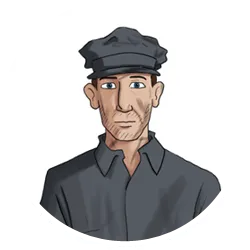
John Sullivan O'Connell was born in Bootle, Liverpool, Lancashire, England, on the 23rd December 1895, the son of Geoffrey and Mary Ann O’Connell (née Leeson). His father was a dock labourer, and John was the eldest of four children in the family. In 1915, the family home was at 7, Boreland Street, Bootle.
He was a professional seaman in the Mercantile Marine and signed on as a fireman in the Engineering Department on board the Lusitania at Liverpool on the 12th April 1915 at a monthly rate of £6-10s-0d, (£6.50p.).
He reported for duty on the morning of the 17th April, before the liner left the Mersey for the last time and survived her sinking three weeks later.
When the ship was torpedoed, he was on watch in the engine room where a fellow fireman, Isaac Linton, from the same watch, suffered a head injury. John O’Connell helped him up to the deck and into the sea, but despite this, Linton did not survive. O’Connell did, however, and like all crew survivors, on his eventual return to Liverpool, he was officially paid off from the liner‘s last voyage, the cut-off date being the 8th May, 24 hours after the sinking. The balance of wages owing to him was £4-14s.-0d. (£14.70p.).
On the 7th July 1917, he married Norah Hannaway in Liverpool, and they had seven children, Mary, Norah, Francis, James, Sheila, Geoffrey and Colette.
In 1957, John O’Connell gave an interview to Ian Severns, a reporter for local newspaper The Liverpool Echo about his experiences on the Lusitania and afterwards, and this was published in the edition of the 5th April 1957. He stated: -
"The layout of the stokehold and engine-room - where one third of the crew would be on duty - combined with the failure of the ship's lighting system must have wiped out any chance the majority of the Black Squad had of ever seeing daylight again. On reflection, I consider I had the best chance of any of the stokers of reaching the boat deck at all."
He was indeed luckier than most of his shipmates. Off duty, he was within a few feet of the open deck instead of being trapped below. O'Connell leaned against a bulkhead, outwardly cool, but inwardly a bewildered 19 year old waiting for a half chance.
Two well-to-do women, one young and pretty, the other old, wept beside him. He put his arms round them and led them into the lounge where safety at least seemed more real. Then, as he walked out again, he heard Captain Turner give the word, "Every man for himself." He jumped.
He went down so far he didn't know whether he was going up or down, until just as he decided to open his mouth, the water changed colour and he broke surface.
Lusitania was gone. Swimming to a plank, he twined his arms around it and then threaded his hands through his belt in case he lost consciousness or got cramp. Other men began to cling avariciously to his plank, threatening to drown them all. He cut loose and made for an upturned boat.
Gradually, this boat became a miniature social register. A young Frenchwoman swam over, Lady Allen (sic) was there, and an American youth going to Marlborough. There was an engineer and right in the centre - as if to maintain some kind of grotesque balance - a completely naked man.
"I eyed the poor chap for a while and then decided it was time things began to get back to normal. I slipped off my singlet and threw it to him." But Mr. O'Connell is short, the other man was tall, and propriety took a poke in the eye.
Two incidents were to remind Mr. O'Connell of the ordeal very soon after. When he landed at Queenstown, the young American insisted that O'Connell
had saved his life. "I may have given him a bit of a hand, but that's all I remember in the turmoil," he says. Nonetheless, the youngster pulled out a fashionable sovereign purse and handed him a golden sovereign for his pains.
Lady Allen was saloon passenger Lady Marguerite Allan, from Montreal, Quebec, Canada, the wife of Sir Hugh Allan, who was Vice Chairman of The Allan Steamship Line. Marlborough, where the American youth was bound, was Marlborough College, a famous public school in Wiltshire, founded in 1843. A gold sovereign was worth £1-0s.-0d. Sterling, almost a week's pay for a fireman in those times!
The account continued: -
The second incident occurred after he had returned to Liverpool. Crossing London Road thinking about nothing in particular, he saw a group of Liverpool Scottish volunteers come marching down. In the middle of them was the naked man from the boat, (fully clothed again, of course!). He had joined the Army presumably for revenge of the speediest kind. "He nearly persuaded me to go along with him; I managed to assure him, however, that I was no lubber."
The naked man from the boat was almost certainly former First Class Waiter Noel Finucane, from Wallasey, on the other side of the River Mersey from Liverpool. After service on the Lusitania's sister ship, Aquitania, in the Dardanelles, Finucane had indeed joined the Liverpool Scottish, to gain revenge for the sinking off The Old Head of Kinsale!
The headquarters of the Liverpool Scottish, which was officially designated the 10th Battalion, The King's (Liverpool Regiment), (Liverpool Scottish), was at that time in Fraser Street, just off London Road.
7494 Private N. Finucane was killed in action in the Ypres Salient of Belgium on the 4th January 1917, shot through the head by a sniper.
The Echo account continued: -
However, Mr. O'Connell had been giving financial matters some thought. He was courting, (he married in 1917) and, as he put it, "I was out of a job the minute the torpedo struck." His money amounted to 3s 9d a day, plus 4½d daily danger money.
As the Empire cost a shilling a show, the Saturday Hippodrome, sixpence, boxing 3s.6d and the fare to town fourpence - what with life becoming a round of well earned pleasures and the courting man's penny buns being tuppence - O'Connell, in his own words, "did a bolt back to sea, to cut the expenses."
He continued to serve at sea until 1919, when disillusioned by the poor level of pay for all the hours worked, he ‘swallowed the anchor’ and got a job as an engine room operator at the local gasworks in Bootle, along the river Mersey from Liverpool. He stayed there for the rest of his working life. At that time, he was living at 52. Scott Street, in Bootle, just down the Mersey riverbank from Liverpool.
After a long and active life, he died peacefully at his home, in Scott Street, on the 2nd June 1988, aged 93 years. By this time, he had seven children, 23 grandchildren and 18 great-grandchildren! On the 7th June 1988, Requiem Mass was held for him at St. James Roman Catholic Church, Bootle, followed by interment at Ford Cemetery, Bootle. His remains lie there today in Section 5D, grave 1361.
Register of Births, Marriages and Deaths, Liverpool England Catholic Baptisms 1741 – 1919, 1901 Census of England, 1911 Census of England, 1921 Census of England, 1939 Register, Cunard Records, Commonwealth War Graves Commission, Liverpool Echo, PRO BT 100/345, PRO BT 350, Graham Maddocks, Maurice Rigby, Gerry Stenson, Geoff Whitfield, Michael Poirier, Jim Kalafus, Cliff Barry, Paul Latimer, Norman Gray.
Copyright © Peter Kelly.
Revised & Updated – 28th January 2025.