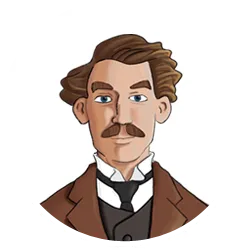
John Wilson was born in Glasgow, Lanarkshire, Scotland, in 1888. All that is known about his family is that his mother was Mrs. Isabella Wilson, and that he had at least four siblings – Mary, Isabella, Jane and Peter. By 1901, his family home was at 54. St. Vincent Crescent, Glasgow.
After completing his education in Scotland, he went to Cambridge, Massachusetts, in the United States of America, where he studied chemistry, possibly at Harvard University. Having qualified as an analytical chemist, he returned to Glasgow.
In July 1914, he had travelled to Boston, Massachusetts, most likely in the course of his profession, and in the spring of 1915, decided to return home and consequently booked second cabin passage on the May sailing of the Lusitania from New York to Liverpool. Having left Cambridge some time in April, he boarded the vessel at her berth at Pier 54 in New York on the morning of 1st May 1915, in time for her scheduled 10.00 a.m. sailing. He shared his cabin on board with a friend from his student time, Archie Donald, fellow Englishman George Bilbrough and Irishman Doctor Ralph Mecredy.
The Lusitania was late leaving harbour because she had to load cargo and embark passengers and crew from Anchor Liner the S.S. Cameronia, which had been requisitioned by the British Admiralty for service as a troop ship at the end of April. She finally left port at 12.25 p.m. and moved out into the North River and the Atlantic Ocean for the last ever time.
John Wilson spent most of his time on the crossing, playing bridge with Archie Donald George Bilbrough and Scots Episcopalian Minister, The Reverend Herbert Gwyer, who, recently married, was on his way to take up a post as senior curate at St. Mary’s Church at Mirfield, near Bradford in Yorkshire.
All of their games came to an abrupt end on the afternoon of 7th May 1915, however, when the Lusitania was torpedoed by the German submarine U-20 off the coast of southern Ireland, only hours away from her home port.
John Wilson was in the second class dining room when the torpedo struck and immediately busied himself with fellow passenger Herbert Ehrhardt, several other passengers and some crew members, with closing as many portholes as he could,
thinking it would help to save the ship. By the time he had finished, the dining room was almost empty and he spotted one of the few passengers left in there, Lorna Pavey from Cheltenham in Gloucestershire.
He took her by the hand and together they pushed through the deepening dining room debris on the floor and made their way up to the deck. By this time, the ship was listing so badly that they had to use the stays of the banisters like rungs of a ladder to get onto ‘C’ Deck. Once there, Wilson spotted a boat already lowered into the sea, which was only half full of people, but was already making water.
Wilson encouraged Miss Pavey to slide down a rope into the boat and then followed her into it himself. It was filling with water because the bung was out of the bottom and once this was realised, it was put back in and the twelve occupants began to bale it out furiously. Despite the small numbers of survivors in it, the crew members who began to row it away from the sinking ship at first refused to stop to pick up any more! This was almost certainly Lifeboat No. 9.
Eventually, the occupants, now swelled with survivors from the water were rescued from the sea and landed at Queenstown. There, John Wilson, Archie Duncan, who had managed to get into a collapsible lifeboat from the sea, and Lorna Pavey searched the hotels, private houses and the mortuaries for people they had known on board. They must have been pleased to find that George Bilbrough and The Reverend Gwyer had also survived the sinking, although Margaret Gwyer was actually sucked down one of the funnels of the sinking ship and then blown back out again as the ship’s boilers imploded! Herbert Ehrhardt, who had led the drive to close the portholes in the second class dining room, also survived.
It is presumed that John Wilson eventually made it from Queenstown to his original destination in England.
In early September 1915, John Wilson received a letter from a Mrs. Prichard, whose son, Richard Preston Prichard, was another second cabin passenger on the voyage and of whom no trace had been found following the disaster. Mrs. Prichard wrote to all the survivors she could trace in an effort to learn of her son’s fate. John Wilson replied: -
54 St. Vincent Crescent,
Glasgow 18th Septr., 1915
Dear Madam,
In reply to your letter of 4th inst. I regret to say that I am afraid I am able to give you very little assistance in your distress. From the photograph you enclose of your son, although the face is familiar to me, I would not be prepared to assert that I saw him on the “Lusitania”, and as the number of acquaintances I formed during the voyage was very small indeed, I am quite sure I never entered into conversation with him. In the last moments of the disaster I saw extremely little, as I never got the length of the uppermost deck, and therefore did not see the launching of any lifeboats, but went overboard from Deck “C” in company of a lady friend and was in the water for a short time until we got into a waterlogged lifeboat. When the ship went down we were some considerable distance from where she sank, owing to her having dived forward and away from us.
I only saw two men in the water both of whom, I am informed, reached the shore.
During the voyage I did not see any lifebelts other than the ordinary type of ship’s belt.
With regard to the position of your son’s cabin i.e. D.90, I am quite confident he had ample time to proceed from his stateroom to the upper deck, as I myself was on deck “D” at the stateroom of my friend a considerable number of minutes after the boat had been struck, and after which I had no difficulty in proceeding up the stairway even with a child in my arms.
I presume you have already examined the photographs taken of the bodies which were landed at Queenstown, although of course as the number of number accounted for was not very large, this may have been no assistance to you.
I return the photograph as desired and am extremely sorry at my inability to be of greater service to you.
Yours faithfully,
John Wilson.
Nothing further is known about John Wilson once he returned to Glasgow.
1891 Census of Scotland, 1901 Census of Scotland, New York Passenger Lists 1820 – 1957, Cunard Records, IWM GB62, Boston Globe, Daily Record, Dundee Peoples Journal, Last Voyage of the Lusitania, PRO BT 100/345, Graham Maddocks, Geoff Whitfield, Michael Poirier, Jim Kalafus, Cliff Barry, Paul Latimer, Norman Gray.
Copyright © Peter Kelly.