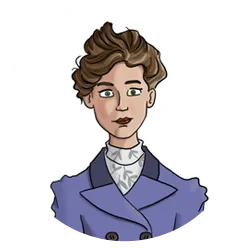
Julia O’Neill, also known as “Neill”, was born on her family farm at Froe, Roscarbery, County Cork, Ireland, on the 17th March 1886, the daughter of Daniel and Johanna O’Neill (née O’Neill). She was the younger of two children, although she had four step-brothers and sisters from her father’s first marriage, which ended on the death of his first wife.
Julia O’Sullivan had left Ireland on board the Ivernia, which she boarded at Queenstown on the 26th August 1908, and gone to Long Island, New York, in the United States of America, where she had found employment with the Branders - a childless couple who soon accepted her as one of the family, even including her on their annual holidays. When she met her future husband, Florence ‘Flor’ O’Sullivan, who was also an Irish emigrant, from County Kerry, the Branders liked him too and secured a position for him as a barman at The Stuyvesant Club in New York. When the Branders died, - within three months of each other - Julia and Flor O’Sullivan married, their wedding taking place in Boston, Massachusetts, on the 30th August 1914, and set up home in New York. . Whilst in America, Flor and Julia omitted the “O’” in their surname, being known as Flor and Julia Sullivan.
All this time, Flor O’Sullivan’s aging father, back home on the family farm in
Kilgarvan, County Kerry, had been imploring his son to return home to manage the family farm, so early in 1915, the young couple reluctantly decided to return to Ireland, as it would have meant losing the farm otherwise.
As a result, they booked second cabin accommodation for themselves on the Lusitania, then berthed at New York, having first crated all the expensive furniture left to Julia O’Sullivan by the Branders, and had it loaded on board. They then joined the vessel early, on the instructions of Purser James McCubbin, a friend of Flor O’Sullivan; so that he could make sure that they got the best available cabin. Consequently, when the liner left New York just after on 1st May 1915, they were very well appointed! The O’Sullivan’s friendship with James McCubbin meant that during the voyage, they enjoyed many privileges of saloon class passengers.
When the liner was torpedoed, the O’Sullivan’s were on deck excitedly looking at the coast of Ireland which neither of them had seen for some time. Whilst on board, they had made friends with Pat Callan, another ex-patriate Irishman, who having lived in America for some time, had taken out United States citizenship, and was now returning home to take over the running of the family business.
Having first gone to their cabin to retrieve family papers, money and share certificates, Flor O’Sullivan had stuffed a wad of banknotes into his pocket and some more into his wife’s bodice and she had pinned the oilskin bag with the rest in it, to the inside of her lifejacket. The couple then made for the boat deck where they found their friend Pat Callan urging them forward to jump into one of the lifeboats which was in the process of being launched. He and Flor O’Sullivan jumped in, but Julia refused to make the jump and Flor had to leap back onto the deck with her. Her refusal possibly saved their lives, however, because moments later, the lifeboat tipped up, spilling its occupants into the sea and killing many of them, including Pat Callan.
As the ship eventually began its final plunge, both of them were pitched into the sea and being kept afloat by their lifejackets, struck out to swim as far away from the Lusitania as possible. During this time, they became separated, and Flor was rescued from the sea and landed at Queenstown.
After some time, Julia O’Sullivan was spotted in the water by First Class Waiter Vernon Livermore, Steward's Boy Cornelius Horrigan, Fireman Francis Toner and First Class Waiter Charles Hotchkiss, who were sitting on top of an overturned lifeboat. They were able to drag her on top with them and eventually, they were all rescued from this precarious perch by the Royal Naval craft H.M.S. Heron. Because of Julia O’Sullivan’s condition, the Heron‘s captain H. Iver R.N.R., diverted the vessel to Kinsale, a fishing village just around the headland from where the Lusitania had gone down. There, she was examined by Doctor John Corcoran, the Medical Officer of Fort Charles, the British Army Barracks at Kinsale. He insisted that she was sent to hospital, which undoubtedly saved her life.
At an inquest held at Kinsale the following day by Coroner John Horgan, District Inspector Alfred Wansbrough of The Royal Irish Constabulary stated: -
The reason the Captain came into Kinsale was that Mrs. O’Sullivan seemed so very ill that it was absolutely necessary to get the speediest
possible medical assistance, otherwise he would have gone to Queenstown.
Also landed at Kinsale from the Heron, were Second Cabin Passengers John Preston Smith and Stanley Critchison, Third Class Passengers Fred Bottomley, Michael Doyle and Joseph Thompson and First Class Waiter Charles Hotchkiss and Second Class Waiter Harold Rowbotham. Five dead bodies were also landed, three passengers and two crew.
Julia O’Sullivan had lapsed into a coma during her ordeal and the first she knew of her rescue was when she woke up in a Kinsale hospital. After being examined by a doctor she learned that she was in no medical danger and naturally asked for news of her husband. She only learned later that evening from a priest who had made enquiries for her, that he was safe and well and in Queenstown. She was later re-united with him in Queenstown and together, they eventually made it back to Kilgarvan, in a car loaned to her by a Mr. R.C. Pratt. They were accompanied on the journey by a military nursing sister! There was no sign of the oilskin bag containing their life’s savings!
In the summer of 1915, they applied for financial assistance to The Lusitania Relief Fund, which had been set up after the disaster by The Lord Mayor of Liverpool and other local worthy dignitaries. They were granted the sum of £10-0s-0d., to replace clothing lost in the sinking.
Sometime after the sinking, however, her bag was handed in at the Cunard office at Lynch's Quay, Queenstown. It had been found by the crew of the boat that brought her into Kinsale, lying on the deck. Incredibly, it contained not only a banker's draft, but some banknotes and a quantity of gold coins! It was the bag which Julia had pinned to her lifejacket! It was sent to her at the Kilgarvan address on 7th September 1915, but not after some difficulty. Julia had to satisfy Cunard officials that Julia Sullivan, the name she had travelled under, and Julia O’Sullivan, her correct name, were the same person. The money which her husband had stuffed in her bodice, she had given to a little girl who had lost her parents and brothers and sisters in the sinking.
First Class Waiter Charles Hotchkiss would later recount a story that although he could not swim, (like so many sailors of the time), as the ship was sinking, he dived into the sea to rescue an American lady passenger who was drowning. Although the facts do not tally accurately, it is probable that the ‘American’ was Julia O’Sullivan, who, although Irish, may have picked up an American accent during her seven years in Boston. The rescued lady gave Charles Hotchkiss a gold pen in gratitude for her rescue and this is still in the possession of his family today.
For the remainder of their lives, Flor and Julia O’Sullivan farmed the land at Kilgarvan, and in the process, had at least eight children.
In January 1941, one of their daughters, Mary, died at their home of natural causes, aged 21 years. Then, on the 20th April, another daughter, Nellie, was killed in a German air-raid at St. Peter’s Hospital, London. According to reports, she was a nurse at the hospital and was in the process of evacuating ten children from one of the
wards when she was killed in the blast from an exploding bomb. She was aged 19 years. Miraculously, all ten children escaped unharmed.
Flor O’Sullivan died soon afterwards, on the 7th July 1941, aged 56 years. Although he was in poor health for some time, his death was no doubt hastened by the untimely death of two of his daughters.
Julia O’Sullivan died at the hospital in the nearby town of Kenmare, County Kerry, on the 18th October 1948, aged 62 years.
Register of Births, Marriages and Deaths, Massachusetts U.S. Marriage Records 1840 – 1915, 1901 Census of Ireland, 1911 Census of Ireland, Massachusetts Passenger Lists 1820 – 1963, Cunard Records, Liverpool Record Office, Commonwealth War Graves Commission, Birmingham Daily Herald, Cork Examiner, Nottingham Journal, Liverpool Record Office, Seven Days to Disaster, PRO BT 100/345, Seven UniLiv D92/2/427, Graham Maddocks, Geoff Whitfield, Michael Poirier, Jim Kalafus, Cliff Barry, Paul Latimer, Norman Gray.
Copyright © Peter Kelly.