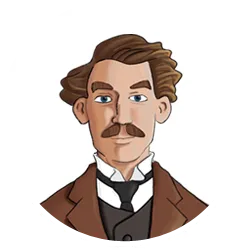
Justus Miles Forman was born in LeRoy, Genesse County, New York, in the United States of America, on 1st November 1875, the son of Jonathan Miles and Mary Melissa Forman (née Cole). He attended school in Leroy until the death of his mother in 1879, when he moved to Minneapolis, Minnesota, to be cared for by his half-brother, Frank W. Forman. He graduated from Yale University in 1898.
He was a popular short-story writer and novelist - his most famous work being
The Garden of Lies and he had traveled extensively around the world, being a member of the Royal Geographical Society. He was also well known in the circles of New York society. He was unmarried and lived at 14, East 37th Street, New York City.
In 1915, he had become alarmed by the activities of certain German-Americans - who were much in favour of American involvement in the German war effort and who were popularly known in New York as ‘Hyphens’.
In his book The Tragedy of the Lusitania, written not long after the sinking, Captain Frederick D. Ellis told of Justus Forman’s dissatisfaction with this movement, and his determination to halt its progress: -
Mr. Forman was so much impressed by the activities of the hyphenated Germans in America in the early days of the war, that he decided to put them into a novel. Then it appeared to him that there would be no time to publish such a work before it might be stale. So he decided to make his first effort as a playwright in utilizing the material for the stage. He outlined the play, known as ‘The Hyphen,’ and read it to his friend, Edward Sheldon, who sent it to Charles Frohman in New York.
Mr. Frohman read the play one Friday, accepted it the next day, and on the day after, he was engaging actors for the performance. Never before had any unknown playwright found such a ready market for his work.
The character of the work became in some way known to Hermaun Ridder, editor of the Staats Zeitung, who sent Mr. Frohman a violent protest against its production. He demanded a copy of the scenario, which was sent to him. Then he desired a more detailed account of the contents of the work.
After learning its character he protested against the performances, said that the German American Societies were united to a man in opposition to the use of the activities of Germans in this country in fiction or on the stage, and declared that he would not in any way be responsible if the first night performance was interrupted by the expression of their disapproval.
A few plain clothes men were in the theatre when the piece was acted. There were some signs of displeasure, but there was no need of police interference. The play proved a finely written, but altogether undramatic work. After a few performances it was taken to Boston, but was acted there for only one week.
It was the failure of this play which decided Mr. Forman to go to Europe. He at first intended to be a war correspondent, but his arrangements to that effect were not carried out. But he had already made his plans to sail and when he learned that Mr. Frohman was sailing on the Lusitania, he took passage and thus it came about that he was lost through the activity of the country which he had shown in such an unflattering light in his play.
Justus Forman had indeed booked saloon passage on the Lusitania’s May sailing to Liverpool and having booked his ticket - number 14469 - through a Mr. Alf Hayman, of The Empire Theatre, New York, he boarded the liner at her berth at Pier 54 in New York harbour, on the morning of 1st May. Once on board, he was escorted to his accommodation in room D2, which was under the personal supervision of First Class Bedroom Steward William Fletcher, who came from Wallasey in Cheshire, on the opposite bank of the River Mersey from Liverpool.
The Lusitania’s sailing was delayed until the afternoon of May Day, as she had to embark passengers, crew and cargo from the Anchor Liner
Cameronia, which had been requisitioned by the British Admiralty for war work, at the end of April. She finally left the port just after mid-day.
For Justus Forman and his fellow New York socialites, the voyage across the Atlantic at first, was one of opulent pleasure and Forman’s constant companions were, apart from Charles Frohman, millionaire Alfred Vanderbilt, fellow dramatist Charley Klein and popular actresses Josephine Brandell and Rita Jolivet. Although Forman was still brooding about the relative failure of
The Hyphen, Charles Frohman tried to enliven him with the prospect of the new theatre scene in London.
All the joviality and conviviality of the crossing came to an abrupt end, however, on the afternoon of 7th May, when the
Lusitania was torpedoed and sunk by the German submarine U-20, twelve miles off the coast of southern Ireland and only 250 miles away from her home port.
Justus Forman was one of those killed as a result and as his body was never recovered and identified afterwards, he has no known grave. He was aged 39 years. Not long after his death had been accepted in the southern Irish port of Queenstown, his one and only play The Hyphen was taken off from its brief run at The Hollis Street Theatre in Boston!
Of his companions on the Lusitania's crossing, only the actresses Josephine Brandell and Rita Jolivet survived, probably because they were able to get into one of the few lifeboats that was successfully lowered into the sea.
Bedroom Steward William Fletcher, who had looked after Justus Forman in room D2 also survived the sinking and eventually made it back to his Wallasey home.
He had a niece named Katherine Forman Barratt whose husband was executor of Justus Forman’s will.
A claim filed by ten of his relatives for compensation did not succeed as the Mixed Claims Commission decided that none of them were financially dependant on him.
1880 U.S. Federal Census, Minnesota Territorial and State Censuses 1849 – 1905, 1910 U.S. Federal Census, New York Passenger Lists 1820 – 1957, U.S. Passport Applications 1795 – 1925, Cunard Records, Mixed Claims Commission Docket No. 2266, Last Voyage of the Lusitania, New York Times, Seven Days to Disaster, Tragedy of the Lusitania, PRO BT 100/345, PRO 22/71, Deaths at Sea 1871 – 1968, Graham Maddocks, Geoff Whitfield, Stuart Williamson, Michael Poirier, Jim Kalafus, Cliff Barry, Paul Latimer, Norman Gray.
Copyright © Peter Kelly.