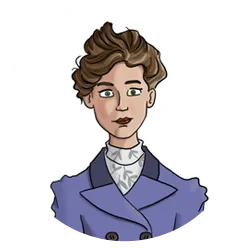
Martha Ann Bussey was born in Hyde, Cheshire, England, in 1854, the daughter of John and Jane Bussey (née Barker). Her father was a cotton spinner in a local cotton mill, and Martha was one of seven known children in the family. The family lived for many years at Well Meadow, Hyde, before moving to Curzon Road, Ashton-under-Lyne, Lancashire.
Her entire family worked in cotton mills, and on completing her education, Martha became a cotton weaver.
On the 30th May 1893, she married Aaron Taylor Whyatt at the Parish Church, Hurst, Ashton-under-Lyne. Her husband was a weaver at Whittaker’s Mill in Ashton-under-Lyne and had been a collector for the Ashton Weavers’ Association for nearly 30 years. The couple had no children, and established their home at 167. Curzon Road, Ashton-under-Lyne.
In 1911, however, the couple went to New Bedford, Massachusetts, in the United States of America, to look after an elderly uncle, Mr. John Hall who was suffering from pancreatic cancer.. Mr. Hall was originally a native of nearby Dukinfield and had
immigrated to America when he was aged 19 years in 1855, and had subsequently fought in the American Civil War.
The Whyatt’s resided at 47. Fruit Street, New Bedford, with John Hall, and then, on the 26th May 1913, Martha’s husband, Aaron, died at St. Luke’s Hospital in New Bedford. John Hall died on the 28th July 1914.
With nothing to keep her in Massachusetts, Martha Whyatt decided to return home to Hurst and booked passage as a second cabin passenger on the Lusitania, en route to her brother's home at 138, Curzon Road, Hurst, Ashton-under-Lyne.
She boarded the liner at The Cunard berth at Pier 54 in New York on the morning of 1st May 1915 and was allocated room E82, which she shared with Miss Polly Higginbottom, who also originally came from Hyde, in Cheshire, and who had been working in Fall River, Massachusetts.
The liner was sunk six days later on the afternoon of 7th May, by the German submarine U-20, within sight of the southern Irish coast. Martha Whyatt managed to survive this action and after being landed at Queenstown, returned to Hurst in the early hours of Sunday 9th May 1915 after which she gave an account of the sinking to a representative of the local newspaper, The Stalybridge Reporter. This account stated: -
It is indeed a miracle that I am alive. It was a terrible experience - I never want to put my foot on a boat again.
I was a second-class passenger on the Lusitania. When we left New York, the band was playing and the Welsh choir was singing. I never heard of any warning of any sort, or else you can guess I should have been on the look out for submarines. It was a beautiful day, and I had not got up that morning until about eleven o'clock. We had our tickets given us so that we could go ashore.
I had just left the dining-room to go into the sitting room when the first explosion came. The band had been playing "Its a Long, Long Way to Tipperary." It was just like a lot of cannon going off. The ship rocked from one side to the other, and everybody was tumbling about. There was almost a panic for the moment and a deal of running about and confusion. Then the second explosion came. A young man who was quite unknown to me put a lifebuoy round me, which had a collar to fit the neck, and which fastened under the arms.
In another moment the boat seemed to dive. I put my hands over my face and cried "Oh Lord, have mercy on me." I saw the water, as it were, rushing towards me. I shall never forget the sight of all those hundreds of people, men, women and children, struggling in the water. I can still hear the screaming of the children. Women were holding up babies, men were swimming around and holding others up in the water. I composed myself and resigned myself to my fate. I floated on my back and folded my arms on my breast, and tried my best to keep conscious.
I heard one young man say to another, "We have not done all that we ought to have done, Let us pray!" They prayed and then one said "Let us sing!" and all the people round joined in singing "O God Our Help in Ages Past." The
bodies of children and old men floated past me. Many people had their faces and heads bleeding. They had evidently been wounded by the explosions. I saw one old man with blood streaming down his face, sink for the last time.
The water was not cold, but after I had been drifting for some time, I began to feel a chill in my feet and hands. I was in the water for four and a half hours, and I had floated over 20 miles before I was picked up about four miles from land by a small steamer. I heard a man shout, "A woman! A woman!" Seemingly they were picking up the women before the men. They picked me up, and cut my clothes off me, and rubbed me, and wrapped me in hot blankets. The captain asked me if I could speak, and after a while, I was able to speak to him.
There were thousands watching as some bluejackets carried us ashore. An officer came to me and asked my name and address. He said, "Are you a British subject?" I replied "British to the backbone!" "Good," he answered, “you are a brave little woman." They took us to an hotel at Queenstown and put us to bed, and we slept two in a bed. Everyone was very kind and I was given some clothing before I went on with a party of survivors to Kingstown, where we boarded a boat which took us to Holyhead.
A special train was waiting, and a young man, whom man, whom I did not know, was most kind to me, and looked after me very well. He was going to London and at Chester, he put me in charge of another person who was travelling to Manchester. He had lost all he possessed, and had not a penny. I arrived at Manchester about a quarter past four on Sunday morning. Someone procured a taxi-cab for me, and I landed here about a quarter to five.
"Have I lost everything? Well I had 500 dollars worth of luggage with me; that has gone, but I managed to save my uncle's watch, which was in my bodice.
Poor Miss Polly Hegginbottom, (sic) of Audenshaw, slept in the same berth as me. I am afraid she is lost. To get to our bunk, which was No. 82, E Deck, she had to descend about three flights of stairs. It was an outside berth, with a port hole.
Miss Hegginbottom always went down to the berth after luncheon, and I had been speaking to her not many minutes before she said she would go to the berth. I never saw her again. There was a lot of luggage in the corridor, and I think the force of the explosion would block up the passage with the baggage, and she would be unable to get out. She was a very nice girl, and I quite liked her.
They can have America as wants, but give me good old England.
Mrs. Whyatt was probably mistaken when she said she had drifted in the water for twenty miles, because even with heavy currents, it is unlikely that she would have drifted so far as the liner was only twelve miles off shore when she was first struck and probably two miles further towards the coast when she sank.
Polly Higginbottom was indeed killed as a result of the sinking and no trace of her was
ever found again, dead or alive!
Martha Whyatt later successfully applied to The Lusitania Relief Fund, which was administered by the Lord Mayor of Liverpool, for a grant of £5-0s-0d., to replace clothing lost in the sinking. This fund had been set up just after the sinking by the Lord Mayor and other prominent business houses in the area to give financial aid to second and third class passengers or the relatives of those who had perished, who had suffered monetary loss because of the sinking. It was thought that saloon class passengers and their relatives were sufficiently wealthy not to need help.
On reaching Ashton-under-Lyne, Martha Whyatt took up residence at 138. Curzon Street, and while there, received a letter from Mrs. Gertrude Prichard, whose son, Richard Preston Prichard, had been a second cabin passenger on the Lusitania, and of whom nothing was heard about following the sinking. Mrs. Prichard wrote to all of the survivors she could obtain addresses for in an effort to learn something of her son. Mrs. Whyatt replied: -
June 25 1915
138. Curzon Road
Hurst
Ashton u Lyne
Dear Madam,
Just a few lines in regard to your son on the voyage of the Lusitania. I got your letter this morning and I feel very sorry for you in your great trouble and to all them who have lost there (sic.) friends but I will try and tell you what I can about it as I have been very sick every (sic.) since came home as I cannot tell how I was saved as I was in the water for 4 and a half hours and it must be God’s goods that I was saved well about your son I do not know if it was him or not as I did not speak to him but I will tell you what I know as I saw a young man in the sitting room that look (sic.) like him and there was a young woman speaking to him that was coming to Manchest (sic.) but she is lost and she was a doctor (sic.) wife but I could not tell you her (illegible word) name as I forgot it but he did not look as if he had anything to do with anyone as he look (sic.) very quite (sic.) and why I look at him was with having the dimple in his chin and that was why I look (sic.) at him as I have lost my husband while I have been in America and he had a dimple in his chin and that was why I look (sic.) at him so but if he was in his room I do not think he could get out as there was no time for anything and there must be hundreds in that boat yet that could not get out as I have 2 friends lost and they have not found there bodys (sic.) yet and I do not think they ever will this is all I can tell you but he must be lost or you would have heard something before now I only wish I could tell you more I would be glad to do it I have been in the doctor every (sic.) since I came home and he say it will be a long time before I am myself again but still I am thankful to be here and I shall be glad if this will comfort you in your great trouble as I feel heart sorry for you hoping that you will hear better news.
I am sincerely your
Mrs. M.A. Whyatt.
No trace was ever found of Richard Preston Prichard.
Martha Whyatt died in Ashton-under-Lyne on the 27th November 1928, aged 75 years. She was buried in the cemetery adjacent to Hyde Chapel, Gee Cross, Hyde, Cheshire.
Register of Births, Marriages and Deaths, 1861 Census of England & Wales, 1871 Census of England & Wales, 1881 Census of England & Wales, 1891 Census of England & Wales, 1901 Census of England & Wales, UK Outward Passenger Lists 1890 – 1960, Massachusetts Passenger Lists 1820 – 1963, Cunard Records, Liverpool Record Office, IWM GB62, Oldham Standard, Stalybridge Reporter, Graham Maddocks, Dave Fernley, Geoff Whitfield, Michael Poirier, Jim Kalafus, Cliff Barry, Paul Latimer, Norman Gray.
Copyright © Peter Kelly.