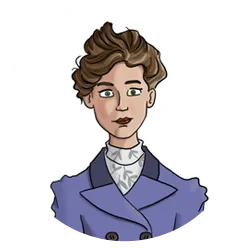
Mary Picton Stevens was born in Hoboken, New Jersey, in the United States of America, on the 16th May 1886, the daughter of John and Mary Marshall Stevens, (née McGuire), of Castle Point, New Jersey. The Stevens family were English settlers who arrived in the United States before the Revolutionary War. They were associated with George Washington and Thomas Jefferson, founded the city of Hoboken, and pioneered steam travel by boat and rail. They also founded the Stevens Institute of Technology. In 1895, her father died, followed by her mother in 1904, leaving Mary a millionaire.
On 8th April 1907, she married Ogden Haggerty Hammond, who was introduced to her by one of her husband’s friends in Bernardsville, New Jersey. The newly-weds went to live in Superior, Wisconsin, where her husband was a partner in an insurance brokerage, but a year later moved to 30, East Street, New York City. They also purchased a country home in Bernardsville, New Jersey, which had 47 rooms! Despite the number of rooms, her husband added a swimming pool and another five rooms before they moved in to the house in 1908, a short time before the birth of their first child, a daughter named Mary Stevens Hammond. She was followed by another daughter – Millicent Vernon Hammond, born on 25th February 1910, and a son, Ogden “Oggie” Haggerty Hammond Jr. in 1912.
As her husband’s business interests prospered and grew, and he became involved in local politics, Mary became a member of the Colony Club, and got involved in other local community activities. In 1915, with the war raging in Europe, Mary got involved in the Red Cross and decided she would aid the victims by establishing a hospital in France. With this in mind, she decided to travel to France at the earliest opportunity.
In the spring of 1915, her husband unable to dissuade her, and thus making the decision to accompany her, booked a saloon passage for himself and Mary on the May sailing of the
Lusitania, which was scheduled to depart from New York for Liverpool at 10.00 a.m. on 1st May 1915. Having stayed overnight at the New York address, the couple arrived at the Cunard berth at Pier 54 in New York harbour on that morning and having boarded with ticket number 46099, were escorted to their accommodation in room D20, which was the personal responsibility of First Class Bedroom Steward William S. Fletcher, who came from Liscard, Wallasey, Cheshire, on the opposite bank of the River Mersey from Liverpool.
Although rumours were circulating in the weeks leading up to the departure about the safety of the great liner, Mary was not to be distracted from her mission, and whereas Alfred Vanderbilt and Charles Frohman received anonymous warnings, Mary’s warning was more specific and personal.
Mary’s aunt Elsie was a personal friend of the German Ambassador to the United States, Count Johann von Bernstorff, and he is reputed to have told Elsie, a few days before the scheduled sailing, “Do not let anyone you know get on the
Lusitania”. Elsie believed that the Ambassador’s words were genuine and did not delay in going to Ogden and Mary, who were in Bernardsville at this time, and warning them. Mary is believed to have laughed at her, stating, “I’m sailing on the
Lusitania”.
After Elsie left them, Ogden, and his brother John, spent all night trying to get Mary to change her mind, but she refused. On being asked by John if she had made a will, she stated that she had not, but suggested that John draw one up for her, which he apparently did.
The liner’s departure was then delayed until the early afternoon, as she had to wait to embark passengers, and some crew and cargo from the Anchor Liner
Cameronia, which the British Admiralty requisitioned for use as a troop ship at the end of April. Just six days, later, on the afternoon of 7th May, whilst sailing past The Old Head of Kinsale in southern Ireland and only hours away from her Liverpool destination, the Lusitania was torpedoed and sunk by the German submarine
U-20.
Although Ogden Hammond survived, this action, Mary Hammond was lost. She was aged 28 years.
Mr. Hammond later told his experiences to representatives of the press and his account appeared in many newspapers across the world, including the
New York Times of 10th May 1915, which stated: -
When the torpedo struck us I was on the starboard side of the boat deck with my wife. An officer said 'Go back; there is no danger,' and I wanted to go to our stateroom to get some things together but my wife wouldn't let me go. Some stewards started to lower a boat and put my wife and the other women in sight in it and got in myself. The man at the bow let the rope slip through his hands while the man at the stern paid it out too slowly.
The situation was terrible. We were dropping perpendicularly when I caught the rope and tried to stop the boat from falling. My hands were torn to shreds, but the boat fell, and all in it were thrown into the water, a dense struggling mass.
I went down and down, with thirty people on top of me. I thought I never could come back and must have been partly unconscious, for I can only remember getting almost to the surface, sinking back again, and doing this three or four times. Then I was hauled into some boat, but no one else from the boat that fell was ever seen again.
That number included Mary Ogden whose body was never recovered from the sea and identified afterwards. As a consequence, she has no known grave.
After Ogden Hammond was landed at Queenstown, he cabled the sad news of his wife's death to her aunt, Mrs. H. Otto Wittpen of Hoboken, New York. This may have caused unnecessary distress as the first Cunard list published in America stated that Mary Hammond had been saved.
Bedroom Steward Fletcher, who had looked after Mary and Ogden Hammond in room D20, did survive the sinking, however, and eventually made it back to his home in Wallasey.
Ogden Hammond returned to his children in New York in June 1915, and some time later filed a claim for compensation for his wife’s death and the loss of their personal property with the U.S. State Department. He also returned to his real estate and insurance businesses.
On the 21st February 1924, the Mixed Claims Commission decided on the various claims filed. They awarded Ogden Hammond the sum of $15,000.00, personally, for the loss of his wife, and a further $2,970.00 to compensate him for the loss of his personal belongings. In addition, the sum of $5,000.00 was awarded to each of the three Hammond children – Mary Stevens Hammond, born in 1907, Millicent V. Hammond, born in 1910, and Ogden Haggerty Hammond Jr., born in 1912. Ogden Hammond and John Henry Hammond, executors of the estate of Mary Picton Stevens Hammond were awarded the sum of $31,143.00 as compensation for the loss of her belongings in the sinking, the most expensive item being a pearl necklace, valued at $25,000.00, which had been a Stevens’ family heirloom.
1910 U.S. Federal Census, U.S. Passport Applications 1795 – 1925, Cunard Records, Mixed Claims Commission Docket No. 290 & 292, The Last Voyage of the Lusitania, New York Times, Newark Evening Star, Orange Advertiser, PRO 22/71, Deaths at Sea 1871 – 1968, Graham Maddocks, Geoff Whitfield, Michael Poirier, Jim Kalafus, Cliff Barry, Paul Latimer, Norman Gray.
Copyright © Peter Kelly.