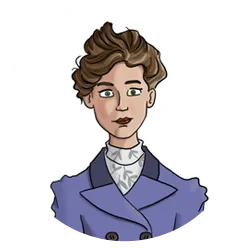
Mary McMahon was born in Glasgow, Lanarkshire, Scotland, on the 21st December 1881, the eldest of two daughters of Christopher and Margaret McMahon (née Heenan). Her father was a boilermaker, and the family resided at 17. McIntyre Street, Glasgow.
On completing her education, Mary trained as a teacher in a Roman Catholic training college in Glasgow.
She married James Tierney in Glasgow on the 8th August 1907 and they had a daughter, Jeanie McMahon Tierney, known as “Nina”, who was born in 1909.
In October 1912, James Tierney, who was a lead burner by occupation, emigrated to the United States of America in search of a better life for his family. He found work in Natrona, Pennsylvania, and once he had established himself there, he sent for Mary and Nina to join him.
On the 16th August 1913, Mary and Nina Tierney boarded the California in Glasgow, and after their arrival in New York, they continued on to Natrona. Sometime later, the family moved to 109. Madison Avenue, Vandergrift, Pennsylvania, although some sources state that they resided at 130. Franklin Avenue.
In the spring of 1915, Mary Tierney decided to return to Scotland to visit her family and friends, and taking Nina with her, she left Vandergrift at the end of April 1915, travelling by rail to New York, where second cabin passage awaited them both on the Lusitania.
They joined the liner there at the Cunard berth at Pier 54 on the morning of 1st May 1915, and then had to wait until just after mid-day on 1st May 1915 before she slipped her moorings for the very last time and sailed out into the North River. This delay was caused because she had to embark passengers, crew and cargo from the Anchor Lines vessel the S.S. Cameronia, which the British Admiralty had requisitioned for war work as a troop ship. They shared a cabin with fellow Scots, Mrs. Arabella Bryce and Miss Mary Buchanan.
Six days later, both Mary and Nina Tierney, along with Mary Buchanan, were dead, killed after the vessel was torpedoed and sunk by the German submarine U-20, within sight of the coast of southern Ireland on the afternoon of 7th May. Mary Tierney was
aged 33 years, although she gave her age on boarding the vessel as being 26 years!
Both of their bodies were recovered from the sea, however, and landed at Queenstown. Mary Tierney’s body was the second to be brought in, and having been taken to the temporary mortuary set up at the Cunard offices at Lynch’s Quay, it was given the reference number 2, before it was buried.
This took place on 10th May 1915, in Mass Grave C, 3rd Row, Upper Tier, in The Old Church Cemetery, just outside Queenstown. This was the day in which most of the bodies of the Lusitania victims were buried, following a long funeral procession which began outside the Cunard office in the town. At the same time, the body of her five year old daughter, Nina, was buried in the same mass grave, in the 6th Row, Lower Tier.
It is probable that no immediate association was made at the time between mother and daughter, or they would have been buried together.
On 3rd June 1915, Cunard’s Liverpool office received a cable from America which stated: -
Mrs. James Tierney - Were remains forwarded to Glasgow?
Presumably, Cunard replied in the negative, but it proves that by that date, her husband James was not aware that his wife had been buried at Queenstown and possibly, neither was Cunard. The following day, however, Cunard was able to state in another cable: -
Mrs. James Tierney and Nina Tierney identified by J. Henan, Glasgow and buried Queenstown.
J. Henan was Mrs. J. Henan of 4, Landressy Street, Glasgow, Lanarkshire, who had identified the Tierney mother and child from photographs numbers 101 and 102. However, although body No. 102 was that of Nina Tierney, body 101 was never subsequently identified and Mrs. Henan’s identification proved to be erroneous. This did not come to light until early June 1915, however, when Mr. James Tierney and Vandergrift jeweller William Steinhertz communicated with the shipping company in New York.
This communication was in response to a list of jewellery already forwarded to James Tierney, which was presumably assumed to belong to his late wife. By this time, Mr. Tierney and Mr. Steinhertz had seen photographs of the recovered bodies and obviously realised that body No. 2 was in fact Mary Tierney and not No. 101. Their letter stated that Mrs. Tierney’s jewellery included the following: -
1 wedding ring, 18 ct. English, 1 gold keeper, 9 ct. English 1 gold ring set with five diamonds, not mentioned in list, initialled J.T. TO M.M., 1 gold curb bracelet, and 1 pair of drop coral earrings, also missing from the list.
and also stated: -
NINA TIERNEY - 1 gold chain with locket attached, initialled N.J.T., 1 gold ring on middle finger of left hand, and points to the fact that the drop coral earrings mentioned in his list are plainly visible on the
photograph of remains No.2. Mr. Tierney asks that the effects of both be sent to him.
As it was necessary to bury all the recovered dead as soon as was practicable, for reasons of hygiene, they were all photographed in the mortuaries in Queenstown before being buried. Relatives of those missing were then invited to identify their loved ones through these photographs.
The recovered property of mother and daughter was put on board the S.S. Orduña bound for New York on 8th July 1915 and arrived at the Vandergrift address on 3rd August.
1901 Census of Scotland, Maryland U.S. Federal Naturalization Records 1795 – 1931, New York Passenger Lists 1820 – 1957, Cunard Records, Edinburgh Evening News, Pittsburgh Gazette Times, Pittsburgh Press, PRO BT 100/345, UniLiv.D92/1/5, UniLiv D92/2/182, Deaths at Sea 1871 – 1968, Graham Maddocks, Geoff Whitfield, Michael Poirier, Jim Kalafus, Cliff Barry, Paul Latimer, Norman Gray.
Copyright © Peter Kelly.