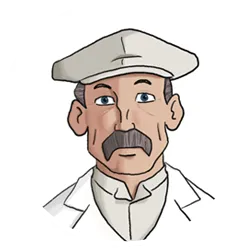
Matthew ‘Matt’ Freedman was born in London, England, on the 11th October 1895, one of the thirteen children of David and Leah Freedman (née Davis), and resided at 50, Old Compton Street, Soho, London, where his father, who was born in Poland, carried on a tailoring business. The family anglicised their family name to “Freeman” at some point.
Matt Freeman was a fit young man and, in his teenage years, was an amateur featherweight boxing champion of England and a member of the Polytechnic Boxing Club in London.
He, like all his family, worked in the family business, and in 1913, accompanied by four of his brothers, he made his first trip across the Atlantic Ocean. All five brothers gave their occupations as being tailors on entering Canada, giving their destination as Vancouver, British Columbia.
It is not known when he returned to England, but in February 1915, he arrived in New York City on board the White Star liner Adriatic, in connection with the family business.
Deciding to return home to England, on the 30th April 1915, he engaged on the Lusitania as a waiter in the Stewards' Department at a monthly rate of pay of £4-5s.-0d., (£4.25.), and he was on board when the liner left there for the last time on the early afternoon of the 1st May 1915. Many trans-Atlantic liners were short staffed because of the War and engaged casual staff on occasions, and Matthew Freeman obviously decided to earn some money as he made the trip home. There is no evidence that he enlisted in the Mercantile Marine, or that he had ever served as a waiter prior to this.
Just six days later, he survived the sinking of the vessel after she had been torpedoed by the German submarine U-20, off the Old Head of Kinsale in southern Ireland, only hours away from her home port.
According to Adolph and Mary Hoehling in their book The Last Voyage of the Lusitania, published in 1956, when the ship was struck, he tried to help some members of the crew to lower the boats but in the process, he cut his hand quite badly. It was then bandaged by saloon passenger Madame Marie Depage, whose husband was a renowned surgeon.
The Hoehlings then describe what happened to him next: -
Matt Freeman, ..... was in a hurry to get off, once his hand had been treated by Marie de Page (sic). He ran to the stern, now the highest part of the ship. When he looked down, he wondered if it weren't a bit too high.
Being an athlete in peak trim, he had full self-confidence. He climbed on to the railing and dived. He struck the side of a floating lifeboat. The blow opened a deep gash in his head and he could feel the blood ooze, even under water. But it had not knocked him out, and he began to swim.
Eventually, he came across a small keg floating in the sea and with five other people also trying to keep a hold on to it he managed to cling on to it with his fingertips.
Just before he had found the keg, he had been submerged a second time by a man who grabbed him, ‘eyes with bulging with fear‘.
The athlete had become faint with the effort to stay afloat. No match for the clawing mass of terrified men, he slipped away from the keg. He seized a passing deck chair and finally reached an upturned lifeboat to which a dozen people already clung.
In the hours that followed, many dropped off. Half-conscious himself, he was aware that "ten of them died beside me there in the water".
Second cabin passenger Dr. Daniel V. Moore of Yankton, South Dakota, later told of how the keg got into the water and how he came across Matt Freeman, in the book The Tragedy of the Lusitania, written by Captain Frederick D. Ellis and published not long after the disaster. In it, he said: -
By this time the ship was almost on its side and sinking by the bow. I saw a woman clinging to the rail near where a boat was being lowered. I rushed her into the boat and jumped after her. It was a twelve foot drop. The boat was heavily loaded, and when it dropped into the water we were almost swamped. Although we kept an even keel, water came over the gunwales faster than we could bail it out with our hats.
I realized that we would sink soon, so I threw a keg overboard and sprang after it. A young steward named Freeman also used the keg for a support. A full minute later we saw the boat swamped. After an hour and a half Freeman and I were picked up by a raft.
Dr. Moore and Matt Freeman were then eventually rescued from this raft by the Royal Naval trawler H.M.S. Brock, which landed them both at Queenstown.
From there, Matt Freeman eventually made it to Liverpool, the Lusitania’s home port, where he was officially discharged from her last voyage and paid the balance of wages owing to him. This amounted to £1-18s.-2d., (£1.91p.) and was in respect of his service from the 1st May until the 8th May 1915, 24 hours after the liner had foundered.
Marie Depage, who had administered first aid to Matt Freeman on the sloping deck of the liner, was on her way to Belgium to tend the war wounded in her husband’s hospital. She, unfortunately, perished during the sinking.
In 1916, Matt Freeman returned to New York City. Having been rejected by the British and U.S Armies due to defective eyesight, he spent the war years travelling around the United States of America giving talks about his experience of surviving the Lusitania sinking and appearing at screenings of a movie about the event called Lest We Forget, starring another survivor, Rita Jolivet.
After the War had ended, Matt Freeman returned to the clothing business becoming a cloth buyer, and as such, he crossed the Atlantic Ocean on numerous occasions. He lived in New York City for many years, but frequently returned to England.
By the mid-1940’s, he had met Miss Laura Kirby, of 16. Grange Road, Eastbourne, Sussex, who was a caterer. The couple lived together at her Eastbourne home, and whereas from 1950, she was styling herself as Mrs. Laura Freeman, no record of their marriage has been found. It is possible that they married at some time in the United States of America.
In 1952, the couple were residing at 1042. Michigan Avenue, Miami Beach, Florida, having moved there from Los Angeles, California. Matt Freeman became a naturalized U.S. citizen around this time.
It is not known when Matt and Laura Freeman returned to England, but when they did, they took up residence again at 16. Grange Road, Eastbourne.
Matthew Freeman died in Eastbourne, Sussex, England, on the 24th March 1968, aged 72 years. He was buried close to his wife’s parents at Ocklynge Cemetery, Eastbourne, Sussex. His wife died in 1973, and at the time of her death, she was still living in their home.
Register of Births, Marriages and Deaths, 1901 Census of England, 1911 Census of England, 1921 Census of England, 1939 Register, 1950 U.S. Federal Census, Canadian Passenger Lists 1865 – 1935, New York Passenger Lists 1820 – 1957, UK Incoming Passenger Lists 1878 – 1960, Cunard Records, U.S. World War I Draft Registration Cards 1917 – 1918, Aberdeen Press and Journal, Boxing World and Mirror of Life, Larne Times, Northern Whig, Last Voyage of the Lusitania, Tragedy of the Lusitania, UniLiv. D/92/6/1, Graham Maddocks, Stuart Williamson, Geoff Whitfield, Michael Poirier, Jim Kalafus, Cliff Barry, Paul Latimer, Norman Gray.
Copyright © Peter Kelly.
Revised & Updated – 26th November 2023.