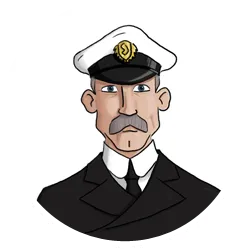
Albert Arthur Bestic was born at 186. Claremont Road, Sandymount, Dublin, Ireland, on the 26th August 1890, the son of Arthur Robinson and Sarah Martha Bestic (née Stephenson). His father was a bank official, working for the Bank of Ireland, and Albert was the younger of two children, having an older sister named Olive Geraldine.
He lived at 40, Parkbridge Road, Prenton, Birkenhead, Cheshire. At the age of 18 years, he commenced his apprenticeship ‘before the mast’ in sailing ships in the process of becoming a professional deck officer in the Mercantile Marine. On one occasion, whilst serving on the three-master Denbigh Castle, in the Atlantic Ocean, he saw the Lusitania under full steam and thrilled at the possibility of joining her one day as a member of her crew!
His chance came with the outbreak of the Great War when vacancies for deck officers with The Cunard Steam Ship Company became available as some of the regular ones were called up for service with the Royal Navy.
In early 1915, he married Queenie E. T. Kent in Birmingham, Warwickshire, and the couple would have three children, all boys.
Having applied to join the Lusitania, he was given an immediate appointment as Junior Third Officer on the morning of the 17th April 1915 as a replacement for Junior Third Officer R. J. Allen, who would be transferred to another Cunard ship in New York. Bestic therefore joined the Lusitania just before she left Liverpool for the last time. His previous ship had been the Leyland, Frederick, and Co. Ltd. vessel Californian, which had played a part in the Titanic tragedy of April three years earlier. As junior third officer on the Lusitania, Albert Bestic’s monthly rate of pay was £10-0s-0d.
Having arrived safely in New York, the Lusitania left on her return leg to Liverpool on the early afternoon of the 1st May 1915, and just six days later, she was torpedoed and sunk by the German submarine, U-20, off the coast of southern Ireland, only hours away from her home port.
Albert Bestic survived the sinking and having been rescued from the sea and landed at Queenstown, eventually made it back to Liverpool, where, like all Lusitania crew survivors, he was required to give a deposition on oath to a Board of Trade official, concerning his experiences of the sinking. Most of these depositions have long since been lost or destroyed. but a few, including that of Bestic, have survived in the Public Record Office in Richmond, Surrey, England in ‘facsimile’ form - i.e. copied out by hand, probably at the time. That of Junior Third Officer Bestic given on the 12th May 1915 states: -
At the time of sailing the ship was in good condition and well found. She was unarmed having no weapons of offence or defence against an enemy.
Boat drill was carried out before the vessel left New York, the boats being swung out but not put into the water.
On Thursday 6th May at 5.30 to 6.30 a.m., the boats were all swung out. On 7th May Deponent went off watch at noon and returned to relieve the Intermediate Third Officer for lunch. Deponent left the bridge at about 2 p.m.. The Old Head of Kinsale was about 5 points on the port bow, distant about ten miles. The vessel was going full speed by the telegraph and making about 18 knots. .....
Just after he had returned to his cabin, he got the call from Baggage Master John Crank to supervise the bringing up of luggage from the baggage hold. This was always a dirty job which had to be supervised by an officer. Bestic realised that he was wearing a new uniform which he had only just purchased in New York and told Crank that he would follow him down when he had changed.
There are two possible reasons why Crank had been ordered to bring up luggage from below. The first is that as the weather was fairly good at the time, luggage brought up on the Friday afternoon could safely remain on the deck and make the unloading of the vessel in the early hours of the following morning at Liverpool, much quicker. The other, is that the Admiralty had finally realised the danger to the ship from submarine attack and had ordered her to put into nearby Queenstown! After such a passage of time and the need to keep certain movements secret during the war, it is impossible to know which was the correct one! Whatever the reason was, Bestic’s decision to change his uniform certainly saved his life! His deposition continued: -
Deponent was in the Officers’ smoke room on the Bridge Deck. He heard a violent explosion. The vessel commenced to list to starboard and the lights went out on the instant. Deponent ran out to the starboard side of the bridge and saw debris falling from a height above the funnels and the wake of a torpedo. As far as he could make out the torpedo struck the vessel between the second and third funnels.
Deponent heard the captain on the bridge ordering the boats to be lowered to the rail. Passengers were rushing up onto the boat deck. There was no panic but some women were crying. The crowd impeded the movements of those getting out the boats.
Deponent’s station was Boats 2 to 10, personal boat No. 10. Deponent went to No. 10 first. A sailor took the after fall and deponent the forward
fall and commenced to lower. The list being so great to starboard, the boat came in on top of the collapsible boats underneath.
Under orders from staff captain Anderson Deponent went to the bridge and requested the 2nd Officer to trim the vessel with port tanks. Shortly afterwards the vessel commenced to recover a little but not sufficient to allow of the port side boat being thrown clear of the rail. The ship now was sinking by the head. None of the boats 2 to 10 got away. Some persons, presumably passengers let go guys with the result that some of the boats swung inboard.
Deponent continued his efforts until the water reached abaft of the bridge. He then stepped over the side, (a drop of 2 or 3 feet) into the water. Deponent was dragged down with the ship, came to the surface and eventually took refuge on a stove-in collapsible boat. He picked another man up from the water got the side of the boat raised a little and took in several persons from the water on an upturned sinking boat.
After several hours, Bestic and the others came across some more people clinging to a bread safe and coming across another upturned boat, he kept everyone together until they were finally picked up by the Royal Naval patrol boat H.M.S. Bluebell and eventually landed at Queenstown.
All the handlers in the baggage hold, including Baggage Master John Crank, were killed as a result of the torpedo explosion, or were trapped between decks in the loading cages and were subsequently drowned. Only Bestic’s decision to change his uniform prevented his being there with them!
Whilst in Liverpool, Albert Bestic was officially discharged from his service on the Lusitania and paid the balance of wages owed to him in respect of his service on board. This amounted to £8-6s-8d., (£8.33p.).
At the end of June 1915, he was called to give evidence at the official enquiry conducted into the sinking, chaired by Lord Mersey, and held at Caxton Hall in London. The questions he was asked, however, like most of those put to crew members, only elicited a response which was convenient to the finding which was required!
He continued to serve on Cunard vessels until June 1917, when he was commissioned as a temporary Lieutenant in the Royal Navy, serving on a number of vessels before being demobilised in November 1919 and being listed on the Royal Naval Reserve. He was described as an excellent officer by all of his commanding officers during his naval service.
He returned to Ireland and joined the Commissioners of Irish Lights – the organisation that is responsible for lighthouses and lightships around the island of Ireland. His first command was the lightship, Alexandra.
Having survived the war at sea, Albert Bestic continued to be haunted by the Lusitania story and in the 1930’s, he was involved in several schemes to recover goods and artefacts from the wreck. Although none of them ever amounted to anything, in the autumn of 1932, he visited Captain Turner at his home in Great
Crosby, near Liverpool. At that time, Turner was in failing health and would only have just over six months to live! When Albert Bestic announced himself to the Captain’s house keeper Mabel Avery, Turner did not remember him until Bestic recalled that Turner had always called him “Bisset”.
Once they had established their relationship again, like most former shipmates, the pair reminisced about their times at sea and their last voyage together. When Bestic told him of his intention to discover the wreck with a salvage company, his former commander gave him the chart which he had taken from the chart table just before he had been washed off the bridge. On this, he had marked, fairly accurately, as it later turned out, the position of the liner when she was first struck! He also asked his former Junior Third Officer if he could recover his sextant that he had left in his day cabin!
On the 19th December 1940, Albert Bestic was in command of the lightship, Isolda, which left Rosslare Harbour, County Wexford, with a crew of twenty eight to provide relief crews for the lightship anchored at “The Barrels”, off Carnsore Point, and also the Conningbeg lightship, anchored off the Saltee Islands. A German aircraft attacked and sunk the vessel, despite it flying the neutral Irish flag and being clearly marked “Lighthouse Service”. Six men were killed and seven wounded. The survivors, including Albert Bestic, managed to land at Kilmore Quay, County Wexford, in their lifeboats.
In 1942, he was again commissioned at a temporary Lieutenant in the Royal Navy for the duration of the Second World War, returning to his position with the Commissioners of Irish Lights when hostilities ended.
Albert Bestic was, unlike many Lusitania survivors, quite happy to talk about his experiences in later life, slightly different versions of which appeared in different books from the 1950’s to the 1970’s. His deposition, however, given on oath a mere five days after the sinking, is likely to be the most accurate.
Albert Bestic died in Bray, County Wicklow, Ireland, on the 20th December 1962, aged 72 years, and was interred in a private vault underneath St. Michan’s Parish Church, Church Street, Arran Quay, Dublin.
Register of Births, Marriages and Deaths, 1911 Census of Ireland, Cunard Records, UK Apprentices Indentured in Merchant Navy 1824 – 1910, UK and Ireland Masters and Mates Certificates 1850 – 1927, The Gazette, London Gazette, Last Voyage of the Lusitania, Lusitania, Lusitania and Beyond, Seven Days to Disaster, Merchant Fleet At War, Commissioners of Irish Lights, PRO ADM 340/11/16, PRO BT 100/345, Graham Maddocks, Geoff Whitfield, Michael Poirier, Jim Kalafus, Cliff Barry, Paul Latimer, Norman Gray.
Copyright © Peter Kelly.
Revised & Updated – 14th December 2022.