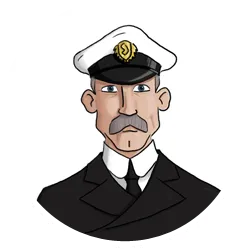
Percy Hefford was born in Rugby, Warwickshire, England, in 1881, the son of David and Maria Hefford (née Hedge). His father was a furrier and hatter, and Percy was the youngest of three children.
His father died on the 22nd October 1880, four months before Percy was born, and his mother then married a Mr. William F. Wood who was a hatter and hosier and who lived in Sheep Street, in Rugby.
From being a small boy, it had always been Percy Hefford’s ambition to serve at sea - especially on the great trans-Atlantic liners and after basic education; he trained for a career as a deck officer in the Mercantile Marine.
On the 13th February 1915, he was married to Elsie Maude Nevanas at St. Hildeburgh’s Church, Hoylake, Cheshire, and they lived at 12, Aylesbury Road, New Brighton, Wallasey, Cheshire. This was across the River Mersey from Liverpool and allowed him easy access to Liverpool docks and the Cunard liners, on which by this time, he was serving.
On the 12th April 1915, he engaged at Liverpool as Second Officer in the Deck Department for what would be the Lusitania’s final voyage, at a monthly rate of pay of £16-0s.-0d. and he joined the liner five days later on the morning that she sailed out of the River Mersey for the last ever time.
The liner crossed the Atlantic Ocean without incident and having docked in New York on the 24th April 1915, left there on the early afternoon of the 1st May, for her return to Liverpool. Then, six days later, on the afternoon of the 7th May, she was torpedoed and sunk by the German submarine U-20, within sight of the coast of southern Ireland. At that time, she was only about 250 miles away from the safety of her home port. Percy Hefford lost his life as a result of this action. He was aged 34 years.
In a deposition given to an officer of the Board of Trade on the 12th May 1915, survivor Able Seaman H. R. Johnston remembered Second Officer Hefford being on the bridge
before the liner went down: -
I was at the wheel and heard a very loud explosion and felt the ship quivering. Just before the explosion I heard Mr. Hefford, Second Officer sing out from the bridge “Here is a torpedo” and immediately afterwards the Captain gave me the order “hard a starboard”, and I put the wheel to 35 degrees and I reported to the Captain “helm is hard a starboard” and he replied “all right boy.” .....
After the Captain gave the order “Hard a starboard” when the vessel was head on to Kinsale, I heard him say to the Second Officer W. Hefford, “Have a look what list she has got”, and Mr. Hefford answered “She is listing 15 degrees to starboard, Sir.”. Then I heard the Captain sing out “Watch if she goes any further” and the Second Officer watched the indicator on the compass until he got some other order which I did not hear from the Captain and Mr. Hefford told me to watch the indicator and sing out if she went any further.
According to a small article in The Northampton Mercury for the 14th May 1915: -
Mr. W.F. Wood of Sheep Street, Rugby, has received from an officer friend of Mr. Hefford a message to the effect that Mr. Hefford was last seen standing on the bridge of the liner and wearing a lifebelt.
However, in The Tragedy of the Lusitania privately published in 1915, second cabin passenger Frederick S. Judson described reaching a lifeboat, in which he found Second Officer Percy Hefford and Able Seaman Francis Hennessy. He said: -
Between them these two men saved at least a dozen lives. Hennessy dived repeatedly and brought women up.
If Mr. Judson was correct, then Percy Hefford must have died some time after this. As Judson did not name Hefford, however, but merely called him the second officer, it could be that he was referring to another officer and mistook his rank.
Either way, Hefford’s body was not recovered and identified after the disaster and consequently, he is commemorated on the Mercantile Marine Memorial at Tower Hill, London.
In an account of her experiences of the sinking, second cabin passenger Annie Richardson also later stated: -
With my friend’s help we went to the Cunard office, where numbers were laid out in rows for identification. One lady lay with her baby tightly clasped to her, the second officer was also among them, what a gruesome sight .....
She must have been mistaken, however and probably saw the body of Staff Captain James Clarke Anderson and confused the rank.
When Percy Hefford’s will was proven, on the 20th July 1915, his effects amounted to £433-1s.-6d. (£433.7½p.). In August, the balance of wages owing to him, paid up to the 8th May, 24 hours after the sinking, was forwarded to his widow, Elsie. Some time after
her husband's death, she moved to 34, King's Gap, Hoylake, Cheshire. In addition, The Liverpool and London War Risks Insurance Association Limited also granted a yearly pension to Elsie Hefford to compensate her for the loss of her husband which amounted to £55-4s.-6d. (£55.22½p.) which was payable at the rate of £4-13s.-9d. (£4.68½p.) per month.
In an article about the sinking published in The Wallasey News, on the 15th May 1915, Second Officer Hefford's address is shown as Molyneaux Drive, New Brighton, but this must be a mistake.
Elsie Maud Hefford married Arthur Stephenson Pollard in Liverpool in 1919 and resided at 12. South Albert Road, Sefton Park, Liverpool, and later at 47. Ribbledale Road, Mossley Hill, Liverpool. Arthur Pollard died in Liverpool in 1950, and Elsie died in 1969.
Register of Births, Marriages, and Deaths, 1881 Census of England, 1891 Census of England, 1901 Census of England, Liverpool England Crew Lists 1861 – 1919, Cunard Records, Commonwealth War Graves Commission, UK and Ireland Masters and Mates Certificates 1850 – 1927, Liverpool Echo, Northampton Mercury, Wallasey News, The Wallasey and Wirral Chronicle, Last Voyage of the Lusitania, Tragedy of the Lusitania, Probate Records, PRO ADM 137/1058, UniLiv. PR 13/24, PRO BT 334, PRO BT 351/1/61090, Deaths at Sea 1871 – 1968, Graham Maddocks, Geoff Whitfield, Michael Poirier, Jim Kalafus, Cliff Barry, Paul Latimer, Norman Gray.
Copyright © Peter Kelly.
Revised & Updated – 4th January 2024.