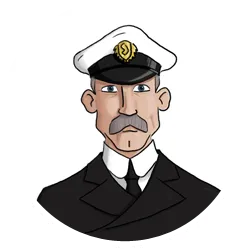
Edward John Heighway was born in Parnell, Auckland, New Zealand on the 22nd December 1872, the son of John Felton and Dora Heighway (née Edgar). His father was an engineer, and Edward was the youngest of four children. His mother died in 1873, and his father remarried in 1874, having another four children with his second wife.
Nothing is known of his life until the early 1900’s, when it appears that he became a professional seaman and immigrated to the British Isles.
On the 5th July 1905, he married Elizabeth “Betty” Skillen in Downpatrick, County Down, Northern Ireland, and it was here, in the village of Strangford, that he lived and raised a family with his wife. The couple had two sons, Sydney Craig, and Gerard Cecil Fulton. He also lived at 77 Highfield Street, in Liverpool, which was probably a lodging house he stayed at between voyages, and also had connections with Sutton Oak, near St. Helens in Lancashire.
On the 29th June 1909, he joined the Freemason’s Lodge No. 30 Killyleagh, County Down.
He was a professional seaman in the Mercantile Marine and on the 12th April 1915, he engaged on board the Lusitania at Liverpool as an able seaman in the Deck Department. His monthly rate of pay in that rank was £5-10s.-0d. (£5.50p.) and he reported for duty at 7 a.m. on the 17th April 1915, before the vessel left Liverpool for the last time. It was not the first time that he had served on the ship.
Having completed her voyage to New York, he survived her sinking three weeks later on the early afternoon of the 7th May, when she was torpedoed by the German
submarine U-20 off the Old Head of Kinsale in southern Ireland - only hours away from her home port on her return crossing!
On his return to Liverpool, like all surviving crew members, he was interviewed by an official from the Board of Trade and gave a deposition on oath, concerning his experiences of the sinking. Most of these depositions have long since been lost, but that of Able Seaman Heighway has survived in the archives of The Public Record Office in Richmond, Surrey, England. Like the other surviving documents, however, it is not the original and was copied out by hand at a later date. Although it is labelled a “facsimile” copy, the transcriber has mistaken Heighway’s name as Beighway in the copy! The original was given on the 13th May 1915 and states: -
The said ship was in the vicinity of The Old Head of Kinsale and deponent was on the saloon deck when he noticed a ripple on the water as from a periscope about 300 yards distant abeam on the starboard side and almost immediately he saw the wake of a torpedo. The torpedo was visible when 10 yards distant from the “Lusitania” and deponent sang out a warning and made for his boat station, No 5 boat, starboard side.
The next instant, there was a violent explosion, the torpedo striking the ship just about amidships starboard side. The vessel took on immediate heavy list to starboard and within 20 seconds, deponent noticed the wake of another torpedo which struck the vessel on the starboard side quarter.
Deponent, on reaching his boat, worked at the fall but before anyone could get into her, someone let the forward fall go, so deponent let the starboard rope run, to try and get the boat level to the water, but this rope choked and the boat losing by her after fall with her forward end trailing in the water. (sic).
Deponent then proceeded aft to No 15 boat, got into her and helped to fill her mainly with women and children. When about 80 people were in her, she was safely lowered, the first officer Mr. Jones working at the forward fall, afterwards sliding down the fall to the boat.
There are quite a few inconsistencies in Able Seaman Heighway’s deposition which do not make a great deal of sense, given that it was dictated so soon after the sinking, but they show how clearly stressful conditions can alter the perceptions of the participants involved in a disaster.
There was only ever one torpedo fired by Kapitänleutnant Schwieger in command of the U-20, so Heighway could only have seen the wake of one! Equally so, Lifeboat No. 5 was destroyed by water and debris dropping onto it after the torpedo strike, and from his account, it is more likely that the able seaman is describing the fate of Lifeboat No 17. If this was so, it, is difficult to see how he could have proceeded aft to No 15 boat, as Lifeboat No. 15 would have been forward of No. 17. He is correct, however when he mentions No. 15 boat having about 80 persons in it and being under the command of First Officer Arthur Jones. His deposition continues: -
At this moment, the Lusitania took a tremendous dive, practically standing on her head and sank, killing hundreds of people. This was about 20 minutes after being torpedoed.
Deponent’s boat then pulled towards an empty boat and under orders from first officer, deponent and about 20 others transferred to it. They then pulled around and picked about 50 people out of the water, afterwards making for land, being eventually taken aboard the Wanderer of Peel.
The empty boat described by Heighway was probably Lifeboat No. 1, which was not entirely empty, but had been swamped when the ship sank, throwing out most of its passengers. The Wanderer of Peel was a Manx fishing smack which just happened to be fishing in the area when she saw the liner go down. She then rescued many passengers and crew from the sea.
Able Seaman Heighway also gave evidence at the official enquiry conducted into the disaster, chaired by Lord Mersey in June and July 1915 at Caxton Hall in London and his account of two torpedoes having been fired must have suited the official findings of the enquiry. He was photographed outside the building, with five other crew member survivors and this photograph was circulated widely in the press at the time and was also published in Part 10 of the post-war publication I Was There.
In a follow-up to this, in Part 12, a former army sergeant named Lahiff who had served in the 2nd Battalion of the Loyal North Lancashire Regiment during the conflict, who came from Sutton Oak, near St. Helens, wrote a letter to the editor, identifying Able Seaman Heighway (although Lahiff’s letter spelled his name Highway), in the photograph and stating that he knew him personally and saw him regularly in Sutton Oak at the end of each voyage he made. Thus, it would appear that Edward Heighway continued to serve as a merchant seaman after the Lusitania‘s sinking.
Some time after his return to Liverpool, Edward Heighway was officially discharged from his service on the Lusitania and paid the balance of wages owed to him in respect of it, which amounted to £4-18s.-8d. (£4.93p.). Like all crew members, survived or perished, this service was counted from the 17th April 1915 until the 8th May; 24 hours after the liner had gone down.
In May 1914, Edward Heighway had received a silver medal for gallantry from King George V. The award was made for an incident which occurred on the 9th October 1913 while Heighway was serving on the Carmania. His vessel had gone to the assistance of the Canadian Northern Steamship Company’s Volturno, which had caught fire in the north Atlantic. 30 officers and 103 passengers, out of a total of 654 souls, had perished, and Edward Heighway was awarded his medal for jumping into the freezing sea, and rescuing a man who had fallen overboard from the burning ship. Ironically, the man whom he successfully rescued was a German by the name of Walter Trentepohl!
Fellow able seaman F.H. O’Neill who also survived the sinking of the Lusitania also lived at 77 Highfield Street.
Edward Heighway continued to serve in the Mercantile Marine for many years, mostly as a master-at-arms. He finished his career as a nightwatchman on the Training Ship Indefatigable, a training ship that was moored near Rock Ferry on the River Mersey and used to train young boys in seamanship for a live in the Royal Navy or Mercantile Marine.
Edward Heighway died at the Whiston General Hospital, St. Helen’s, Lancashire, on the 23rd November 1950, aged 77 years. He was residing at The Hospital Farm, Peasley Cross, St. Helens, Lancashire, in his retirement years.
Administration of his estate was granted to his son, Detective Sergeant Sydney Craig Heighway, at London on the 10th February 1951 and his effects amounted to £1,272-2s.-3d. (£1,272.11p.).
Register of Births, Marriages, and Deaths, New Zealand Birth Index 1840 – 1950, 1911 Census of Ireland, 1921 Census of England, 1939 Register, Liverpool England Crew Lists 1861 – 1919, Cunard Records, Grand Lodge of Freemasons of Ireland Memberships Registers 1733 – 1923, I Was There, Belfast Newsletter, Irish Independent, Probate Records, PRO ADM 137/1058, PRO BT 100/345, PRO BT 348, PRO BT 349, PRO BT 351/1/61122, Graham Maddocks, Roy Makinson, Geoff Whitfield, Michael Poirier, Jim Kalafus, Cliff Barry, Paul Latimer, Norman Gray.
Copyright © Peter Kelly.
Revised & Updated – 4th January 2024.