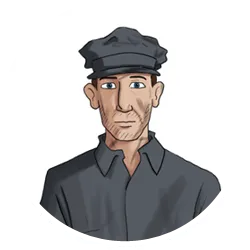
Andrew Cockburn was born at 8, Coalmarket, Kelso, Roxburghshire, Scotland, on the 7th September 1871, one of the four children of Alexander and Anne Cockburn, (née Black). When he was only three years old, his mother died, and in 1876, his father married Jane Jones Chalmers and they gave the young Andrew a further twelve half brothers and sisters!
After initial education, Andrew Cockburn undertook an engineering apprenticeship with Messrs. Morrison and Sons of Leith, Midlothian, and completed study at Lockie’s Evening Academy, before becoming a journeyman with R. & W. Hawthorn, Leslie & Company of Newcastle upon Tyne, Northumberland, England.
In 1892, he joined the shore staff of The Cunard Steam Ship Company, in Liverpool, as a fitter where he remained for a year before he sailed on the maiden voyage of the Lucania as Second Engineer, on which he served until 1896, and during which time she completed the then fastest trans-Atlantic crossing of five days, seven hours and twenty five minutes, capturing the fabled ‘Blue Riband’ from the American Lines vessel Paris.
In 1897, he married Laura Forrett at Liverpool, and they had three children, Margaret Alexandra, who was born in July 1902, Flora Jane, who was born in December 1907 and Nancy Laura, who was born in 1910.
From 1893 onwards, Andrew Cockburn continued to serve Cunard at sea, and served on many liners including the Umbria, the Campania and the Ivernia. At some stage during this period of time, he was commissioned as an officer in the Royal Naval Reserve, later being awarded the Royal Naval Reserve Decoration, (R.D.). Then in March 1914, he was appointed Intermediate Second Engineer for the maiden voyage of the Aquitania.
He had decided to retire from active life at sea sometime that year, but on the 4th August 1914, the Great War broke out and everything changed! At that stage, he was serving on the Lusitania’s sister ship the Aquitania and, on the 2nd August, that vessel was requisitioned by the British Admiralty as an armed merchant cruiser, and he was then re-commissioned as a Royal Naval Reserve Engineer-Lieutenant. He was reassigned to the Lusitania in January 1915, having completed a single voyage to New York and back on the Mauretania.
On the 12th April 1915 at Liverpool, he engaged for a further period of service on the Lusitania as Second Engineer in the Engineering Department at a monthly rate of pay of £22-0s.-0d. and reported for duty on board on the morning of the 17th April 1915, before the liner left the River Mersey for the very last time. At that time, the family home was at 16, Kitchener Street, St. Helens, Lancashire.
Having completed her westward crossing to New York, the liner left there just after
mid-day on the 1st May 1915 for her return journey to Liverpool, having taken on board passengers, cargo, and some of the crew of the Anchor Liner Cameronia, which the British Admiralty had requisitioned for use as a troop ship. Then, six days out of New York, she was torpedoed by the German submarine, U-20, within sight of the Old Head of Kinsale in southern Ireland.
Engineer Cockburn survived this action and was later called to the investigation into the sinking presided over by Lord Mersey at Central Hall, Westminster, London. He was questioned on Wednesday, the 16th June 1915, by The Attorney General, Sir Edward Carson, and informed him that his normal engine room watch was from 8 a.m. until 12 noon, each day.
He then said that when the torpedo had struck, he was outside his cabin on ‘C’ Deck and had immediately gone down into the engine room where he could see that the watertight doors were already closed. Once there, having put on a lifebelt, he conversed with the Chief Engineer, Archibald Bryce, and the Second Engineer, (probably Second Senior Third Engineer George Little). The engine room was in darkness by this time and as all the steam had gone, everything was stopped. He could hear water rushing in but could not tell exactly where.
Realising that nothing more could be done for the ship, Cockburn went back up on deck, which was, by this time, severely listing to starboard. He was just in time to get over the deck rail and some netting before virtually stepping into the sea just as the Lusitania sank, taking him with her. Having struggled back to the surface, he kept himself afloat for a while by clinging to a valise, before he managed to get on top of an upturned boat, before eventually being picked up by the Royal Naval Trawler Indian Empire.
From there, he was landed at Queenstown and then eventually made it back to Liverpool, where, at Cunard’s offices in Water Street, he was officially discharged from the Lusitania’s last voyage and paid the balance of wages owed to him in respect of it. This amounted to £17-17s.-6d. (£17.87½p.) and covered the period from the 17th April until the 8th May 1915, 24 hours after the great liner had foundered.
When he first went back to sea after the Lusitania sinking, he served on board the Mauretania carrying troops from Halifax, Nova Scotia, to Britain and then in March 1917, he was appointed Chief Engineer of the Aurania on her maiden voyage, under Admiralty control and fitted out as a troopship. He was still serving on board her on the 4th February 1918 when she was torpedoed by the German submarine, UB-67, off the coast of Ireland, on a voyage to New York. Although she did not sink immediately as a result of this action, and was taken under tow, the tow parted in heavy weather off western Scotland and she was driven ashore and wrecked near Tobermory, on the Island of Mull in Argyllshire, with the loss of eight of her crew.
Cockburn survived this second shipwreck, and after it, returned to the Mauretania, firstly as Senior Second Engineer, and then in 1919, he became her chief engineer, serving on board for the next ten years or so.
On the 28th March 1931, his wife died, and at that time they were living at 113. Wilton Road, Shirley, Southampton, Hampshire. When the trans-Atlantic liners left Liverpool for Southampton, Andrew Cockburn and his family had moved to there. and he went on to marry Maude Packer in 1936.
He finally retired from the sea on the 31st December 1932, and was awarded the honour of The Order of The British Empire, in 1935, for his service to his country.
Andrew Cockburn married Maude Gerald Packer (née Wheldon), possibly in 1935. His second wife had been born in Massachusetts, in the United States of America, and was the widow of Dr. Flavius Packer, a well-known New York psychiatrist, who had died in 1930. Where or how they met, and when and where they married is not known. They continued to reside at 113. Wilton Road, Shirley, Southampton, for the remainder of their lives.
James Cockburn died, aged 84 years, at his home at ‘Hendersyde’, 113. Wilton Road, Shirley, Southampton, Hampshire on the 15th August 1955. He was buried at Hollybrook Cemetery, Southampton. He left an estate of £16,158-17s.-5d. (£16,158.87p) to his widow and their three daughters.
His second wife, Maude, died in 1960, his daughter, Margaret, in December 1967, aged 65 years, his daughter, Flora, in November 2002, aged nearly 95 years, and his daughter, Nancy, in 1995, aged 85 years.
In a letter to Graham Maddocks in April 2003, his grandson, John Ackroyd, Flora’s son, stated: -
He was described by all who knew him as a quiet modest man.
I remember him describing with great pride how he had beaten some of the American Ryder Cup team at a golf putting game played on board ship. He knew how the ship rolled!
Register of Births, Marriages, and Deaths, Scotland Select Births and Baptisms 1564 – 1950, 1881 Census of Scotland, 1891 Census of Scotland, 1901 Census of England, 1911 Census of England, Cunard Records, British Vessels Lost At Sea, Marine Engineers’ Association Journal, Last Voyage of the Lusitania, Lusitania Saga and Myth, Mersey Enquiry, Probate Records, PRO ADM 137/1058, PRO BT 100/345, PRO BT 348, Graham Maddocks, John Ackroyd, Geoff Whitfield, Michael Poirier, Jim Kalafus, Cliff Barry, Paul Latimer, Norman Gray.
Copyright © Peter Kelly.
Revised & Updated – 9th January 2023.