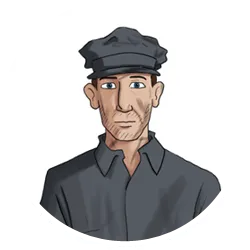
Bernard Conlon was born in Liverpool, Lancashire, England, on the 27th April 1895, the son of Bernard and Mary Conlon (née Jones). His father was a dock labourer, who died in 1910, and Bernard was one of six children.
Bernard became a professional seaman in the British Mercantile Marine, and he signed on as a trimmer in the Engineering Department on board the Lusitania at Liverpool, on the 12th April 1915 for what would be the liner’s last ever voyage to America and reported for duty at 8 a.m. on the 17th April, the day she left the River Mersey. As a trimmer, his monthly rate of pay was £6-0s-0d. and upon engagement, he was given an advance on his pay of £1-0s-0d. This was to be his third trip on the great liner.
He survived the sinking and eventually got back to Liverpool where he was officially discharged from the liner’s final voyage and paid the balance of wages still owing to him. This was reckoned to be from the 17th April 1915 until the 8th May, 24 hours after the liner had foundered.
Bernard Conlon continued to serve with Cunard for some years afterwards, serving on, among other trans-Atlantic liners, the Lusitania’s sister ship, Mauritania. He eventually moved to Australia, settling in Brisbane, Queensland, and continued his career as a seaman. He gave an interview to a reporter for The Sunday Mail, Brisbane, about his experiences as the Lusitania sank, and this account was printed in the newspaper on the 17th March 1935. He stated that he was working in the forward stokehold when the torpedo struck the vessel, and made his escape by climbing the escape ladder on the starboard side of the stokehold as the sea water rushed in. He stated: -
“The head fireman led the way. I never mounted a ship’s ladder so quick in my life. The water was rushing into the stokehold, and we were nearly crazy with fear.”
But escape was not as easy as that. “It was every man for himself in that mad scramble up the ladder,” says Mr. Conlon philosophically. The leading fireman was ahead, and well I remember his shout when he reached the top of the escape ladder that led to the ventilator. ‘We’re trapped like rats,’ he yelled, for his head had struck the thickly coiled wire netting, bolted to the side of the ventilator, which prevented him or us getting out. We were all howling and cursing and pushing. Our pushing did the trick! We pushed his head clean through the netting, and all climbed onto the deck like a lot of be-sooted monkeys.”. ...
A DREADFUL SCENE
“I remember looking up at the bridge and hearing the captain yelling out, ‘Women and children first.’ I saw one of the officers knock down a man who was screaming. But women were screaming all over the place.
“The boats on the port side were full of women and children, but the list of the vessel prevented the boats being launched. Eventually the boats had to be cut away, with the result that the people already in them were tipped into the water. Most of the boats capsized on hitting the water, and the cries of the drowning were pitiful.
“When the cry, ‘Every man for himself, came I dived overboard, as I thought the vessel would turn turtle any moment. I sank, and thought I would never come to the surface again. On reaching the surface I swam about a bit until picked up by a lifeboat containing one of the engineers and a seaman. I was told to grab an oar, and we picked up others of the crew until we had enough hands to row with. We were given orders by the engineer not to pick up any men, only women and children.
“The water was alive with struggling people, all crying out to us to save them. In no time we were overloaded with women, some with children in their arms. Others kept tugging at our arms and bodies as we rowed, imploring us to rescue their children.
“Hundreds of persons were clinging to wreckage and rafts. A score or more men and women hung on to the dragging ropes of our boat, but we were unable to pull them in, as we were dangerously overcrowded. As we rowed away from the sinking vessel it was horrifying to see hands slip off the sides of the boat and the victims disappear with despairing cries.
SANK IN 45 MINUTES
“The ship sank in about 45 minutes. She literally turned turtle. Some of the boats that had been safely launched on the starboard side were in terrible danger owing to the superstructure. The slowly descending funnels and davits killed many, and also fouled many of the boats.
“But the final plunge of the Lusitania was one of the greatest sights I have ever seen except for the horrible tragedy of it. She lay on her side first, then her stern rose up in the air for several minutes before the final plunge.”
Bernard Conlon married Helen Lowther in Brisbane, Queensland, Australia, in 1938. He died on the 26th August 1951, aged 56 years. He was residing at 85. Kennigo Street, Fortitude Valley, Brisbane, at the time of his death and he was buried in Portion 5, Section 101, Grave 71, in Lutwyche Cemetery on the 29th August 1951, where his remains lie to this day. His grave is unmarked.
Register of Births, Marriages and Deaths, Australia Death Index 1787 – 1985, 1901 Census of England, 1911 Census of England, Cunard Records, The Sunday Times, Brisbane, Brisbane City Council, PRO BT 348, PRO BT 350, Graham Maddocks, Geoff Whitfield, Michael Poirier, Jim Kalafus, Cliff Barry, Paul Latimer, Norman Gray.
Copyright © Peter Kelly.
Revised & Updated – 14th January 2023.