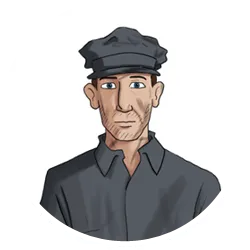
Andrew Cross or Crosse (he used both spellings of his name) was born in Liverpool, Lancashire, England, on the 1st January 1881, the son of Andrew Henry and Elizabeth Cross (née Boardman). His father was a butcher and Andrew was the youngest of six children in the family.
In 1906, he joined the British Mercantile Marine as a fireman on steam ships, and in late 1908, he married Ann Dorney in Liverpool. The couple would have at least four children. In 1915, his home was at 155, Leyden Street, Kirkdale, Liverpool.
He engaged as a fireman in the Engineering Department on board the Lusitania, at Liverpool, on the 12th April 1915, at a monthly rate of pay of £6-10s.-0d. (£6.50p.), £1-0s.-0d. of which was advanced to him at the time, and he reported for duty five days later for what became the liner‘s last sailing from her home port. He had served on the Lusitania before.
Having completed the liner’s crossing to New York without mishap, Fireman Cross was serving on board on the early afternoon of the 1st May, as the Lusitania left New York on the start of her return voyage to Liverpool. Then, six days out of that port, on the afternoon of the 7th May, she was torpedoed and sunk by the German submarine, U-20, within sight of the coast of southern Ireland. At that time, she was only about fourteen hours steaming time away from the safety of her home port.
Andrew Cross survived the sinking and having been rescued from the sea and landed at Queenstown, he was eventually able to get back to his native home. There, he gave a short interview with the press, which was published in The Lancashire Daily Post on Monday, the 10th May, which stated: -
Andrew Cross, a fireman, ..... said he put a lady passenger in a collapsible boat on the upper deck of the liner, and this was precipitated into the sea when the liner sank.
When he jumped into the water himself, he was grasped by the hair of the head by the very lady whose escape he had assisted, and who helped him into the boat.
One of the funnels was blown up, and when the liner fell over on her starboard side, the three other funnels crashed into and destroyed a number of laden lifeboats.
Once back in Liverpool, Fireman Cross was officially discharged from the last voyage of the Lusitania’s final voyage and paid the balance of wages owing to him, which amounted to £5-14s.-0d. (£5.70p). This was in respect of his service on board from the 17th April 1915, until the 8th May, 24 hours after the vessel had gone down! All the Lusitania’s crew, survived or perished, were given this privilege by Cunard.
The Lancashire Daily Post of the 10th May 1915 gives Fireman Cross’s address as 149. Arlington Street, Liverpool, which is the very next street to Leyden Street, in Kirkdale.
Sometime following his ordeal on the Lusitania, Andrew Cross found work as a foundry labourer at David Rollo & Son Limited, a ship building and repairs company at Sandhills, Liverpool, and moved with his family to 87. Leyden Street, and later 149. Leyden Street.
Andrew Cross died at Walton Hospital on the 4th November 1945, aged 64 years. His home at that time was at 41. Hursley Road, Liverpool. He was buried at Kirkdale Cemetery, Section 22, Grave 741, where he lies today. Administration of his estate was granted to his widow at Liverpool on the 15th January 1946. He left an estate of £256-2.-9d. (£256.14p.).
Register of Births, Marriages and Deaths, England and Scotland Select Cemetery Registers 1800 – 2016, 1881 Census of England, 1891 Census of England, 191
Campaign Medals Awarded to World War I Merchant Seamen 1914 – 1925, Lancashire Daily Post, PRO BT 100/234, PRO BT 351/1/31172, Graham Maddocks, Geoff Whitfield, Michael Poirier, Jim Kalafus, Cliff Barry, Paul Latimer, Norman Gray.
Copyright © Peter Kelly.
Revised & Updated –24th January 2023.