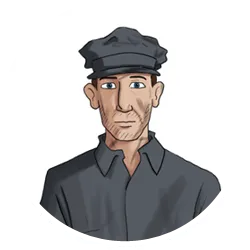
Frederick Davies was born in Liverpool, Lancashire, England, on 14th June 1895, the son of Nathan and Lucretia Davies (née Allen). According to his family, his father was a Jewish Latvian immigrant and had changed his name to Nathan Davies on the journey to England. The family home was at 2, Scotland Road, Liverpool, Lancashire, where his parents ran a men's outfitting shop. Nathan Davies left Liverpool for America when Frederick was aged about six years and was later reputedly killed in the San Francisco earthquake of 1908.
After attending Granby Street School, in Toxteth, Liverpool, Frederick decided not to enter the family business but instead go to sea. It is possible that he served a spell in the Royal Navy because when war broke out, he was classified as belonging to the Mercantile Fleet Auxiliary.
His first wartime sailing was as a trimmer on board the White Star Liner Teutonic and he also served on the Laconia and the Alsatian, before joining the Lusitania for the first time in March 1915. Following a trip on the Armora, he joined the Lusitania again on the 17th April 1915, for what would be her final voyage. His monthly rate of pay as a trimmer, was £6-0s.-0d., and he had £1-0s-0d, of this advanced to him when he engaged.
Three weeks later, with the liner six days out of New York on her return home and only hours away from her Liverpool destination, Frederick Davies was on duty in the stokehold No. 3, forward of No. 1 Boiler Room, when the torpedo struck. At first no water entered where he was, but he was not able to escape from the normal exit door as he found that the watertight doors had been shut almost immediately when the liner had been struck. Returning to the stokehold, he found water pouring through the loading apertures in the bunkers, as the ship began to list.
Eventually, he managed to find an escape ladder through a ventilating shaft and forcing open a grill, he and Fireman Thomas Madden managed to escape through the ventilator to the boat deck. They were the only two survivors from No. 1 Boiler Room.
Realising that the ship was sinking rapidly, Trimmer Davies then jumped into the sea and was injured in the left hip by the imploding of one of the boilers, as the sea rushed down the funnels. Despite his injury, as he was a strong swimmer, he managed to make for a raft already full of people. Realising that the raft was in danger of capsizing, however, he swam away from it and reached a floating locker which supported him until his eventual rescue.
Having been landed at Queenstown, he then got back to Liverpool, where he was officially paid off from the liner’s last voyage and given the balance of wages owing to him, which amounted to £4-14s.-8d. (£4.73p). This was in respect of his sea service from the 17th April 1915 until the 8th May - 24 hours after the vessel had foundered!
Apart from the injury to his hip, he also suffered damage to his throat, through ingesting oil, and this latter would make him speak with a gruff voice for the rest of his life. Like all the other crew survivors, he was interviewed soon after the disaster by a Board of Trade official, but his deposition has not survived to the present day.
In 1957, however, he described his ordeal to Ian Severns, a features writer from local newspaper, The Liverpool Echo, and this was published in the edition of the newspaper for the 4th April of the same year. It stated: -
He was at work in No. 3 stokehold when U-20 struck, and as the lights went out he groped in a hell of inky blackness, groans, steam and utter bewilderment. Mr. Davies eventually climbed into a ventilator and fumbled up the long tilting ladder towards daylight far above. Strong, and 20 years old, he grasped his way back to the top, bent his strong back to the grating and forced it off, saving himself and the others blindly following him, a chance to live. So came the black squad to the deck.
Frederick Davies was not quite 20 years old - his twentieth birthday would not be until the following month, and the black squad was the nickname given to engine room trimmers, firemen, and greasers. The account continued: -
“I had no lifebelt; from what I saw, most of the other exhausted stokers could not get them either. I did not even try to get into a boat and although ours was, I think, the roughest crowd of men I have ever sailed with, I saw very few of them getting into any boat while still on board.”
After he had deliberately refused to get into a boat, Mr. Davies waited for the ship to take him into the sea. ..... Instead of waiting to float to the surface again, he was propelled by an explosion, probably from the ripping boilers. “As I went down, I felt all my breath going, it was like a dream. The colour of the water changed. Then I shot up to the surface covered with grimy oil. Lusitania was gone.”
He dazedly scrambled into a boat so full, that people stood in it shoulder to shoulder - and he got out again and swam instead to a potato locker which, with its lid, gave him a cosy, buoyant nest. He sat in there, “king of the castle”, for half an hour, until picked up.
Despite his ordeal, he resumed sea service in August 1915 and continued to serve on Royal Naval and Mercantile Marine vessels until the war ended. After this, he served a brief spell in the Royal Navy on the training ship H.M.S. Ganges, from April to November 1919.
On the 12th November 1919, he married Gertrude Newton in a Registry Office in Liverpool, and then, on the 8th December 1919, they married again in St. Francis Xavier Catholic Church in Liverpool. The initially resided with Gertrude’s mother at 32. Rupert Hill, Liverpool, before they moved to 35, Rupert Hill. They had five children, Henry, Veronica, Eric, Joseph, and James, but Joseph died in infancy.
Frederick Davies continued to serve at sea - including active service in the Mediterranean Sea for two years, during the Second World War, - for the rest of his life. His last ship was the Mersey Dredger Leviathan, on which he was serving when ill health forced, what was for him, his early retirement, at the age of 65 years in 1960. He was still living at 35, Rupert Hill, Liverpool.
Not adapting easily to life ashore, he died on the 22nd February 1961 at Broadgreen Hospital, Liverpool, in his 66th year. He is buried in St. Swithen's churchyard, Croxteth, Liverpool. His wife, Gertrude, had died in 1953. Administration of his estate was granted to his daughter, Veronica Coulter, on the 22nd January 1962 at Liverpool and his effects amounted to £699-4s.-6d. (£699.22½p).
The family suffered further at the hands of Germany's U-Boat arm in the Second World War. On the 2nd July 1940, Henry, the eldest son, lost his life serving as a pantry boy on board the passenger ship Arandora Star when she was torpedoed and sunk by the German submarine, U.47, in the Atlantic Ocean, northwest of Ireland. Frederick Davies had also been due to sail on this ship, but at the last moment, he was transferred to another vessel. Henry was one month short of his nineteenth birthday when he was killed. His father had been one month short of his twentieth birthday when the Lusitania had been torpedoed and sunk, 25 years earlier!
Register or Births, Marriages and Deaths, Liverpool England Catholic Marriages 1754 – 1933, 1901 Census of England, 1921 Census of England, 1939 Register, Cunard Records, Commonwealth War Graves Commission, UK Campaign Medals Awarded to World War I Merchant Seamen 1914 – 1925, UK Campaign Medals Awarded to World War II Merchant Seamen 1939 – 1945, Liverpool Echo, Probate Records, PRO BT 100/345, PRO BT 350, PRO BT 351/1/33599, PRO BT 364, PRO BT 395/1/23072, Graham Maddocks, Veronica Coulter, Eric Davies, Lawrence Evans, Geoff Whitfield, Michael Poirier, Jim Kalafus, Cliff Barry, Paul Latimer, Norman Gray.
Copyright © Peter Kelly.
Revised & Updated –11th February 2023.