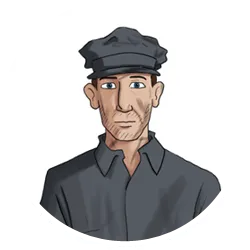
David Evans was born in Liverpool, Lancashire, England on the 28th July 1869, the son of Jonathan and Sarah Evans (née Jones). His father was a mariner, and as far as can be ascertained, David was an only child.
He followed his father to sea, working as a fireman and trimmer on ocean-going steam ships, and on the 30th December 1891, he married Annie Jones at St. Paul’s Church, Kirkdale, Liverpool. The couple lived with Annie’s parents at Oriel Road, Kirkdale, and as far as can be ascertained, they only had one child, a son named Robert.
In 1903, Annie Evans died, and on the 11th August 1908, he married Sarah Davies (née Melia), who was also widowed, and they lived with her children and widowed father at 7, Nevada Street, Bootle, Lancashire.
As a professional seaman in the Mercantile Marine, he engaged as a Leading Fireman in the Engineering Branch on board the Lusitania at Liverpool on the 12th April 1915, at a monthly rate of £7-10s.-0d., (£7.50p.), of which £1 was advanced to him upon engagement. He reported for duty at 8 a.m. on the 17th April for the liner’s last ever voyage out of the River Mersey.
He survived the sinking, three weeks later and on the 12th May 1915, after his return to Liverpool, he gave evidence on oath there, concerning the sinking, to an official of the Board of Trade. In this deposition he stated: -
On Friday 7th May shortly after 2 p.m. while on my 12 to 4 p.m. watch in the centre of No. 3 section stokehole, standing on the port side, I heard a big crash as if the vessel had struck a wreck. The stokehole became full of dust and the men cried out “They have got us at last”.
I immediately followed the men through the pass into the after stokehole of No. 3 section. I stood hesitating a few minutes being alone.
I went into No. 4 section and while turning to shut the door the water began to rush through. I succeeded in closing the door and jumped on the ladder close to and climbed to the fan flats on the port side and reached the firemen’s quarters. There I got a lifebelt and went through the firemen’s mess room and came out on C Deck on the port side. When in the act of putting the lifebelt on, it was snatched from me by a passenger. Although the vessel had a heavy list to starboard, word was passed that she would be all right.
I then climbed up the rails and over the fans onto the boat deck and being pushed by the crowd to the starboard side, reached either No. 15 or No. 16
boat. The boat was down by the front and I pushed my way to give a hand to heave it up. I jumped into the boat and helped several ladies on board. Another boat was being lowered, one fall slipped and everybody was thrown into the water.
I hung onto the boat and suddenly the ship and the boat sank. Afterwards I came to the surface and caught hold of a rope fastened to a collapsible boat which was floating right way up with a canvas cover over it. A trimmer, McKenna, who was on top of the canvas with a lady passenger helped me up. We then cut the cover off the boat and put the sides up and then began to pick up about 40 or 50 people who were in the water.
I afterwards helped to bale the water out of the boat using (a) water cask having first knocked the head in and after rowing about for some time, we were finally picked up by the steam trawler Indian Empire. I never saw the submarine at all.
There were three trimmers named McKenna on board the ship, Frank McKenna from Wallasey, Cheshire who survived the sinking and Bernard McKenna from Castlebellingham, County Louth and John McKenna from Liverpool, who were both killed. It is not known which one Leading Fireman Evans met on top of the collapsible boat.
Sometime after his return to Liverpool, Leading Fireman Evans was paid off from the liner’s final voyage and received the sum of £6-0s.-11d., (£6.04½p.), which was the balance of wages owing to him. In common with all the Lusitania’s crew members, irrespective of whether they died or survived, he was paid up to and until the 8th May, - 24 hours after the liner went down!
David Evans continued to reside at 7. Nevada Street for many years with his stepchildren after his second wife, Sarah, died in 1919. He eventually found a position as a fitter’s labourer with the Harland & Wolff engine and ship repairs workshop in Bootle, Liverpool.
Register of Births, Marriages and Deaths, Liverpool England Church of England Baptisms 1813 – 1919, Liverpool England Church of England Marriages and Banns 1754 – 1935, 1901 Census of England, 1911 Census of England, 1921 Census of England, Cunard Records, Liverpool England Crew Lists 1861 – 1919, PRO ADM 137/1058, PRO BT 351/1/42087, PRO BT 100/345, Graham Maddocks, Geoff Whitfield, Michael Poirier, Jim Kalafus, Cliff Barry, Paul Latimer, Norman Gray.
Copyright © Peter Kelly.
Revised & Updated – 7th November 2023.