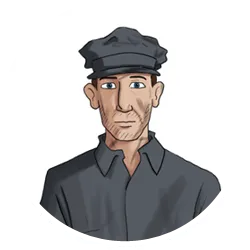
William Ewart Gladstone Jones was born in Liverpool, Lancashire, England, on the 6th February 1886, the son of William Alfred and Annie Jones (née Pugh). He was the second eldest of six children, and his father was the manager of a chemist shop. While he was a child, the family moved to West Kirby, on the Wirral Peninsula, Cheshire, where his father became well known and was given the nickname ‘Sand Lea Jones’.
On completing his schooling, William Jones took up an apprenticeship with Cammell Laird, the shipbuilding firm in Birkenhead, Cheshire, and on qualifying as an electrician he found employment as a ship’s electrician with the Cunard Steam Ship Company.
On the 10th February 1913, he married Olwyn Danvers Jones in Birkenhead, Cheshire. In 1915, they lived at Brookfield Cottage, Carpenters Lane, West Kirby, Cheshire, with their twin sons who were born in May 1913.
On the 12th April 1915, he engaged at Liverpool as Third Electrician in the Engineering Department on board the Lusitania, at a monthly rate of pay of £10. It was not his first engagement on the liner, and he reported for duty at 8 a.m. on the 17th April, as she left the River Mersey for the last time.
Three weeks later, he survived the sinking and after being landed at Queenstown, he managed to make his way back home. In an interview given to a reporter of The Birkenhead News and Advertiser on the 9th May, he gave his account of the sinking, which was published in the edition of the 12th May: -
He said that he went down with the ship. He felt the shock but was told of what had actually happened by another young fellow with whom he swam about for some time but of whom he lost sight having been several minutes in the water.
He was keeping afloat with the utmost difficulty, when he felt something tugging at one of his legs. He looked round and saw that a woman was clinging to him. She appeared to be unconscious but was holding him in a death-like grip. He struggled hard to free himself and whether intentionally or not, he cannot say, but a moment later, she hit him across the bridge of the nose with a piece of wood to which she was clinging.
Half exhausted, it took him some time to recover from the blow, and so far as he can recollect he was picked up about half an hour later, by a boat in which several survivors were huddled together the majority of them dead-beat or half-unconscious.
Being one of the first to recover, he was put in charge of one of the boats with which they came up and after having rowed about for some hours, he put into Queenstown with a boatful of passengers. Some hours later he joined his wife and father in West Kirby, tired and badly bruised, but still a husband and father living.
When his wife first heard the news of the sinking, she was naturally frantic with worry until she received a telegram on the morning of Saturday, the 8th May, sent by her husband from Queenstown, which simply stated: -
Coming Home.
A different version of Third Electrician Jones’ survival was given in The Last Voyage of the Lusitania, by A.A. and M. Hoehling, published in 1956. In their book, they wrote: -
W.E.G. Jones, third electrician of the lost Cunarder, a man who never swum in his life, had clung to wooden debris until he saw a large box floating towards him. It turned out to be one of the sturdy wooden lockers kept on deck for storage of lifebelts. He struggled aboard it, was surprised to find a lady already inside, sitting rather placidly, with water sloshing up to her waist.
“Is there room for one more?” he recalled asking. The two sat there, side by side, cold and wet, until they bobbed alongside of the Stormcock.
The Stormcock was H.M.S. Stormcock, a Royal Naval tug, which was reputed to have rescued over 160 people from the sea. This version of Jones’ story conflicts somewhat with the account published in The Birkenhead News and Advertiser, just after the sinking.
Eventually, Third Electrician Jones was officially discharged from the Lusitania’s final voyage and given £8-1s.-6d. (£8.07½p.), which was the balance of wages owing to him in respect of his sea service from the 17th April until the 8th May, 24 hours after the ship foundered.
William Jones continued to serve as an electrician in the Mercantile Marine for many years after his ordeal.
William and Olwen Jones had two more children, a daughter and a son, and later lived at 23. Banks Road, and then 65. Westbourne Road, West Kirby.
William Jones died in hospital in Birkenhead, Cheshire, on the 21st September 1956, aged 70 years. At the time of his death, he was residing at 5. Ludlow Court, West Kirby, Cheshire.
Register of Births, Marriages and Deaths, 1891 Census of England, 1901 Census of England, 1911 Census of England, 1921 Census of England, 1939 Register, Cunard Records, Birkenhead News, (photo 12/05/1915, p.2 c.4 ), Liverpool Daily Post, Liverpool Echo, Last Voyage of the Lusitania, PRO BT 100/345, PRO BT 350, PRO BT 351/1/73703, Graham Maddocks, Geoff Whitfield, Michael Poirier, Jim Kalafus, Cliff Barry, Paul Latimer, Norman Gray.
Copyright © Peter Kelly.
Revised & Updated – 31st January 2024.