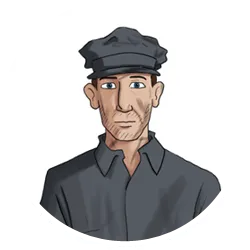
Andrew McKinley was born in Little Neston, Cheshire, England, on the 6th October 1880, the son of Owen and Ellen McKinley (née McCumiskey). His father was a farm labourer, and Andrew was the middle child of the five children in the family.
Both of his parents had been born in County Armagh, Ireland, and after the birth of their first child, Bridget, in Newry, County Down, Ireland, the family moved to Neston, Cheshire, England, where Andrew, his older brother, Stephen, and his sister, Margaret, were born. The family returned to Newry, County Down, in 1884 or 1885, where his youngest sister, Mary Ann, was born in 1885.
In February 1889, his father died, leaving his mother to support the family on her own until Andrew and his siblings came of age to be able to work. On completing their education, Stephen and Andrew became general labourers, while Bridget, Margaret and Mary Ann worked as spinners in a local linen factory.
In March 1899, he enlisted in the 6th Battalion of the Royal Irish Rifles, and although he was deemed medically unfit to be a full-time soldier, he did remain with the 4th Battalion of the regiment as a part-time militiaman until 1909.
By 1915, Andrew McKinley was working as a labourer with Messrs. Joseph Fisher & Sons, Newry, who were coal and timber brokers and owned their own cargo ships, and is likely that he worked as a trimmer and firemen on their vessels.
He decided to make some money by working as a trimmer on a number of trans-Atlantic steamship crossings before settling in the United States of America, and thus engaged as a trimmer in the Engineering Department on board the Lusitania on the 12th April 1915 at Liverpool at a monthly wage of £6-0s.-0d., and joined the liner on the early morning of the 17th April 1915 in time for her last ever sailing out of the River Mersey. It was to be his first trans-Atlantic crossing.
Three weeks later, after the liner was torpedoed on her return voyage to Liverpool, he was fortunate to be counted amongst the survivors and eventually landed at Queenstown.
Following his return to Newry, he was interviewed by a correspondent from the Belfast News Letter newspaper at the home of his mother. The correspondent erroneously referred to him as ‘M’Kendry’, and his account was published in the edition of the 11th May 1915: -
Interviewed at his mother’s house yesterday. M’Kendry (sic.) was reluctant to talk of his experiences. It was his first trip on the ship. Previously he had been working in the timber yard of Messrs. Joseph Fisher & Sons, Newry, but he shipped on board the Lusitania on her last voyage from Liverpool, intending to make a few round trips before settling in the United States. Of the run to New York he had little to say. Everything went with humdrum exactness until they neared the Irish coast. Three other Newry men were on the ship, but the fate of any but M’Kenna (sic.), M’Kendry (sic.) is totally ignorant. M’Kenna (sic.) was in the stokehold when the vessel was torpedoed, and how he got on deck in time M’Kendry (sic.) is unable to comprehend. He himself was lying in bed at the time the ship was struck,
and all at once there was great excitement on board. Discipline was, however, quickly in force, and passengers and crew alike maintained a wonderful calmness. Boats were lowered and lifebelts served out, as it was seen that the ship was done for. He does not know how he escaped, but he found himself in the water in a short time, and owed his life to the fact that he learned to swim at the Track Line in Newry when a boy. After swimming about for some time he seized some wreckage, which kept him afloat until he got into a collapsible boat, already full of survivors. They were afterwards taken on board the tug Frying (sic.) Fish, and landed at Queenstown. M’Kendry (sic.), who left last night for Liverpool, added that a number of men from Adavoyle and Dundalk were included in the crew.
‘M’Kenna’ was Fireman Patrick McKenna from Newry, who like Andrew McKinley, survived, and the other two crew members were trimmers Patrick Loughran and Michael McGuigan, both of whom were lost. The tug that picked up Andrew McKinley was the Flying Fish!
Andrew McKinley also stated that he visited the temporary morgues in Queenstown to view the dead and try to identify some of his ship mates.
Nothing further is known about this crew member.
According to the list of crew members who signed on for the final voyage of the Lusitania, this man is identified as Andrew McKinley; however, in various newspaper reports he has been described as ‘McKendry’ and ‘McKindrey’.
Register of Births, Marriages and Deaths, Cheshire Non-Conformist & Roman Catholic Registers (Baptism) 17th Century - 1910, 1881 Census of England, 1901 Census of Ireland, 1911 Census of Ireland, 1921 Census of England, Cunard Records, Scotland Ireland Wales Military Attestation Papers 1800 – 1915, Belfast News Letter, Newry Journal, Newry Memoirs, PRO BT 100/345, Graham Maddocks, Geoff Whitfield, Michael Poirier, Jim Kalafus, Cliff Barry, Paul Latimer, Norman Gray.
Copyright © Peter Kelly.
Revised & Updated – 3rd January 2025.