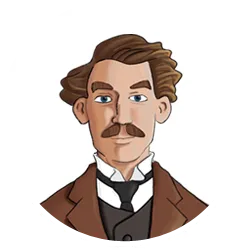
Charles Frohman was born in Sandusky, Erie County, Ohio, in the United States of America, on the 15th July 1856, the son of Henry and Barbara Frohman (née Strauss). He was one of seven children. At the time of Charles’ birth, his father owned, or managed, a saloon in Sandusky.
When Charles was aged 14 years, the family moved to New York. Within a short time, young Charles got a job as a night clerk with the
New York Graphic. In 1876, the Graphic sent him to Philadelphia to sell the newspaper at the Centennial Exposition. Charles was in charge of all the newsboys the
Graphic sent to the event. Later, he moved to the New York Tribune, where he worked by day, and sold theatre tickets by night at Hooley’s Theatre in Brooklyn. After a year, he joined his eldest brother, Daniel, working in theatre management.
In 1880, Charles went to Boston for the opening night of the play, Shenandoah. He is reputed to have had only fifty cents in his possession, but by the end of the evening, he had secured the road rights for the play. . He progressed from clerk to manager of a small theatre and then became manager of a troupe of minstrels; bringing them to London, England in 1885. Thus began a long association with that city.
In 1890, he formed the Charles Frohman Company, and by 1893, he had built The Empire Theatre in New York, (having inaugurated The Empire Theatre Stock Company the previous year) and his main offices were situated at the rear of the building’s fifth floor. He counted amongst his principle players, such stars of the time as Ethel Barrymore, John Drew, Nat Goodwin, and Enda May, to name just a few. In 1897, he acquired the lease of The Duke of York Theatre in London where he presented many plays by leading British dramatists. He became known as The Napoleon of Drama – perhaps because of his physical appearance - and had made his home at The Knickerbocker Hotel, in New York City
By the time of his death, he had an interest in five other leading London theatres and had managed many of the leading actors and actresses of the day, including Maude Adams, Ethel Barrymore and Julia Marlowe.
At the time of his death, The Times said of him: -
He was probably the most successful theatrical manager ever known, as he was the first to carry out the idea of turning theatrical management into a gigantic business.
In fact, most of the plays which he put on in America were obtained in Europe and for many years, he moved English drama and actors back and forth across the Atlantic. Three of his most successful and best known plays were J.M. Barrie’s
The Admirable Crichton, Peter Pan and What Every Woman Knows. In fact, in 1905, Frohman had bought the rights to
Peter Pan, when other promoters would not even consider it. He cast Maude Adams in the title role, and made history. The play made a fortune for Frohman, Adams, and of course, Barrie. In 1910, he formed a repertory company at the Duke of York Theatre.
Frohman lived a very private life, and encouraged his actors and actresses to do likewise. He was well known for his love of sweet things, especially candies, but rarely dined in the fashionable restaurants. He suffered a bad fall in 1912, which resulted in very painful arthritis. As a result, he took to using a cane, which he called his “wife”! At times, due to being in such pain from his arthritis, he was almost an invalid, and on these occasions, actors would come to his apartment in The Knickerbocker Hotel, and tend to his needs.
Once the Great War had broken out in 1914, Charles Frohman saw no reason why he should let it interfere with his work and being used to making frequent trans-Atlantic trips, he was determined not to be put off by the possibility of danger from U-Boat activity. By 1915, he had produced more than 700 shows, and was employing around 700 actors every season!
As a result, he decided to travel to London, again, on what proved to be his and the
Lusitania’s last voyage and consequently booked saloon passage for himself and his British valet, William Stainton, on the liner which left Pier 54 just after mid-day on 1st May 1915. When they boarded, he was allocated room B75, which was the personal responsibility of First Class Bedroom Steward James Collins who came from Formby near Liverpool, Lancashire. William Stainton was allocated room B61 not far away from his employer. It was rumoured that a short time prior to his departure, he had married Maude Adams.
After the liner was torpedoed, by the German submarine U-20, six days out of New York and only hours away from her Liverpool destination, on the afternoon of 7th May, both Charles Frohman and his valet William Stainton were killed! Frohman was aged 58 years and Stainton, 38 years.
According to The Newcastle Daily Chronicle for 11th May 1915: -
Rita Golivil (who was presumably Rita Jolivet) a survivor of the Lusitania at Kingstown, said her 'brother-in-law’, Mr. Charles Frohman, and she were in the saloon when the explosion occurred. They decided not to go to the boats. Mr. Frohman's last words were "Why fear death? It is the most beautiful adventure in life". The waves dashed them away.
His body, like that of his valet, was recovered from the sea soon afterwards and was landed at Queenstown, where it was initially given the reference number 24 in the temporary mortuary set up in the yard of the Cunard office at Lynch‘s Quay. Once it had been positively identified, however, it was put in the charge of the American Consul, Mr. Wesley Frost, before being handed over to his secretary who had arrived from London especially for the purpose. Having been embalmed, it was then sent to Liverpool, and eventually shipped to New York, on the Hamburg-Amerika Liner City of New York, arriving there on 24th May 1915.
The following day, a private funeral service was conducted at the home of his brother Daniel at 145, West Seventy Ninth Street, followed by a public one at the Temple Emmanu-El, on 5th Avenue and 43rd Street, which was officiated over by The Reverend Doctor Silverman. Fifth Avenue was almost totally blocked by the crowds of mourners who turned out for his funeral. The procession was led by many members of the acting procession and on his coffin was a single bouquet of violets from Maude Adams - who was certainly Charles Frohman’s close friend and many thought he had secretly married!
He was buried in The Union Field Cemetery, Queens, Queens County, New York, where his remains lie to this day. His simple headstone belies his status in life and consists of a black marble panel set into a rectangular white stone block. The simple inscription on the marble states simply: -
CHARLES FROHMAN
BORN
JULY 16, 1860
DIED
MAY 7, 1915
The day and year of his birth are incorrect on the inscription!
Bedroom Steward Collins, who looked after the impresario in Room B75, survived the disaster and eventually got back to his Formby home.
Administration of Charles Frohman’s English will was granted on 1st July 1916 at London, to William Lestocq, Theatrical Manager and the attorney of Daniel Frohman. His effects amounted to £5,804-0s-6d, (£5,804.2½p). Property presumably recovered from his body, was later handed over to Mr. Lewis C. Thompson, The American Vice-Consul at Queenstown at the American Consulate there.
Despite the fact that Charles Frohman never made a will, his eldest brother, Daniel, was appointed as one of two people to administer his estate. A corporation designated Charles Frohman Inc. was formed to manage his goods, chattels, and goodwill, and shares were issued with the administrator holding one-half of the stock, and the remainder being divided equally between his two brothers and four sisters. The entire stock was later sold to the Famous Players-Lasky Corporation.
His brothers and sisters, Daniel, born in 1852, Caryl, born in 1853, Gustave, born in 1855, Emma, born in 1857, Mrs. Rachel Frohman Davison, born in 1859, and Etta, born in 1865, filed a claim for compensation after the war which was adjudicated by the Mixed Claims Commission. By the time their decision was finalized, Caryl Frohman had died. Her death having taken place on 18th January 1924. Being unmarried, she had lived in New York with her other unmarried sisters, Emma and Etta, in a house provided for them by Daniel Frohman.
The Mixed Claims Commission decided that as none of the claimants were financially dependant on Charles Frohman, none were entitled to compensation, and therefore no award was made.
Charles Frohman is also commemorated in England at Marlow-on-Thames, Buckinghamshire, near the river bridge there, on a stone memorial which was originally a drinking fountain. On top of this sits a nude female on a pedestal and over the trough is inscribed: -
IN HAPPY
MEMORY OF
CHARLES FROHMAN
BORN 1860 DIED 1915
The memorial was erected at the instigation of Miss Pauline Chase, an American actress who had taken the lead in Frohman's production of
Peter Pan. It is thought that the nude figure may well have been Miss Chase herself. A further inscription states: -
FOR IT IS NOT RIGHT THAT IN A HOUSE
THE MUSES HAUNT, MORNING SHOULD DWELL;
SUCH THINGS BEFIT US NOT
Two tales of the supernatural concerning Charles Frohman exist, and were reported in a 1990 edition of
The Titanic Commutator, the official journal of The Titanic Historical Society. The first stated: -
Like several other Lusitania passengers, Charles Frohman received a number of mysterious messages warning him not to sail on that vessel. These messages did not deter him, though, for America was not yet in the war and besides, there were a couple of plays in England he wanted to see. Frohman’s entire staff, including “Big John” Ryland went to the pier to see Frohman off when he sailed on May 1st.
It was John Ryland’s nightly duty to inspect the offices over the theater after they had been cleared for the day. He usually did this during the first act of whatever play was being presented on stage. On the night of May 7th, Big John was making his rounds of the offices over the theater, checking doors and making sure that everything was all right. All seemed normal until he approached Mr. Frohman’s private office at the rear of the fifth floor. As Rylands opened the door to the darkened office he received the surprise of his life.
There at the desk, illuminated only by the desk lamp, sat Charles Frohman. His desk was covered with books of press clippings, set designs, pictures of stars and other memorabilia of a life connected with the stage. Mr. Frohman looked up as John Ryland opened the door. “I thought you were almost in Europe by this time, sir,” stammered Ryland. “No John,” replied Frohman with a smile, shaking his head. “You can’t help me John. Just leave me alone for a few minutes. Thanks, and goodbye.
Big John Ryland closed the door to the office and immediately took the elevator down to the lobby. He approached a group of theater employees - the house manager, two box office boys, a press agent and Peter Mason, Frohman’s office boy. Ryland excitedly told these people that Charles Frohman had returned unexpectedly and that he was upstairs in his office. The man laughed at Ryland, refusing to believe him, but they finally agreed to accompany him back to the fifth floor.
When John Ryland again unlocked Mr. Frohman’s office, he was met by only darkness. Switching on the overhead light, the men saw that Mt. Frohman’s desk was clean and neat, just as their employer had left it. All the press books, photos, and other materials were in their proper files. Now the men really laughed at Ryland, although a couple of them were disturbed by their friend’s obvious sincerity and insistence at what he had seen.
The next morning’s newspapers carried the story of the sinking of the Lusitania. Charles Frohman’s name was among those of the lost.
John Ryland continued to work at that Empire Theatre for another twenty-odd years, eventually becoming the overseer of the building’s maintenance staff. Ryland had a certain idiosyncrasy, though, which was well known to fellow workers. Although he could sometimes be persuaded to go to the fifth floor if someone accompanied him, Ryland would not go up there after the sun went down, and he would never go into the offices at the rear of the fifth floor whether anyone accompanied him or not.
The second involved a lady named Joan Grant who regarded herself as a “sensitive” with the ability to “see” the departed spirits of the dead, and who, with her husband Charles was dining at the grill room of The Savoy Hotel in London, towards the end of the Second World War, in 1944.
Having been shown to an empty table, and seated with her back to a square pillar, Mrs. Grant became disturbed because she sensed the presence of a disembodied spirit in the chair.
The Titanic Commutator continued the story: -
Charles Grant pointed out to his wife that there were no other tables available, suggesting that she try and ignore the spirit. Joan was unable to do this, however. She told her husband that the spirit was male and that he had been dead for twenty or thirty years. She sensed too that he was somehow bound to the earthly plane because he had forgotten his real friends. And so the spirit sat by himself in a chair while the years passed, and life flowed on in the restaurant around him.
Joan Grant then decided to help the lone spirit and: -
..... offered thoughts of affection and kindness to the ghost until his loneliness was dissipated.
Several departed friends of the spirit apparently then appeared and helped him to leave his earthly prison! The report concluded: -
After the Grants had finished their dinner and arose to leave, Joan noticed a small brass plaque affixed to the column behind her chair. It read: -
“This Table was Regularly Used by Charles Frohman for Many Years up to 1915.”
Frohman had been a regular customer of The Savoy Hotel for many years before his death on the
Lusitania and he usually sat in the same place in the same chair, often discussing designs for theatrical sets with the famous writer of children’s books, J.M. Barrie, whose plays Frohman featured in his theatres both in America and Great Britain.
On the seventh anniversary of his death, some of his friends held a special dinner in The Savoy and the following day, 8th May 1922, London newspaper,
The Evening Standard ran a report on it, which stated: -
A wonderful tribute to the memory of the late Charles Frohman, one of the many victims of German frightfulness in the Lusitania, was paid at the Savoy last night, when a number of his friends and fellow workers dined together and toasted his great genius.
Earlier in the day, a great wreath of American Beauty roses was placed on the chair in the Savoy grill-room which Mr. Frohman occupied when in London, and where he carried through some of his most famous theatrical deals.
Speeches were made last night bearing on Frohman’s great efforts to promote the Anglo-American entente, to which he devoted not only much time, but money. “His death in the Lusitania,” said one friend “helped to give life to Anglo-American friendship.”
The wreath bore the inscription, in hand written gothic lettering: -
to the Memory of
Charles Frohman
placed here in his old seat
by a few
British and American friends
Why fear death? Death is only a beautiful adventure
7. 5. 1922 Charles Frohman
The latter quotation was from Frohman himself and was a variation of his last known words.
The brass plaque fixed to the pillar behind the chair was certainly still there in the 1960s and although it is not there today, it was probably removed when the grill room underwent a major refurbishment programme between March 1974 and October 1975.
Ohio Births and Christenings 1774 – 1973, 1860 U.S. Federal Census, 1870 U.S. Federal Census, 1880 U.S. Federal Census, U.S. Passport Applications 1795 – 1925, New York Passenger Lists 1820 – 1957, Cunard Records, Mixed Claims Commission Docket No. 420, Probate Records, British Maritime Memorials, Find A Grave, New York Times, Evening Standard, The Times, Lusitania, Saga and Myth, The Savoy: A Century of Taste -, Savoy Group, Titanic Commutator, UniLiv. PR13/6, PRO BT 100/345, Deaths at Sea 1871 – 1968, Graham Maddocks, David Irving, Susan Scott, Geoff Whitfield, Michael Poirier, Jim Kalafus, Cliff Barry, Paul Latimer, Norman Gray.
Copyright © Peter Kelly.