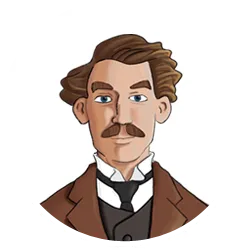
Arthur Thomas Mathews was born in Montreal, Quebec, Canada, on the 5th August 1876, the son of Richard George and Sarah Mathews (née Ahern). His father was a cabinet maker, and his parents had immigrated to Canada from Ireland.
On the 17th August 1901, he married Amy Henderson Stephenson in Montreal, and the couple had at least two children. By 1915, Arthur was a buyer for the Redmond Company, Montreal, manufacturers of paint.
In the course of his business, he travelled regularly to Europe, and in the spring of 1915, he was scheduled to make such a trip, and decided to take the May sailing of the Lusitania across the Atlantic from New York to Liverpool.
Having booked saloon passage through agents W. H. Henry of Montreal, he left that city at the end of April, and arrived at the Cunard berth at Pier 54 in New York on the morning of 1st May 1915, in time for the liner’s scheduled 10 o’clock departure. Having boarded with ticket number 13168, he was escorted to his accommodation in room B94, which was in the care of First Class Bedroom Steward Percy Penny who came from Aigburth, on the outskirts of Liverpool.
He then had to wait until just after mid-day for the liner to leave the port, as she had to embark passengers, crew and cargo from Anchor Lines ship the S.S. Cameronia, which the British Admiralty had requisitioned for war service as a troop ship, at the end of April. On the afternoon of 7th May, the Lusitania was torpedoed and sunk by the German submarine U-20, off The Old Head of Kinsale in southern Ireland and only about 250 miles away from the safety of her home port.
Arthur Mathews was one of the lucky third of all the saloon passengers who managed to survive this action and having been rescued from the sea, he was landed at Queenstown, from where he eventually made it to his mainland destination.
On reaching London, Arthur Mathews gave an interview which was syndicated to a number of Canadian newspapers, including The Province of Vancouver, British Columbia, who published his account in their edition of the 11th May 1915: -
“I was one of four Montrealers sitting in the dining saloon of the Lusitania just after luncheon on Friday. The others were Duncan Stewart and Lionel Taylor, and Emond of Quebec was with us. So far as the list yet published shows, Stewart and Emond are still missing. Suddenly there was a load report like a terrible explosion as if directly underneath the saloon. The boat immediately took a considerable list to the port side. The china and glassware on the tables sprang off and the boat trembled from bow to stern. We and the other passengers immediately left the saloon. There was no panic. No rush even was made upstairs to the deck. I have crossed the Atlantic many times, but I never before tried on a lifebelt. Curiously enough, however, last Thursday night I fitted on one, though it was not the lifebelt that saved my life.
The passengers mentioned by him were Richard Lionel Taylor, who like Arthur Mathews, survived, and Duncan Stewart and Walter Emond, both of whom lost their lives. Also, Arthur Mathews was mistaken in saying that the boat listed to the port side, as it is known it listed to starboard. His account continues: -
Boat’s Heavy List.
“We had the greatest difficulty in reaching Deck B, where my stateroom was, because of the heavy list of the boat. It was practically at an angle of 45 degrees, I and Emond entered another stateroom and each put on a lifebelt. We then rushed upstairs to the ship’s deck, climbing to the topside of the heavily listed ship. Most of the people had gone to the lower side, where the boats were being launched. There were few people there on our topside and a boat was being lowered with only twenty people in. I jumped, but Emond hesitated and did not jump. The boat had been lowered about six feet further when the ropes jammed in the davits, the boat capsized and everybody was thrown into the water, probably fifty feet below. My first feeling was that I was surrounded by a terrible volume of water. Then I felt myself shot up. I shoved away and soon found a considerable distance between myself and the ship. Ten feet away, was floating a large board like the seat of a lifeboat. I can not swim, but by moving my hands in the water I got near enough to grab the board. Looking around, I saw the Lusitania sinking at the bow with a very great list. I saw people dashing around on the decks seemingly afraid to jump. At the next look I saw the keel of the ship standing up and the propellers high in the air almost vertical. She then took a final plunge, sliding rather than diving. This was probably about 15 minutes after the torpedo struck.
Picked Up.
“By this time I had become conscious of the extreme coldness of my limbs, and remembered that the previous day I had placed a small flask of brandy in my hip pocket. I now drank a little, but my fingers were so numb the flask slipped into the sea. I seemed then to drift away from the others. In the water I saw an old gentleman, almost at his last gasp. I could dimly discern a lifeboat in the distance, and called out but with no result. I called again and again. At last a lifeboat came and picked up both of us. Happily I left him, still alive on the Queenstown pier. I must have been in the water an hour altogether. The officer in charge of the lifeboat was the chief dining room steward. There were twenty-five people in the boat, women, children and also men, mostly second-class and steerage passengers. After half an hour’s rowing, a steam trawler took us to Queenstown, which we reached at 9 o’clock, seven hours after the accident. I was bruised about the body, but was otherwise unhurt. From Queenstown and Holyhead, I went to visit my brother, R.G. Mathews, the artist, at his summer residence at Caterham, thus escaping the horrors of Queenstown, which has become a huge morgue now. I feel little the worse for my experiences. So far as I saw, the first class
passengers kept wonderfully calm and collected, but the second-class showed signs of the awful shock.”
Bedroom Steward Percy Penny also survived the sinking and in due course, similarly made it back to his home.
Arthur Mathews stayed with his brother, Richard George Mathews, the famous artist, at Caterham, Surrey, which was his brother’s summer residence. Having recovered from his ordeal, and conducted his business, he returned to Canada when he boarded the St. Louis at Liverpool on the 7th June.
On his return to Canada, he filed a claim with the Canadian Commission, seeking compensation for the loss of his personal possessions, and injuries he suffered, in the sinking. Contrary to the interview he gave to the newspapers, he claimed that his health was serious impaired as a result of his lengthy immersion in the water, and he had suffered irreparable damage to his nervous system, which was supported by medical evidence. In December 1926, he was awarded $5,785 in compensation for the damage to his health and medical expenses, and a further $408.25 for the loss of his personal effects.
Arthur Mathews died in Montreal on the 17th February 1949, aged 72 years, and his remains interred in Cimetière Mont-Royal, Outremont, Montreal.
Arthur Mathews’ name appeared on the passenger manifest as Matthews, but the correct spelling of his family name was Mathews.
Quebec Canada Vital and Church Records (Drouin Collection) 1621 – 1968, 1881 Census of Canada, 1891 Census of Canada, 1901 Census of Canada, 1911 Census of Canada, 1921 Census of Canada, New York Passenger Lists 1820 – 1957, Canadian Passenger Lists 1865 – 1935, Cunard Records, Canadian Claims Case No. 878, The Province, PRO 22/71, Graham Maddocks, Geoff Whitfield, Michael Poirier, Jim Kalafus, Cliff Barry, Paul Latimer, Norman Gray.
Copyright © Peter Kelly.