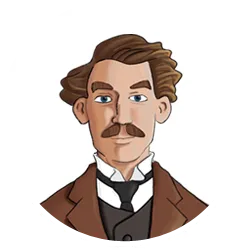
Leonard Leathes McMurray was born in Toronto, Ontario, Canada, on the 1st February 1867, the son of James Saurin and Elizabeth McMurray (née Fuller). His father was a barrister, and Leonard was the eldest of six children in the family.
He was a very successful businessman, starting his working life as a bank clerk, before becoming an export manager for The Gutta Percha Rubber Company of Toronto, Ontario, Canada. On the 19th April 1904, he married Euphemia Elizabeth Smith in Ontario, and their home was at 311, Jarvis Street.
In late January 1909, the couple boarded the White Star Lines, Republic, in New York harbour, bound for Gibraltar and other Mediterranean ports on a pleasure cruise. Early on the morning of the 23rd January, while steaming in fog off Nantucket Island, Massachusetts, the Republic was struck on her port side by the Florida, and sank 39 hours later, but not before the passengers and crew were transferred to other vessels that had come to assist both liners. Miraculously, only six people died as a result of the collision – three on each vessel. The McMurray’s were not injured in the incident; however, they lost all the personal effects that they had on board.
In April 1912, their first child, Elizabeth Smith McMurray, was born in Toronto; however, she died four days later.
Both Leonard and his wife were frequent travellers on liners, Leonard more so than his wife as a result of his employment, and he made frequent business trips to Europe.
At the end of April 1915, Mr. McMurray left Toronto by rail for New York City, en route for business dealings in London. He arrived in time to join the Lusitania at Pier 54 on 1st May and with ticket No. 10860, he was allocated room B69, which was under the personal supervision of First Class Bedroom Steward Walter Wood, who came from Seaforth, a dock area on the outskirts of Liverpool.
Six days later, after the liner was torpedoed and sunk, Leonard McMurray found himself in the sea. However, it would seem that he managed to get inside a lifebelt before the vessel went down, which supported him in the sea, for according to A.A. and M. Hoehling in their book The Last Voyage of the Lusitania, fellow saloon passengers J.H. Brooks and C.E. Lauriat had managed to get into an abandoned collapsible lifeboat and the Hoehlings recounted: -
Shortly the sail of a fishing vessel appeared dead ahead. Just then they came abreast of a man swimming all by himself. "I'm off on my own," he explained, politely refusing a lift.
Yet the boat had not pulled ahead many yards before the man changed his mind and yelled. Around him was one of the Lusitania's few big round white lifebuoys, which could have protected him almost indefinitely sinking, but the chill had become too much to endure. L. McMurray, of Toronto, as he introduced himself, was blue when pulled aboard the collapsible.
Fellow saloon passenger survivor, Laura Ryerson, must have seen Leonard McMurray shortly after this, for she later recounted after her rescue: -
I am a good swimmer and although there was a good crowd struggling together I got clear and came up against a raft on which were Leonard McMurray and Mr. Lockhart of Toronto. The raft was sinking with so many on it, so I and others swam to a lifeboat floating near and got into it.
The Hoehling account continued: -
..... Soon McMurray thawed sufficiently to lend a hand with the oars as they pushed towards the fishing smack.
The fishing smack was the Manx vessel, The Peel 12, which soon became overcrowded with the many survivors and some of them were transferred to the Queenstown harbour tender, The Flying Fish, or the Royal Naval tug, H.M.S. Stormcock, from which they were landed at Queenstown. Once there, Leonard McMurray was able to cable his firm in Toronto to say that he was safe!
Fellow saloon passenger and Toronto resident, Reginald Lockhart, whom Laura Ryerson saw with Leonard McMurray on the collapsible lifeboat, also survived, as did Bedroom Steward Walter Wood, who had looked after McMurray in room B69.
Sometime after the disaster, a wallet, containing letter of credit in favour of Leonard McMurray and presumably his property, was discovered in the sea, or at the water’s
edge and handed into the Cunard office at Queenstown. On 12th June 1915, it was sent to him at 4, Queen Victoria Street, London, where he was presumably staying at that time.
Leonard McMurray remained in England until the 26th October 1915, when he boarded the Nieuw Amsterdam at Falmouth, and after an uneventful passage, he disembarked in New York City on the 4th November. From there, he travelled by rail to his home in Toronto.
He filed a claim with the Canadian Commission, seeking compensation for personal injuries and the loss of his personal effects. In his claim for $2,400 in compensation for personal injuries, he stated that he had jammed his ankle between a lifeboat and some wreckage, and as a result of this injury, he was unable to work for sixteen weeks and required medical treatment in Queenstown. He claimed $1,500 for the loss of his personal effects, and stated that he was carrying samples from his company worth $2,500. It would appear he was very honest in the evidence he submitted to the Commission, claiming to having recovered $1,000 from insurance he had on his baggage, and accident insurance of $2,290.20; however, the Commission awarded him full claim of $3,900.
Cunard records give Mr. McMurray’s forename as Louis, but all other sources show it to have been Leonard, which is correct; however, his younger brother, Louis Saurin McMurray was also employed by the Gutta Percha Rubber Company, which could have contributed to this confusion.
In their later years, Leonard and Euphemia McMurray resided at 62. Maple Avenue, Toronto. Leonard McMurray died on the 30th December 1949, aged 82 years. His wife had died on the 30th November 1946, and they are interred together in St. James’ Cemetery, Toronto.
Ontario Canada Deaths and Deaths Overseas 1869 – 1948, 1871 Census of Canada, 1881 Census of Canada, 1891 Census of Canada, 1901 Census of Canada, 1911 Census of Canada, 1921 Census of Canada, New York Passenger Lists 1820 – 1957, Canadian Passenger Lists 1865 – 1935, Cunard Records, Canadian Claims Case No. 779, Edmonton Journal, Last Voyage of the Lusitania, PRO BT 100/345, UniLiv D92/2/405, Graham Maddocks, Geoff Whitfield, Michael Poirier, Jim Kalafus, Cliff Barry, Paul Latimer, Norman Gray.
Copyright © Peter Kelly.