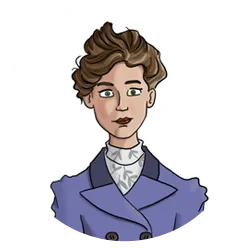
Laura Mary Ryerson was born in Toronto, Ontario, Canada, on the 14th March 1892, the daughter of Dr. George Ansel Sterling and Mary Amelia Ryerson (née Crowther). The family home was at 66. College Street, Toronto, Ontario, Canada. Her father was a physician, and Laura Ryerson four older brothers - George Crowther, Yoris Sterling, Eric Egerton, and Arthur Connaught.
Her father had founded the Canadian Red Cross in 1896, and in March 1915, he was sent to Europe to assess the needs of the Red Cross in Flanders. Accordingly, he sailed from New York on the Lusitania on April 3rd, arriving in Liverpool a week later.
By this time, her brothers, George and Arthur Ryerson, were serving in Flanders, serving as officers in the Canadian Expeditionary Force, and having arrived in London, their father learned of the furious battle near Ypres which had begun on 22nd April, in which the Germans had used poison gas for the first time. The line around Ypres had only held there, because of the heroism of the Canadians.
Unfortunately, he also learned bad news concerning his sons. Captain George Crowther Ryerson, of the 2nd Canadian Infantry Battalion, had been killed in action on 23rd April, and Lieutenant Arthur Connaught Ryerson had been severely wounded. As a result, he made haste across the Channel and found Arthur, with shrapnel wounds to the abdomen, in a military hospital in Boulogne, in France. It transpired that whilst taking ammunition to the front line, Arthur Ryerson, quite by chance, had come across the dead body of his brother by the roadside, and as he had been loading his brother’s body onto his empty ammunition limber, both he and his horse had been hit by a German shell burst!
Despite the fact that Arthur Ryerson was wounded whilst trying to recover the body of his brother George, Captain G.C. Ryerson’s body, could not be found and identified after the war and as a result, he is commemorated on the Menin Gate Memorial to the Missing of the Salient, at Ypres.
Once he had seen his wounded son safely onto a hospital ship bound for England, Dr. Ryerson cabled his wife in Toronto to come to England as quickly as she could, to comfort their son, and as he had crossed the Atlantic successfully on the Lusitania, he advised his wife to join that ship.
The next available sailing on the liner was on 1st May 1915, so at the end of April, Mrs. Ryerson, with her daughter Laura as a companion, set off from Toronto and joined the vessel at New York, in time for the sailing, which was delayed until just after mid-day. Once on board, (with ticket number 446106), the pair were allocated saloon room D55, which was under the personal supervision of First Class Bedroom Steward Edwin Huther, who came from Liverpool.
Six days later, when the liner was torpedoed and sunk, further tragedy hit the family for although Laura Ryerson was saved, her mother Mary perished. After her rescue, Laura Ryerson gave her account of the sinking: -
My mother and myself had finished lunch and were taking coffee when there was a jarring noise - not loud. Almost immediately, the ship began to list. We went to the upper deck but several boats could not be lowered because of the list of the ship. Mother and I got into the last boat which was lowered safely, but just then, the ship went down and our boat was overturned.
I am a good swimmer and although there was a good crowd struggling together I got clear and came up against a raft on which were Leonard McMurray and Mr. Lockhart of Toronto. The raft was sinking with so many on it, so I and others swam to a lifeboat floating near and got into it. There was a hole in one end, but by clinging to the other end we kept the hole out of the water. We were in the water up to our knees for three hours when we were picked up a destroyer and taken to Queenstown. The commander of the destroyer took me to his house, where I remained three days hoping to find mother.
Leonard McMurray and Mr. Lockhart of Toronto were in fact fellow saloon passengers Leonard McMurray and Reginald Lockhart, and both came from Toronto, as stated by Miss Ryerson. It is possible, also, that the broken lifeboat was under the command of crew member Boots George W. Maylor, as, in an article printed in the newspaper, The Liverpool Echo in 1957, Mr. Maylor stated: -
I swam round doing what I could before being picked up by a lifeboat. There were about 36 of us in it. They made me skipper.”
Here Mr. Maylor was overcome as he remembered having to turn swimmers away.
“It was no use taking them on board or we would all have gone down. I shall never know how that lifeboat kept afloat for the stern was completely smashed.”
Mary Ryerson's body was never recovered, although at first, Second Steward Robert Chisholm identified a body recovered from the sea and landed at Kinsale, County Cork, on the evening of the sinking as hers. Once he had realised his mistake, however, he retracted his identification.
George Ryerson senior, still on the Continent, did not hear of the sinking until the evening of May 8th and it was first reported that both his wife and his daughter had been killed. Having hurr
town to bring her to England.
When she arrived, she still had on the clothes she was wearing when the Lusitania sank. Some newspapers published after the sinking, also stated that she had been responsible for saving at least 36 people during her time spent in the damaged lifeboat! By the 5th June, Laura was staying at the Hotel Meurice, Rue de Rivoli, Paris.
Bedroom Steward Edwin Huther, who had looked after Laura Ryerson and her mother in room D55, also perished in the sinking.
Extraordinarily, sea tragedy was no stranger to the Ryerson family. In 1912, William Edwy Ryerson, one of Laura’s cousins, was serving on the White Star liner Titanic as a second class saloon steward when she hit an iceberg and sank in the North Atlantic on her maiden voyage on 15th April 1912, and only survived because he was ordered to row a lifeboat - Lifeboat No. 9 - away from the sinking ship. Another cousin, first class passenger Arthur Larned Ryerson was not so lucky, however, and perished when the liner sank, having first made sure that his wife, his son, his two daughters, their governess and the family maid had got into Lifeboat No. 4! They all survived.
Laura Ryerson, accompanied by her father, sailed on the Espagne from Bordeaux, France, to New York in early July 1915, and travelled by rail to their home in Toronto.
On the 22nd March 1919, Laura Ryerson married John Stupart Galbraith in Buffalo, New York. John Galbraith, a divorcee, who was an engineer in Toronto. The couple had three children – Mary, born in 1920, Laura Joan, born in 1921, and John Douglas Ryerson, born in 1924. The family resided at Peace Acre Farm, North York, Toronto.
Laura Mary Ryerson Galbraith died from heart disease on the 21st December 1943 in Toronto and was buried two days later in Mount Pleasant Cemetery in the city. She was aged 51 years. Her husband married for the third time in 1944.
Ontario Canada Births 1832 – 1914, New York State Marriage Index 1881 – 1967, Ontario Canada Deaths and Deaths Overseas 1869 – 1948, 1901 Census of Canada, 1921 Census of Canada, Canadian passenger Lists 1865 – 1935, Cunard Records, Liverpool Echo, Toronto Daily World, Windsor Star, PRO 22/71, PRO BT 100/345, UniLiv D92/2/370, Deaths at Sea 1871 – 1968, Graham Maddocks, James Maggs, Phyllis Ann Ryerse, Geoff Whitfield, Michael Poirier, Jim Kalafus, Cliff Barry, Paul Latimer, Norman Gray.
Copyright © Peter Kelly.