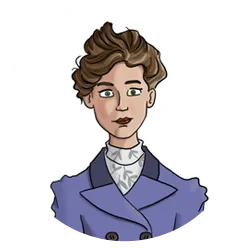
Frances Ramsay McIntosh was born in Montreal, Quebec, Canada, on the 27th January 1851, the daughter of Nicholas Carnegie and Margaret McIntosh (née Brown), and one of nine children. Her father was a cabinet maker, and on completing her education, Frances became a teacher.
On the 27th January 1878 – her 27th birthday, she married George Washington Stephens in Manhattan, New York City, in the United States of America. Her husband had been married to Frances’ older sister, Elizabeth, with whom he had two children, however: Elizabeth had died in 1876. Frances and her husband had four children – Elizabeth May, born in 1879, Francis Sumner and Marguerite Claire, twins born in 1882 - Francis dying in infancy, and Francis Chattan, born in 1887.
George Washington Stephens was a lawyer and was elected to Montreal City Council as a councillor on several occasions from 1868 to 1892. He was also elected as a Liberal candidate to the Legislative Assembly of Quebec in 1881. Although defeated in the elections of 1885 and 1890, he was re-elected in 1892 and 1897, and was appointed a minister without portfolio in the cabinet formed in 1897. He retired from politics in 1900, and died on the 20th June 1904 at Saint-Alexis-des-Monts, Quebec.
The couple’s eldest son, Francis Chattan, became a stockbroker and married the daughter of Sir Albert Edward Kemp, who was a successful businessman and politician, and in 1915, had been appointed as the chairman of Canada’s War Purchasing Commission.
In the spring of 1915, her son, Lieutenant F. Chattan Stephens was a serving officer with Princess Patricia's Canadian Light Infantry and had been wounded in the fighting around Ypres, Belgium, on the Western Front. He was recovering in a London hospital and Mrs. Stephens made arrangements through agents W.H. Henry of Montreal, to cross the Atlantic to be with him, accompanied by her infant grandson, John, her maid Miss Elise Oberlin and John's nurse, Miss Caroline Millen. The child’s mother was already in London at the time.
As a result, the party of four left Montreal at the end of April and arrived at the Cunard berth at Pier 54 in New York on the morning of 1st May. With ticket number 13170,
they boarded the liner and Mrs. Stephens and her maid Miss Oberlin were escorted to room D5, and her grandson and his nurse were escorted to nearby D9. Both these rooms were the personal responsibility of William McLeod who came from Bebington, a district of Birkenhead, Cheshire on the opposite bank of the River Mersey from Liverpool. McLeod was an experienced employee of Cunard and had achieved the rank of Chief First Class Bedroom Steward, but was serving as an ordinary first class bedroom steward on what was to become the liner’s final voyage.
The Lusitania’s departure from the port which was scheduled for 10 a.m. on 1st May, was delayed until the early afternoon because she had to embark passengers cargo and some crew from the Anchor Lines vessel Cameronia, which the British Admiralty had requisitioned for use as a troop ship. Just six days later, all the party of four was killed when the Lusitania was torpedoed and sunk by the German submarine U-20, within sight of the southern Irish coast and only hours away from her Liverpool destination.
While on board, she spent much of her time in the company of Frederick Orr-Lewis, Lady Allan and her two daughters, and Miss Dorothy Braithwaite. In a letter to his family a short time after the terrible event, Frederick Orr-Lewis related his account of the sinking, and the events leading to Mrs. Stephen’s death: -
All the way over I slept every morning until about eleven, but on the Friday morning I found it impossible to sleep and was up on deck early. I met Lady Allan and the children and we sat around and chatted and walked etc, until lunch time. We had a table by ourselves, composed of Lady Allan, Mrs. G.W. Stephens Senr, Miss Dorothy Braithwaite, Gwen, Herbert Holt’s son, Anna and myself. The foregoing are the seats they occupied all the way over.
I cannot say that any of the people on the ship were feeling very bright on Friday. We finished our luncheon and went upstairs to the Lounge, had our coffee and were smoking our cigarettes when like a bolt from the blue, a torpedo struck the ship and my servant, George and Lady Allan’s and the children’s maids, who were taking their luncheon at the time, saw the torpedo coming towards the ship and did not know what it was. There was no cry, no noise and no one, outside of the above that I met, saw the torpedo.
We rushed out on deck at once and I got them all together, put life-belts on them and went over to the starboard side to see what was being done with the boats, but she gave such a terrible lurch that I came back and started about getting them in a boat on the port side. Two were launched but the man in charge of the rope at the stern of the first one let go when she was full of people, with the result that they all tumbled out into the water and I think the great majority of them were killed.
The next boat fared almost the same fate, with the exception that the man in the bow let go. It all happened within probably two minutes, when the staff captain appeared on the top deck of all and called out forbidding the launching of further boats and stated that the ship was alright. It is quite true she did straighten herself on a more even keel and we all began to hope that she would not sink.
Our cabin steward then came up and stated that the water tight compartments had all been closed and that the boat was all right, but she
began to lurch so much to the starboard side that the boats on the port side could not be launched and this had the effect of placing the boats on the starboard side so far away that it was impossible to get into them, so there was nothing to do but wait, when in the twinkling of an eye, she took the most awful dive and we all went down with her. I had Gwen by the hand and Lady Allan had Anna and the two maids were next and Mrs. Stephens with Chatham’s baby. Miss Braithwaite somehow became separated from us. How far we went down or what happened nobody will ever tell. Only those apparently were saved who were not killed in the water as the ship went down and the only reason, I should judge, why anyone is here to tell the tale, is an account of the explosion of the boilers which sent us up to the surface, and I came up alone near an upturned boat, which I got on to and as far as I can remember I was the first on it.
Following his eventual rescue and landing at Queenstown, Mr. Orr-Lewis relates how he identified the body of Mrs. Stephens: -
The next morning I was asked to go and identify some of the bodies and the first one I saw was Mrs. Stephens. In the meantime I had sent a telegram to Whitewebbs, including Miss Braithwaite’s name as one of the hotel women clerks had told me she was in the hotel and wanted to see me. I was unable to go to her and the next morning I found that it was not Miss Braithwaite nor was it myself who had been asked for.
Before a positive identification was made of Mrs. Stephens’ remains, it was given the reference number 28, in the temporary mortuary set up in the yard of the Cunard office at Lynch’s Quay on the waterfront in Queenstown. It was then embalmed, on the instructions of a Mr. Maitland Kersey, who may have been a legal representative. Eventually, her son-in-law, Mr. J. Wedderburn Wilson, of 'Roelent', Caldy, West Kirby, Cheshire, arrived in Queenstown and identified her body in the mortuary and he later took charge of personal property recovered from her corpse. This included a jewellery bag which contained a string of pearls which are still in the possession of the family today.
Although Cunard records do not show that her body was returned to Canada, her remains were being shipped on board the Allan Lines, Hesperian, which departed from Liverpool on the 3rd September. While steaming about 85 miles off the Fastnet Rock, not far from where the Lusitania was sunk, she was intercepted and torpedoed by the German submarine U-20, again under the command of Kapitänleutnant Walter Schweiger, on the evening of the 4th September. All but 32 of those on board were saved, however; the casket containing the remains of Frances Stephens went down with the liner.
Bedroom Steward McLeod, who had looked after all four members of the Stephens party also perished in the sinking and never saw his Bebington home again.
Mrs. Stephens’s son, Chattan, died in Montreal of influenza on the 16th October 1918. At that time he was serving as a Captain in the Canadian Army.
Quebec Canada Vital and Church Records (Drouin Collection) 1621 – 1968, New York U.S. Extracted Marriage Index 1866 – 1937, 1861 Census of Canada, 1871 Census of Canada, 1881 Census of Canada, 1891 Census of Canada, Canadian Passenger Lists 1865 – 1935, Cunard Records, Commonwealth War Graves Commission, Birkenhead News, New York Times, British Merchant Ships Sunk By U-Boats, Mount Royal Cemetery, PRO 22/71, PRO BT 100/345, Deaths at Sea 1871 – 1968, Graham Maddocks, Geoff Whitfield, Michael Poirier, Jim Kalafus, Cliff Barry, Paul Latimer, Norman Gray.
Copyright © Peter Kelly.