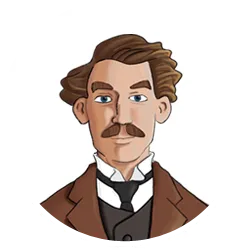
Thomas Butler was born in Caherciveen, County Kerry, Ireland, on the 3rd November 1861, the son of Pierce and Ellen Butler (née Webb). He was the youngest of eleven known children. His father was a shopkeeper and businessman, and the Butler family were a long established and influential family in business and the Catholic Church in south Kerry for a number of generations. His parents died while he was very young.
Thomas grew up with a great love for Irish music and folklore. He was educated as a boarder at St. Colman’s College, Fermoy, County Cork, a very prestigious Roman Catholic college, and on completion of his education, he was employed as a church organist for a number of years, most notably in Youghal, County Cork, and Parsonstown (now known as Birr), County Offaly. As well as learning to read and play music, he also began composing musical arrangements, and it is as a music composer that he is best remembered.
At some point in his early adult life, he began to style his name as “Thomas Whitwell Butler” (Whitwell being a common forename in his family, and was the name of one of his brothers who had died in 1873), and travelled to New Zealand, where one of his married sisters resided. To earn a living there, he gave music lessons and was employed as a choir master.
In 1895, he left New Zealand, and travelled to India, where it is believed he began to write an opera. He spent much of his time during this period of his life living in the Kashmir region.
Although it took him a number of years, he eventually completed his opera –
“Muirgheis” (a Gaelic Irish word meaning “Sea Swan”), which was the first opera known to have been written in the Irish Gaelic language. It consists of three acts and is set in Waterville, County Kerry, near to where Thomas spent his childhood.
How long he spent in India is unknown, but he next appeared in Milan, Italy, where he studied music under Alberto Giovannini, who was a noted music teacher. He then enrolled in the Royal College of Music in London, under the name Thomas Whitwell Butler, and remained for three terms during 1897 and 1898, before returning to Ireland.
By now, he had changed the style of his name to “Thomas O’Brien Butler”, and on occasion to simply “O’Brien Butler”. It is generally believed that the reason for the frequent name changes was to promote his musical compositions and make his name sound ‘more Irish’!
From the latter part of 1898, to 1903, Thomas divided his time between Ireland and London. On the 7th December 1903, his opera “Muirgheis” was performed in its entirety for the very first time in the Theatre Royal, Dublin, Ireland. As far as this author can determine, the opera has only been performed on a handful of occasions since!
Exactly a year after the first full performance of his opera, on the 7th December 1904, Thomas married Mary Jane Mitchell-Burden (née Kavanagh), at the Roman Catholic Cathedral in Columbo, Ceylon (now known as Sri Lanka). Mary was the widow of George Spankie Mitchell-Burden, of St. Kilda, Melbourne, Victoria, Australia, who had died in 1902. Mary was senior to Thomas by thirteen years, being aged about 56 years, whilst Thomas was aged about 43 years).
No details are known of their marriage, but by 1907, Thomas had returned to Ireland to try and promote his opera and other musical works, while Mary is believed to have returned to Australia.
Thomas Butler was not only a music composer, but also owner of a significant amount of farmland in south Dublin. He developed an interest in golf, and converted his farmland at Aidencarrick, Kilmashogue, Rathfarnham, Dublin, into a golf course. It was a short-lived venture, especially when Grange Golf Club was founded close by in 1910.
On the 28th July 1912, Thomas boarded the Lusitania at Liverpool and travelled to New York. His objective was to raise capital and gain support from influential members within the Irish community for his opera and other musical works. Although he was warmly received, interest in his opera was not very forthcoming, and he returned to Ireland after a few months.
His involvement with the Irish Republican movement is not fully known, however; he is credited with writing the music for an early Irish national anthem –
“Freedom’s Hill”, in collaboration with Thomas McDonagh, a nationalist school teacher, who wrote the words to the music. The words and music appeared in a supplement to the 26th December 1914 edition of the
Irish Volunteer, a popular republican newspaper of the time.
Thomas McDonagh was one of the seven signatories to the “Proclamation of the Irish Republic” which was secretly printed and distributed prior to the
“Easter Rising”, a rebellion in Dublin, which commenced on Easter Monday in 1916, the aim being to gain Irish independence from British rule. Whereas the rebellion failed, and the leaders, including Thomas McDonagh, arrested and subsequently executed, the event started a growing feeling of unrest which ultimately led to Ireland gaining its independence in 1921.
Thomas Butler boarded the Lusitania again at Liverpool on the 14th December 1914, and disembarked in New York on the 23rd December. On this occasion, he was more hopeful of negotiating for the production of his opera, and had arranged a concert of some excerpts of hi opera, as well as some of his other works, at the Aeolian Hall, in Manhattan, New York City. Again, he failed in gaining sufficient support for his opera!
No doubt disappointed, he decided to return to Ireland, and booked passage again on the
Lusitania. Joining the vessel before her sailing for Liverpool which commenced in the early afternoon of 1st May 1915, he was not counted amongst the survivors when the liner was sunk, just six days later and within site of O'Brien Butler's native land.
His body was not found and identified later, despite the fact that his brother, Pierce D. Butler, who also lived in Dublin, at 44. Spencer Terrace, Rathfarnham, travelled to Queenstown in the hope of finding him - dead or alive! He spoke with Mrs. Theodate Naisch, who sat at the same table as Thomas at meal times during the voyage, and also with George Griffith, the waiter who served him his meals, but neither had any information to offer. As a result, Thomas O’Brien Butler has no known grave. He was aged 53 years.
In an obituary tribute to him, newspaper The Cork Examiner said of him: -
Mr. Butler was a Kerry man and the scene of his chief musical composition, the Irish opera "Murgheis" was laid in Iveragh. The music for the opera was composed while the author was living in Kashmir, Northern India. Though composed so far away from Ireland the music was characteristically Irish, the author having from childhood, been steeped in the traditional music of his native country.
He used to say himself that he owed much of his inspiration to the haunting Irish airs which he heard an old Irish speaking nurse sing, when he was a child. One of the most delightful melodies in the opera was the fairy chorus, which was arranged for four voices. The arrangements for chorus and orchestra were the work of Mr. O'Brien Butler himself, and he conducted the orchestra when the opera was produced some years ago in the Theatre Royal, Dublin. .....
Mr. O'Brien Butler also composed a number of songs which in recent years have often been set as test pieces at the Feis Ceoil. His "Cincoradh" was the test piece at the Feis Ceoil to-day in the Irish Soprano Singing competition. His death would be a great loss to distinctive Irish music.
When his will was proven on 25th June 1915 at Dublin, administration was granted to his brother, Pierce D. Butler and his effects amounted to £206-9s-6d., (£206.47½p).
His widow, Mary O’Brien Butler, died at 8. Wilson Street, South Yarra, Victoria, Australia, on the 9th March 1920, aged 71 years.
Catholic Parish Registers at the NLI – Diocese of Kerry Baptisms, 1846 – 1863, 1911 Census of Ireland, Irish Volunteer, Cork Examiner, The Argus, Cunard Records, Ireland, Calendar of Wills and Administrations, 1858 – 1920, Victoria, Australia, Wills and Probate Records, 1841 – 2009, PRO BT 100/345, UniLiv D92/2/361, Deaths at Sea 1871 – 1968, Graham Maddocks, Aidan Butler, Kate Wills, Geoff Whitfield, Michael Poirier, Jim Kalafus, Cliff Barry, Paul Latimer, Norman Gray.
Copyright © Peter Kelly.