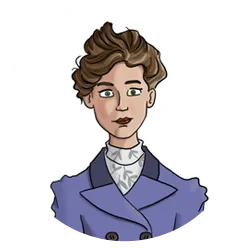
Ellen Ann 'Nellie' Crouch was born in Kettering, Northamptonshire, England, in 1886, the daughter of Robert and Rebecca Crouch (née Brown). Her father was a labourer in a brewery, but by 1891, he was unemployed and described as being an invalid.
Nellie was educated at St. Andrews School, Kettering, and after the death of her father in 1892, her mother remarried, and Nellie moved with her mother, step father, and one of her three sisters to St. Helens, Lancashire. Her step-father, Alfred Rollings, was a shoemaker, and twenty years younger than her mother!
On the 23rd July 1907, she married William Hogg, described as a hair dresser, at the Parish Church, Radcliffe, Lancashire and on the 15th November 1907, their son, George Penketh was born. Not long afterwards, William and Nellie separated, and she went to work as a domestic servant for the Morganroth family at 51. Harris Street, St. Helens. Mr. Louis Morganroth, a German, owned a business making skins for sausage factories. Also living and working as a domestic servant with her was her mother, described in 1911 as being a widow, but as there is no record of her second husband having died before 1911, it is more likely that she had also separated from her husband.
In May 1911, Nellie went to New York City, in the United States of America, in search of work and a better live.. Just months before the
Lusitania's final voyage, in February 1915, she had made a brief return trip to England, perhaps to make plans for bringing her son back to New York City with her, but it appears she returned alone after a short period. Then, in April 1915, she had written to her sisters in Morley Street, Kettering, to say that she was returning once more, on the
Lusitania.
In fact she booked as a second cabin passenger on what became the liner's last voyage and was fortunate enough to survive her sinking. When her sisters in Kettering heard the news of the disaster, they were naturally distraught, until receiving a telegram from Queenstown, which simply said: -
AM SAVED FROM THE WRECK LUSITANIA. AM GOING TO ST. HELENS - NELLIE.
Nellie Hogg actually reached St. Helens on the morning of Sunday, the 9th of May, and made for 84, Eldon Street, the home of a Mr. Thomas Newborn, who was probably a relative, just before two telegrams arrived there, which she had sent from Queenstown the previous day!
She later related her story to a reporter of the local newspaper, The St. Helens Reporter, which was published in the edition of Tuesday 11th May 1915.
She began her account by telling of a dream she had on the morning of the liner’s departure for England. Whilst asleep, she had felt the vibration of the engines and dreamed that the ship was coursing through the waters at full speed. She had then felt a terrific shock, followed by the tipping of the ship and had said to herself: -
Why, they must have sighted a submarine.
The dream had continued with water pouring into her cabin and she went on to say: -
I put my head under the pillow and said goodbye to myself and then I felt the boat tipping again. Just as I thought the end was coming, I awoke and found it was time I got ready to catch the boat.
Her dream was not precipitated by the threats made to the safe passage of the
Lusitania by the Germans, for Nellie Hogg had only learned about these from other passengers, once she was on board the ship. Even then, no-one was alarmed by her dream as they thought that the liner was too fast to avoid a torpedo and that the Germans would not dare to attempt to sink her with so many American citizens on board.
She continued her account by saying: -
We had a beautiful trip until the disaster occurred. The weather was grand and the water so calm that we were making a fairly good speed.
On Wednesday the Second Class passengers held a concert at which £35-13s was collected for the Seaman’s Orphanage and a sum of £125 was collected by the First Class passengers on the following evening.
Another second cabin survivor, Mr. F.J. Lucas of Bromsgrove, Worcestershire, also remembered the collection at the concert but his recollection of the sum raised was £36-16s-11d., (£36.85½p.).
On the Thursday, some of the men had called a meeting to discuss measures to be taken in case of an accident and it was suggested that each man should undertake to teach the women and children how to adjust their lifebelts. When Mrs. Hogg had approached Captain Turner with this suggestion, he said that he didn’t think it necessary, but he had no objections should they wish to go ahead with it. She then described
the fateful Friday: -
When I got up and went on deck I found that most of the other passengers like myself spent a very uneasy night and were unable to sleep. I walked the deck during the morning and went for a first sitting at lunch. I did not eat a very hearty meal because I did not feel well somehow. Afterwards I went along the deck to my cabin, which was situated in the forepart of the saloon passengers quarters, five decks down from the top. I had been in the habit of taking a nap in the afternoon and that’s why I went down this time. I took off my shoes and platted my hair and laid down.
I had been lying there about ten minutes and was beginning to doze when I heard a crash like an awful clap of thunder - in fact it is not possible to realise what it was like.
I had immediately jumped up and ran into the corridor when I met a Mr. Mitchell of Nottingham. I cried “Ah my pocket book”, meaning my handbag, and Mr. Mitchell ran back into the cabin and got it for me. He told me to run upstairs and I did. The corridors were filled with smoke and sulphur but I managed to get up the stairs but not without knocking and hurting my toes. I had not had time to put my shoes on again nor to put anything on my head. I ran along the boatdeck - you can guess how far that was - and scrambled into one of the boats on the port side. But I saw they were not lowering the boats on that side, the list being on the starboard, so I decided to get out and go over there. I slipped all over the deck which was wet, and having no shoes made it very uncomfortable. I managed to get into a boat that had just been made ready for the passengers, and I jumped in.
By a great piece of good luck I saw Mr. Mitchell again. He had got my bag, which contained much of my jewellery and money in his big pocket. I waved to him and he jumped into the boat that I was in. And it was due to his presence of mind that we were not all drowned. Many of the women were sitting on the oars and as the Lusitania turned over onto its side we could see the funnels bearing down on top of us. Mr. Mitchell realised the situation and pushing the women off the oars with his elbows, quickly pulled one up and pushing it against the side of the big vessel, swung the lifeboat into safety. When the tremendous funnels came down, they missed us by only a foot or perhaps less. It was a wonder we did not go under with the suction. Steam and smoke came down on top of us and we were both black and nearly smothered with hot steam.
Mr. Mitchell was second cabin passenger Arthur Mitchell, who was travelling from Toronto, Ontario, Canada, and who was, according to Cunard records, a citizen of the United States of America, although he originated in Nottingham, England. It is also possible that Cunard records were mistaken and he was, in fact, British. A report in
The New York Times for Monday 10th May 1915 states in connection with him that: -
He was in the stateroom of the Lusitania when the torpedo struck the ship. He ran out and assisted two children and Mrs. Ellen Hogg of New York into a boat and then got into the boat himself.
Nellie Hogg’s account of the sinking continues: -
The Lusitania went down without us realising it. I just closed my eyes for a minute to prevent them from being scalded and when I opened them again it was gone.
The swirl of the water carried right over the wreck where there were a lot of little whirlpools. It was quite impossible to put the oars out. It was the most horrifying sight I have ever seen. Mixed with the wreckage were a great number of bodies, some with faces turned upwards and glassy eyes, others with faces downward and blood pouring from their heads. Some passengers were in the water scrambling to get hold of pieces of wreckage.
At last we got away from it all and then we came across a boat in which were two men, one of whom was bailing the water out. Some of us got into the boat. I was the first to be put into it and the assistant purser got in with us. Blood and froth were pouring out of his mouth, and he told me he had gone under with the Lusitania and come up again by the greatest of fortune.
The assistant purser mentioned by Mrs. Hogg would have been William H. Harkness from Everton, Liverpool, who was one of the two officers from the pursers’ section to survive. The other one was Second Purser P. Draper. Mrs. Hogg’s account continued: -
The reason we made this change was that the first boat was so overcrowded. We picked up about 20 men. One of them died, but we revived the others.
At last having been nearly three hours in the boats, we came to a trawler. We were the third boatload to get to it. As we got onto the trawler we sighted torpedo boats coming over the horizon.
The steam tug ‘Flying Fish’ of the Cunard Line was sent out to us and we arrived at Queenstown about 9.25.
It is probable that the trawler mentioned above, was the Peel 12, of Douglas, in the Isle of Man, who rescued quite a number of survivors from the sea.
Mrs. Hogg then spoke the kindly treatment given to all the unhappy survivors by the people of Queenstown and said that: -
Bluejackets and Territorials lined the streets and as we passed along, the people cheered and shouted to us.
She finished her account by saying that she was recovering somewhat from the
fearful shock of her experience but would not be over anxious to make the journey back to America!
Despite saying this, on the 25th August 1915, she boarded the St. Paul at Liverpool, with her son, George, and returned to New York City.
Nellie Hogg worked as a hairdresser for a number of years, and then met James A. Clendaniel, whereas no record of their marriage has been discovered, they were living as married couple by 1925, with Nellie’s son. However, it appears that this union ended like her first marriage.
When she died of a sudden heart attack, aged 47 years, in St. Vincent’s Hospital, on Staten Island, New York, on the 27th April 1947, she was described as being divorced, although she was using the name Ellen Hogg Clendaniel. She was boarding with a Mrs. Lelia B. Schroeder, at 42. Bishop Avenue, New Dorp, Staten Island, at the time of her death, and her next of kin was listed as her son, George.
Register of Births, Marriages and Deaths, Manchester England Church of England Marriages and Banns 1754 – 1930, New York Index to Death Certificates 1862 – 1948, 1891 Census of England & Wales, 1901 Census of England & Wales, 1911 Census of England & Wales, 1920 U.S. Federal Census, 1925 New York State Census, New York Passenger Lists 1820 – 1957, Cunard Records, Daily News, Kettering Advertiser, New York Times, St. Helens Reporter, Graham Maddocks, Robert O’Brien, Geoff Whitfield, Michael Poirier, Jim Kalafus, Cliff Barry, Paul Latimer, Norman Gray.
Copyright © Peter Kelly.