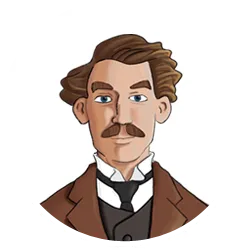
Ian Bernard Stoughton Holbourn was born in Huyton, Lancashire, England, on 5th November 1873, the son of The Reverend Alfred and Mary Jane Holbourn (née Stoughton) later of Ealing, Middlesex. He was the eldest of two boys and his mother died while he was in his infancy. Originally, he was called John Bernard Holbourn, but in later life he substituted the name Ian for John, (Ian is the Scottish equivalent), and added on his mother’s maiden name to his own surname.
He was educated at Bradford Grammar School, until 1883, whilst his father held a term of Ministry at College Chapel there, and afterwards at Mill Hill School, where he excelled at mathematics. Following this he went up to London University to read mathematics, but before he graduated, he transferred instead to The Slade School of Art, where he studied for five years under the Directorship of Le Gros and Frederick Brown.
Following this, he obtained a place at Oxford University to develop his knowledge of the history and meaning of art, and it was during the course of studying for this honours degree that he re-discovered Latin and Greek, and he took as his special subject, Greek Art and Archaeology - going out to the British School at Athens to further his studies! After he graduated, he took up extension lecturing, i.e. as a travelling lecturer, in which he achieved considerable popularity, becoming an expert and author and an authority on classical literature.
In 1904, he married Marion Constance Archer-Shepard, whose brother was a great friend of his at Oxford, and they had three children, named Athelstan Hylas Lachlan Major Stoughton Holbourn, Laurence Alasdair Menander Stoughton Holbourn, and Philistos Rognvald Howard Stoughton Holbourn, whose names reflected their father’s passion for both Greek and Scottish lore. In fact, he was Laird of the Island of Foula, west of the Shetland Islands, where the 200 inhabitants were his
loyal subjects. He had fallen in love with the island, sometimes known as Ultima Thule or Fughley, the first time he ever saw it in 1900, and had bought it soon afterwards. He usually weathered the winter in Edinburgh, with his family, at 1, Mayfield Terrace.
Apart from his love of the classics, he was also renowned for his work for The Children’s Open Spaces Movement.
The Middlesex County Times for 15th May 1915 said of him: -
Mr. Holborn (sic) who has published two or three important books on art and edited a somewhat short-lived but brilliant art quarterly, was closely connected with the Ealing Congregational Church, both through the school and choir, and still retains his membership.
In the spring of 1915, he had been in the United States of America lecturing at various universities there, and whilst at Yonkers, New York, he booked a second cabin passage on the
Lusitania, for his return to England, and joined the liner at Pier 54, before she left there at mid-day on 1st May. He occupied cabin C10.
Once on board, he befriended a young twelve year old girl, Avis Dolphin. Avis was travelling with two companions, (Miss Hilda Ellis and Miss Sarah Smith), as a second cabin passenger from her home in St. Thomas, Ontario, Canada, to stay with her grandparents in England, whilst she continued her education at an English school. She and Holbourn very soon became firm friends, walking, talking and reading together.
Though normally mild mannered, Mr. Holbourn was openly critical of the lack of lifebelts and lifeboat drills, until warned by another passenger to keep quiet, as he was apparently upsetting the lady passengers. Nevertheless, when the liner was torpedoed, his views were vindicated! According to the Hoehlings: -
When the torpedo struck, Professor Holbourn had thought of lifebelts at once. Finding none on deck, he took his twelve-year-old friend Avis Dolphin to his cabin corridor. .....
The professor’s cabin was a mess. Such articles as his toothbrush, razor, and lotions rolled about the floor. Wide-open wardrobe doors revealed suits that hung crazily out into the room. His broad-brimmed black hat had sailed off the closet shelf and lodged itself in the corner behind the door.
Worst of all, the porthole was no longer reassuringly divided, like a well-sliced pie, into equal parts of sea and sky. It was all bright blue, motionless.
Holbourn had to pull himself up the sloping deck by grabbing first at the bed, then the wardrobe door, to which he clung with one hand as he groped on the shelf for the belts. He was afraid the wardrobe would topple over on him.
Finally, he skidded back into the corridor and fastened a belt on Avis. Carrying two extras back to the deck, he and Avis met her travelling companions. One, Miss Smith, refused Holbourn’s offer of a belt, reminding him that he had a wife and three children dependent on him. So he tied it on himself, under protest, as the group went in search of a boat.
Holbourn put Avis in a lifeboat as it was being swung out, then was momentarily distracted by the sight of two men, stripped naked, diving off the boat deck. They struck out towards a boat that was floating, smashed, on the water. Holbourn was amazed to see how quickly the pair were (sic) swept astern, and he deduced that the Lusitania was still travelling at a considerable speed.
He continued around the decks, offering lifebelts to some of Avis’s friends and helping them into boats. Since he was a champion swimmer himself, he resolved he would go forward and swim for it, without trusting to the boats or the way some were being lowered. .....
After he first jumped, he had trouble fighting through the jumble of ropes snarling the water around the liner, like submarine nets. Once free of them, he knifed ahead like a seventy-five-yard dash professional. He thought fleetingly of the curious prophetic dreams of such a disaster he had experienced several times in New York, before sailing.
As the liner sank, he saw a lifeboat narrowly missed by the after mast and the spot where she had gone down: -
..... assume the shape of “a pork pie” - a large, whitish mass, caused presumably by a final explosion.
As he struck out towards the lifeboat, he was able to take in tow a man who was floating beside him, but as he reached it, he found that the man was dead. There was a “petty officer” in charge who decided that the boat was overcrowded and they should make for another, seemingly empty, about three quarters of a mile away. When they finally reached it, it contained two men, naked except for blankets, who were probably the ones Holbourn had seen swimming past the ship.
He decided to stay in the first lifeboat, still overcrowded, despite the transfer of fifteen passengers, where he revived somewhat, because of the sunshine and the effort of rowing, although he still shivered: -
As his boat continued towards shore, they went through seeming endless fields of wreckage, strung out as an indication of the curving shorewards track of the stricken Lusitania. Large numbers of drowning people were “shrieking for help”, but the petty officers in charge of the boat “refused” to assist them. Holbourn believed they could “with absolute safety” have taken aboard at least ten more persons. What especially appalled the professor was the sight of some thirty bodies drowned because their lifebelts were improperly worn.
This naturally made Mr. Holbourn remember bitterly how he was told to stop protesting about the lack of proper drills! Eventually, the occupants of the lifeboat spotted a fishing boat, which turned out to be the
Peel 12 from Douglas, Isle of Man. They were all taken on board and Mr. Holbourn helped some survivors into the hold, which was comparatively safe, but naturally reeking of fish. He then returned to the deck, where he sat shivering until the naval tug, H.M.S. Stormcock, came alongside.
The tug took all the survivors on board and once safe, Holbourn managed to persuade the captain to light a cabin stove to prevent survivors catching pneumonia and then tried to get him, (but in vain), to start making a list of survivors.
Eventually, along with the others, he was landed at Queenstown from where he finally made it home to Scotland, via Birmingham, where he was met by his wife. Her parents lived in Worcestershire. By this time, Marion Holbourn had already heard the news that the liner had been sunk and although shocked, she was not too worried for his safety, for like her husband, who had foreseen the sinking in a dream, she too had had a similar vision, but one in which her husband had survived and had come safely to shore!
This had manifested itself on the evening of 6th May and was later reported in a 1990 edition of
The Titanic Commutator, the official journal of The Titanic Historical Society. It stated: -
On the night in question, Mrs. Holbourn went to bed at around 11 pm. Just as she was dropping off to sleep, however, she had a very strange experience. She suddenly “found herself” on a sinking ship, the vessel being down at the bow and listing heavily. Crewmen were doing their best to lower the lifeboats, and a great crowd of frightened people milled around the boat deck or looked for their friends.
Mrs. Holbourn was struck by the strangeness of the experience she was undergoing. Her “vision” was so realistic that it seemed as if the events were actually taking place around her. “How strange,” she thought, “that I am seeing all this while I am wide awake.”
Again caught up in her vision Mrs. Holbourn seemed to reach the upper deck of the sinking vessel. She saw a young man in uniform and asked if he knew the whereabouts of her husband. “Oh he is all right.” the fellow replied. “I think he got away in one of the boats; anyway he is safe.” Greatly relieved, Mrs. Holbourn continued to watch the tragedy unfold around her but was overcome by a feeling of guilt. “It is very selfish of me,” she thought, “to see all this distress and yet to be unmoved just because my own husband is safe.”
When she awoke on the morning of May 7th, Mrs. Holbourn told members of her household about her experience of the previous evening. Everyone regarded it humorously, agreeing the Germans would not dare attack a passenger ship.
That evening a neighbour called to Mrs. Holbourn from the garden gate and told her that the Lusitania had been torpedoed and sunk. The poor woman was close to fainting but tried to fortify herself with the memory of her vision.
Avis Dolphin was also landed at Queenstown. Having been tossed into the sea when her lifeboat was capsized, she was eventually rescued. Miss Hilda Ellis and Miss Sarah Smith, her travelling companions, were less fortunate, both being killed when the liner sank. Neither of their bodies was ever recovered and identified.
Avis Dolphin was then put on a train and boat for Liverpool, where she was not only met by her aunt, but met up with Professor Holbourn again. She later wrote about the meeting, in 1988, when she was in her eighties: -
I was taken to one of the hotels and was soon tucked up in bed after a drink of hot milk. Professor Holbourn was eventually picked up and brought to the same hotel where I was already asleep. He had enquired whether Miss Ellis, Miss Smith or I were among those brought to the hotel and was informed that I was safe, but there was no news of the two ladies.
The next morning I was taken to see Mr. Holbourn who was still in bed as he was feeling very weak. He told me that he had telephoned his wife in Edinburgh asking her to meet him in Birmingham and that he had sent a telegram to ask my grandparents to meet me there also. Mr. and Mrs. Holbourn intended to travel on to her parents’ home, also in Worcestershire, but my aunt invited them to return with her so that the Professor could have a night’s rest after the long journey from Ireland, before going any further.
Professor and Mrs. Holbourn did then accompany Avis to her grandparents’ home in Feckenham, Worcestershire, before returning home, but the supernatural continued there with a statement by Avis’s grandfather, David Dolphin.
The Titanic Commutator told the story: -
After they arrived, Mrs. Holbourn asked the elderly Mr. Dolphin when it was that he learned of the Lusitania disaster. She was surprised by his statement that he had known about it on May 6th.
“But it did not happen ‘til May 7th!” exclaimed Mrs. Holbourn. “Yes,” replied the old gentleman, “but I knew it on the previous day.” “Do you mean you ‘saw it?’, she asked. “Yes,” he replied. “I saw a small boat capsize, and a little girl came to the surface, and I said to my wife: ‘Depend upon it that’s our Avis!’ “
Mrs. Holbourn inquired what time it had been when Mr. Dolphin experienced his vision, and he told her it had been about 11 o’ clock. This was almost exactly the same time Mrs. Holbourn had experienced her own vision of the tragedy, and Mr. Dolphin was not at all surprised to hear that she, too, had “seen” the sinking of the Lusitania before it happened.
The Holbourn’s eventually returned to their Scottish home, with Ian Holbourn apparently none the worse for wear, despite his ordeal.
Professor Holbourn also had relatives on the Welsh island of Anglesey, Holbourn Road there, being named after one of his family, and
The North Wales Chronicle for 21st May 1915 added more evidence of the loss he suffered with the sinking of the liner: -
Mr. Holbourn was bringing back with him from America a large number of valuable manuscripts, and to provide for the contingency of disaster he had selected a few of the most precious and put them inside his cabin door. These he seized, and he had them in his hand at the moment he jumped into the sea. Some of them were washed out of his hands, but the scanty remainder he tucked into his lifebelt.
The loss of his manuscripts, except for this practically negligible fragment, represents nearly twenty years work, besides all his lectures upon which his occupation depends. He describes the scene of the disaster to the “Lusitania” as heartrending.
After the sinking, he kept in touch with Avis Dolphin, and after she had complained to him that girls’ book were dull, he wrote a book especially for her, an adventure story called
The Child of the Moat, which was published in America in 1916. They then continued to keep in regular contact and in fact, Avis Dolphin met her future husband, journalist Thomas Foley, at the Holbourn’s Edinburgh home, on one of her frequent visits there.
In 1918, Holbourn was appointed Professor in the Extension Department of the University of California, in Art and Architecture and thereafter, for many years, he spent six months lecturing in America followed by six months in Great Britain. He died, peacefully, from complications following an operation, in Edinburgh, on 13th September 1935. He was aged 62 years.
Cunard records show Professor Holbourn’s name to be spelled Holborne, but this is clearly a mistake!
Register of Births, Marriages and Deaths, 1881 Census of England & Wales, 1891 Census of England & Wales, 1901 Census of Scotland, 1930 U.S. Federal Census, New York Passenger Lists 1820 – 1957, Cunard Records, U.S. World War I Draft Registration Cards 1917 – 1918, Isle of Foula, Belfast News Letter, Middlesex County Times, North Wales Chronicle, The Minneapolis Star, Last Voyage of the Lusitania, Seven Days to Disaster, Titanic Commutator, Probate Records, UniLiv D92/2/439, Graham Maddocks, Stuart Williamson, Geoff Whitfield, Michael Poirier, Jim Kalafus, Cliff Barry, Paul Latimer, Norman Gray.
Copyright © Peter Kelly.