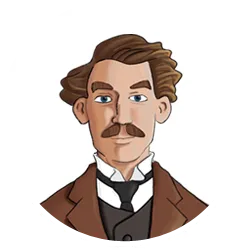
James Robert Kelly was born in Nelson, Lancashire, England, in 1872, the eldest son of
John James and Mary Ann Kelly (née Varley). His father was an engine fitter, and while James was still a child, his family moved to Haslingden, where his father became a member of The Haslingden Board of Guardians.
After formal education, James Kelly was apprenticed to Furneval and Company, Engineers, at the Union Foundry, Haslingden, with which his father was associated, and having completed his apprenticeship as a mechanical engineer, he became a traveller in the engineering trade, moving to Leeds, Yorkshire, in the furtherance of his profession.
On the 3rd October 1891, he married Mary Elizabeth Tattersall, daughter of James Tattersall, who for many years was steward at The Haslingden Liberal Club, and by 1915, they had three children, two sons and a daughter and the family home was at 172, Beeston Close, Leeds, Yorkshire.
By 1904, he had felt confident enough to go into business for himself and founded J.R. Kelly and Co. Ltd., Engineers and Tool Makers, of Lower Bridge Gate, Leeds, and he also became a director of Messrs. George Mann and Co., who were lithographic printers. Not long afterwards, he also commenced an association with The Universal Machine Company of Leeds.
Whilst in Haslingden, he had been closely associated with The Haslingden Cycling Club, and once he had settled in Leeds, he became one of the first motor cyclists in that city and was one time president of The Leeds Motor Cyclists Club. He then went on to become the winner of The Reliability Motor Cycle Trial, which involved cycling from Leeds to Edinburgh in Scotland and back, which he accomplished in 24 hours. Thus did he become well known for popularising the sport of motor cycling in the city. He was also an active and prominent Leeds Freemason.
In January 1915 he had left Leeds to go to America in the course of his firm's business, and some government contracts, and he arrived in New York City on board the Cunarder Franconia on 1st February. For his return to England he booked a second cabin passage on the May sailing of the Lusitania, which was scheduled to leave the Cunard berth at Pier 54 on the west side of New York, at 10.00 a.m. on 1st May 1915. Before he joined the vessel, he cabled home to tell them of his imminent return and then, like all the other passengers and crew, he had to wait until just after noon before the Lusitania actually left port.
This was because she had to wait to embark passengers, crew and cargo from the Anchor Liner Cameronia, which the British Admiralty had requisitioned for use as a troop ship, just as she was about to sail for Glasgow.
Unfortunately, James Kelly never made it home, as he was lost six days later, on the afternoon of 7th May after the ship was torpedoed and sunk by the German submarine U-20, off the coast of southern Ireland. He was aged 43 years at the time.
In their attempts to discover news of his fate, his family cabled Cunard to send them any news of him at all, and on 10th May 1915, received a telegram from the Steam Ship Company, which simply stated: -
REGRET NO MENTION OF JAS. R. KELLY, ENGINEER, IN LIST OF SAVED AT PRESENT.
This proved to be the ultimate outcome for the family, however, as no sign of his body
was ever discovered and identified afterwards. By this time, one brother, William Kelly of Haslingden had gone to the Cunard office in Liverpool seeking information, and another, Richard Kelly, had travelled to Queenstown, but with no more success.
Administration of his estate was granted to a Frank Oliver, of Langhton, who was a merchant, and Herbert Broadbent, who was a solicitor, on 30th October 1915, and his effects amounted to £2,221-8s-10d, (£2,221.49p).
On the outbreak of war in August 1914, one of his sons, Wilfred Varley Kelly, had been apprenticed to a large firm of tool makers in Düsseldorf, Germany. He was only able to escape internment by accompanying a party of Americans down the River Rhine to Rotterdam, after which he was able to reach England. He is later reputed to have enlisted in the 15th (Service) Battalion of The West Yorkshire Regiment, perhaps better known as The Leeds Pals, although this has not been established, but it is known that he survived the war.
Register of Births, Marriages and Deaths, Lancashire England Church of England Births and Baptisms 1813 – 1911, Lancashire England Marriages and Banns 1754 – 1936, 1881 Census of England & Wales, 1891 Census of England & Wales, 1901 Census of England & Wales, 1911 Census of England & Wales, Massachusetts Passenger Lists 1820 – 1963, New York Passenger Lists 1820 – 1957, Cunard Records, Accrington Gazette, The Times, Yorkshire Observer, Yorkshire Post, Leeds Pals, Probate Records, PRO BT 100/345, Deaths at Sea 1871 – 1968, Graham Maddocks, Geoff Whitfield, Michael Poirier, Jim Kalafus, Cliff Barry, Paul Latimer, Norman Gray.
Copyright © Peter Kelly.