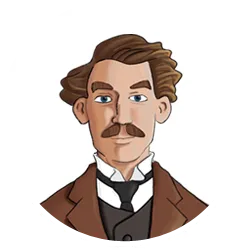
Stanley Llandaff Burnett Lines was born in Shirenewton, Monmouthshire, Wales, on the 20th October 1884, the son of The Reverend Michael Davey and Julia Lines (née Wilcox). His father was a Church of England clergyman, and Stanley was one of five children.
A few years after his birth, his family moved to Islington, London, and on completing his education, Stanley became an electrical engineer.
On the 10th January 1912, Stanley Lines boarded the White Star Lines, Olympic, a sister ship of the Titanic, on the first part of his journey to Toronto, Ontario, Canada. He was taking up a position as the manager of the Canadian branch of The Chamberlain and Hookham Electric Meter Company of Birmingham, Warwickshire, England. Later that year, he made a visit to Japan on behalf of the company.
On the 25th June 1914, Stanley Lines married Miss Ethel Moore Lamping, the daughter of Mr. and Mrs. Frank W. Lamping of Ridley Park, Delaware County, Pennsylvania in the United States of America. The couple embarked on a month‘s honeymoon in England. His father was by now the vicar of St. Paul’s Church, Yoxford, in Suffolk. When war broke out in Europe, they hurried back to Toronto.
In April 1915, however, Stanley was called suddenly to England on company business and his wife decided to accompany him there. Consequently, they booked as second cabin passengers on the May sailing of the Lusitania and having arrived at the Cunard berth at Pier 54 in New York harbour on 1st May 1915, in time to board the liner for her scheduled 10.00 a.m. departure, the couple had to wait until 12.27 before the liner actually sailed. The delay was caused because the liner had to take on board passengers, crew and cargo from the recently requisitioned Anchor Liner Cameronia, which the British Admiralty had taken from trade as a troop ship.
Six days later, on the afternoon of 7th May 1915, the Lusitania was torpedoed and sunk by the German submarine U-20 off The Old Head of Kinsale in southern Ireland and only a few hours away from her ultimate destination. Stanley and Ethel Lines were in the second class dining room when the torpedo struck and southern Irish newspaper The Cork Examiner later published what happened to Stanley Lines, having interviewed him once he had been landed at Queenstown: -
As we sat at the table there was a great boom, and we all sprang clear and got outside the dining-room door, and none of us thought of aught else but to get on the decks. We found that the ship had been torpedoed, and as far as I remember, as we reached the deck, there was a second crash. It was then the other missile took effect. A list to starboard set in as we were climbing the stairs and it so rapidly increased that by the time we reached the deck, we were falling against the taffrail. I managed to get my wife on to the first-class deck and there, three boats were being got out. I got her into the third which was lowered safely, and having kissed her good-bye, I turned to look for a life-belt for myself.
An article in The Yorkshire Post for 11th May 1915, describes in more detail this part of the sinking: -
Mrs. Lines declined to get into a lifeboat without her husband who refused to go with her because there were women and children waiting. Mr. Lines and an officer picked her up and threw her into No. 13 lifeboat, where she was held down. Mr. Lines was the last man to leave the ship.
The Cork Examiner account continues to tell what happened to Mr. Lines after that: -
The boat had no sooner cleared than the ship started to go down. I fell into
the water, some kind soul throwing me a life-belt at the same time. Ten minutes later, I found myself beside a raft, on which were some survivors, who pulled me on to it. We cruised around looking for others and managed to pick up a few, making in all perhaps sixteen or seventeen persons who were on the raft. In all directions were persons struggling for their lives, and the boats gave what help they could.
We, fortunately came on a collapsible boat, and all got safely on board. In this boat were 43 or 44 by this time and it was splendidly handled by the boatswain, John Mazurok (sic.). Amongst the men we picked up were the second engineer. There were some who were on the deck at the time of the torpedoing of the ship and as wild rumours had been rife, our representative took advantage of their presence to ask them what transpired.
They stated that she was not flying the American flag. She had previously been flying the white ensign, her company’s flag being at the masthead. The submarine never showed herself; and therefore that was one reason why she was not fired at; and the second, and the more substantial one was that the Lusitania could not fire because she had nothing to fire with, not having a gun of any kind on board. It is said that the Captain saw the submarine and zig-zagged his ship, but this may have been because the look out had observed the onrush of the torpedo.
The second engineer was either Senior Second Engineer Andrew Cockburn or Junior Second Engineer Alexander Duncan. The man mentioned by Stanley Lines as the boatswain, John Mazurok, was in fact, third class passenger Ivan Mazurak, a Russian national, travelling to Europe from Waterbury, Connecticut, in the United States of America.
Having been eventually rescued from the sea by a larger craft, Stanley Lines was landed comparatively safe and sound at Queenstown where he was eventually re-united with his wife Ethel, who had also survived the sinking in lifeboat No. 13, at the Queen‘s Hotel. This hotel, then as now, the largest one within the town, took many of the passenger survivors from the sinking. It is now called The Commodore Hotel.
Eventually they reached England, by train and steamer and Mr. Lines was able to carry out his business and Mrs. Lines occupied herself with war work.
The two ship’s engineers Cockburn and Duncan eventually returned to sea duties but it is not known whether or not Ivan Mazurak ever made it back to his native Russia, if that was his original intended destination.
On the 19th June 1915, Stanley and Ethel Lines boarded the American Lines steamer Philadelphia at Liverpool, for a return across the Atlantic and then on to Toronto.
Stanley and Ethel Lines went on to have two children – Margery Graham, born in October 1917, and Ernest Owen, born in January 1921. The lived for some years at 21. Regal Road, Toronto, and later at 90 Garfield Avenue in the city.
Stanley Lines returned to England a number of times after surviving the sinking of the Lusitania, either alone or with his wife. His last visit to England was in the summer of 19030, when he was accompanied by his son, Ernest.
Stanley Lines died at his home of a coronary thrombosis on the 10th April 1931, aged 45
years. He was laid to rest in Mount Pleasant Cemetery, Toronto, where his wife was laid beside him over 30 years later, when she died on the 22nd November 1961, aged 80 years.
Register of Births, Marriages and Deaths, Pennsylvania U.S. Marriages 1852 – 1968, Ontario Canada Deaths and Deaths Overseas 1869 – 1948, 1891 Census of England & Wales, 1901 Census of England & Wales, 1921 Census of Canada, New York Passenger Lists 1820 – 1957, Canadian Passenger Lists 1865 – 1935, Canada Ocean Arrivals 1919 – 1924, U.S. Border Crossings from Canada to U.S. 1895 – 1960, Cunard Records, UK Electrical Engineer Lists 1871 – 1930, Canadian Claims Case No. 763, Cork Examiner, Philadelphia Public Ledger, Yorkshire Post, PRO BT 100/345, Graham Maddocks, Gary Box, Leigh Box, Geoff Whitfield, Michael Poirier, Jim Kalafus, Cliff Barry, Paul Latimer, Norman Gray.
Copyright © Peter Kelly.