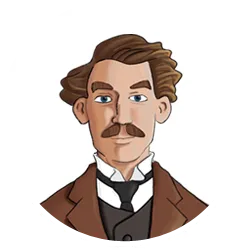
Hugh Henry “Harry” McEvoy was born in Donacloney, County Down, Northern Ireland, on the 31st December 1895, the son of William John and Alice McEvoy (née Crombie). His father was a “tenter” in one of the local linen factories, and Harry was one of eleven children.
By the age of 16 years, he was working as a dispatch clerk in Belfast, County Antrim, and then, in September 1914, he crossed the Irish Sea to Liverpool, where he boarded the Cedric, bound for New York City, where he had arranged to stay with an uncle.
He secured a position as a clerk in the New York house of Messrs. Liddell & Sons, Ltd., but in the spring of 1915, he decided to return home, possibly because of the Great War.
As a consequence, he booked second cabin passage for himself on what became the Lusitania’s final trans-Atlantic crossing, which left New York at mid-day on 1st May 1915. He was accommodated in cabin E22.
After the ship was torpedoed, exactly six days later, he was listed amongst the missing by The Cunard Steam Ship Company, but this proved to be a mistake, as he later made it back home, having been rescued from the sea and landed at Queenstown.
Evidence of his survival was published in the edition of The Northern Whig for 11th May 1915, it was stated: -
Amongst the very few survivors of the Lusitania who arrived home yesterday was Mr. Henry McEvoy, a son of Mr. William McEvoy, Donacloney, who had been employed in the New York house of Messrs. Liddell & Sons Ltd.
Mr. McEvoys’s parents were fortunately unaware that he had sailed on the Lusitania, and therefore they had no anxiety on this account, the first intimation that he was one of the passengers and had been saved coming from Mr. R.M. Liddell, J.P..
He jumped overboard, being drawn underneath the water by the suction, for what he computed to be five minutes. When he regained the surface he swam about for twenty minutes until he and some others succeeded in mounting an upturned boat, on which they remained until rescued by a Queenstown liner some three hours later.
Further proof of his survival is that not long after the sinking, Harry McEvoy applied, himself, to The Lusitania Relief Fund, for financial help. This fund had been set up immediately after the liner had been sunk, by The Lord Mayor of Liverpool and other local businessmen from the area, to help second and third class passenger survivors and the relatives of those who had perished, who had come upon hardship as a result of the loss of the vessel.
The awards committee made Harry McEvoy a once and for all grant of £5-0s-0d on the grounds that his health had suffered because of the disaster. In fact, both his father and Henry himself wrote separately to the Cunard Company seeking
compensation, stating that following his ordeal, Henry was under the care of doctors, confined to bed, and ordered not to return to work for two months.
Harry McEvoy was in a very weak condition on his return home and never recovered from his ordeal. He died at his home on the 15th October 1915, aged 19 years. The cause of his death was recorded as pulmonary thrombosis and exhaustion.
Cunard records which were updated from 1915, throughout the rest of the war years, show that Harry McEvoy lost his life in the sinking. Perhaps, it was officially decided that as he died a little more than four months after the sinking, from conditions believed to have been caused directly as a result of the sinking, he should be included on the list of official casualties.
Register of Births, Marriages and Deaths, 1901 Census of Ireland, 1911 Census of Ireland, New York Passenger Lists 1820 – 1957, Cunard Records, Liverpool Record Office, Belfast News-Letter, Irish News, Lurgan Mail, Northern Whig, PRO BT 100/345, UniLiv D92/2/52, Deaths at Sea 1871 – 1968, Graham Maddocks, Geoff Whitfield, Michael Poirier, Jim Kalafus, Cliff Barry, Paul Latimer, Norman Gray.
Copyright © Peter Kelly.