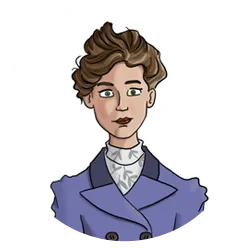
Lorna Mary Pavey was born in Madras, India, on the 3rd August 1886, the daughter of Walter George and Ruth Johnson Pavey (née Bland). Her father was a railway engineer, and Lorna was the younger of two daughters.
Sometime after her birth, her family returned to Great Britain and resided at ‘Forestville, Llewellyn Road, Colwyn Bay, Denbighshire, Wales, where her father died in 1891. Later, the family home was at 'Hazel Lea', Landsdown Road, Cheltenham, Gloucestershire, where her mother ran a boarding house for girls attending a local school to support herself and her daughters.
In 1912, Lorna immigrated to Canada, where she found employment as a governess to the MacDonald family at Fort Qui Appelle, Saskatchewan, Canada.
Then in the spring of 1915, and because of the war situation in Europe, she decided to return home to offer her services to the Red Cross.
As a result, she booked second cabin passage from New York to Liverpool on the May sailing of the Lusitania and joined the vessel on the morning of 1st May at the Cunard berth at Pier 54 on the west side of the city, for her scheduled 10 o’clock departure. As it transpired, the liner did not actually leave port until 12.27 p.m., as she
had to take on board passengers, cargo and crew from Anchor Liner the S.S. Cameronia which the British Admiralty had requisitioned as a troop ship at the end of April.
Once the liner had sailed, Miss Pavey made friends with several other second cabin passengers, including chemist John Wilson, who was on his way home from Cambridge, Massachusetts, Canadian Scot Archie Donald also travelling from Cambridge and The Reverend Herbert and Mrs. Margaret Gwyer, who were on their way to Mirfield near Bradford in Yorkshire, where The Reverend Gwyer had been appointed senior curate at St. Mary’s Church, there.
Six days out of New York, the Lusitania was torpedoed on the early afternoon of 7th May off the southern coast of Ireland by the German submarine U-20. At that time, she was only about fourteen hours sailing time from the safety of her home port.
When the torpedo struck, Lorna Pavey was finishing her lunch with a grapefruit in the second class dining room and obeying The Reverend Gwyer’s instructions not to panic, she was almost left on her own there when the rest of the passengers rushed up on deck. She was then spotted by John Wilson, who took her by the hand and together they pushed through the debris already littering the dining room floor and made their way up to ‘C’ deck. By this time, the ship was listing so badly that they had to use the stays of the banisters like the rungs of a ladder to make their ascent. Once there John Wilson spotted a boat already lowered into the sea, which was only half full of people, but was also half full of water.
Wilson encouraged Miss Pavey to slide down a rope into the boat and as she did so, her full skirt billowed out and she almost floated down, like a parachute, almost missing the lifeboat and landing in the sea. Wilson then followed her down the rope and together they rolled over the gunnel and into the lifeboat. As they started to bale the boat out with their shoes, they realised that it was filling with water because the bung was out of its bottom and once this was realised, it was put back in. Despite the fact that it only held twelve occupants, the crew members who began to row it away from the sinking ship at first refused to stop to pick up any more survivors! It was almost certainly Lifeboat No. 9.
Eventually, the occupants, now swelled with survivors taken from the water were rescued from the sea and landed at Queenstown. There, Lorna Pavey, John Wilson and Archie Duncan, who had survived an immersion in the sea, searched the hotels, private houses and probably the mortuaries as well, for people they had known on board. They must have been pleased to discover that George Bilbrough and The Reverend Gwyer had also survived the sinking, although his wife Margaret acquired doubtful notoriety by being sucked down one of the funnels of the sinking ship and being blown back out again as the ship’s boilers imploded!
After her experiences off the coast of Ireland, Lorna Pavey eventually made it back home to Gloucestershire.
During the summer of 1915 she made a successful application for aid, to The Lusitania Relief Fund. This fund was set up after the sinking, by The Lord Mayor of Liverpool and other local
those second cabin and third class passengers who had survived and the relatives of those who did not.
Following her survival, she was ill for seventeen months, being unable to work until late 1916. She suffered from nervous shock and wasting of the muscles.
In April 1921, she returned to Canada, where she was engaged to be married to Arthur Heath Benson, who was a brother of Mrs. MacDonald, who had employed her as a governess. The couple married on the 12th December 1921, in Victoria, British Columbia, and the couple had two children – a son and a daughter. Her husband was a surveyor in the construction industry, and had served during the War with the Canadian Expeditionary Force.
On her return to Canada, she filed a claim with the Canadian Commission, seeking compensation for the loss of her money and personal effects in the sinking of the Lusitania, and also for personal injuries she suffered at the time. In April 1926, the Commission awarded her $2,590.70.
Lorna Benson died in Vernon, British Columbia, on the 29th June 1962, aged 74 years. Her remains were interred in Whonnock Cemetery, Maple Ridge, British Columbia.
India Select Births and Baptisms 1786 – 1947, British Columbia Canada Marriage Index 1872 – 1935, British Columbia Canada Death Index 1872 – 1990, 1891 Census of England & Wales, 1901 Census of England & Wales, 1911 Census of England & Wales, 1921 Census of Canada, Canadian Passenger Lists 1865 – 1935, Canada Ocean Arrivals 1919 – 1924, Cunard Records, Canadian Claims Case No. 858, Last Voyage of the Lusitania, Liverpool Record Office, Graham Maddocks, Geoff Whitfield, Michael Poirier, Jim Kalafus, Cliff Barry, Paul Latimer, Norman Gray.
Copyright © Peter Kelly.