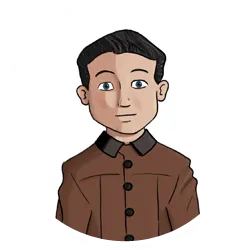
Cecil Henry Richards was born on the 4th April 1911, in Butte, Silver Bow County, Montana, in the United States of America, the son of Thomas Henry and Phillipa (Phyllis) Richards, (née Conner). The family home there was at 2210, Yew Street, and his father was a carpenter in a local quartz mine.
His parents had originally come from Cornwall, England and had immigrated to Montana just after their marriage, in 1907. His father had worked and lived in the area before. Cecil had an older brother named Thomas Percy, but who always known as Percy, who was born in 1908 and a younger sister named Dora Millicent, who was born in 1914. Even though Cecil Richards was born in Butte, and his father had been granted United States nationality in 1906, he and the rest of the family appear in Cunard’s passenger records as British.
In the spring of 1915, his parents decided to leave America for Cornwall possibly as a result of the war and possibly as the result of a feud between family members living in Butte. Consequently, having booked second cabin passage for the whole family on the May sailing of the Lusitania from New York to Liverpool, the family left Butte some time in April and arrived at the Cunard berth at Pier 54 in New York on the morning of 1st May 1915, in time for the liner’s scheduled 10.00 a.m. sailing. This was then delayed because she had to wait to embark passengers, crew and cargo from the Anchor Lines vessel the S.S. Cameronia which the British Admiralty had requisitioned for war service as a troop ship at the end of April. They were accommodated in room D.80.
Six days out of New York, on the afternoon of 7th May, and within sight of the coast of southern Ireland, the Lusitania was torpedoed and sunk by the German submarine U-20. At that time, she
Liverpool home port.
Although Cecil Richards, his brother Percy, and both his parents survived this action - (although Percy was separated from the rest of them for a while) - his baby sister Dora did not! After being rescued from the sea, the surviving members of the Richards family were landed at Queenstown, from where they eventually made it to Cornwall and settled at their former home at Colvorry Farm in Breage parish, eventually buying a property named ‘Waverly’ in the hamlet of Ashton. This was also in Breage parish, on the Penzance to Helston road.
Cecil’s father Thomas Henry later wrote of the family’s experiences to his sister, Mrs. Harry Skewes, back in Butte and this letter was later published in The Butte Miner and stated: -
We left New York at 12:30 o'clock Saturday. We were late owing to the fact that we had to take on the Lusitania the passengers for the Camperonia, a Red Star Liner, that was ordered to Halifax to take on troops or something. Everything went very well until Friday. Had a lovely voyage - could not have expected better. Well, we were at dinner at the second seating. We went to dinner at 1:40 in the afternoon. We had just finished and I was folding my napkin when the fateful shot came. Everyone was on their feet in a second and rushing from the dining room. I am thankful to say I kept my cool and sat there for a minute and asked others to sit still for a while until the rush was over. Then all of a sudden, the Lusitania went down on one side and everything was swept from the tables. “Now,” I said, “Let's go” - there not being much of a crush. We went to our room hearing the words. "Women and children first in the boats.”
Well I thought that Phyllis and the children might be in the boat all night and, if so, would be cold, so I said to put on her fur coat. Then we put on the four life preservers and made for the deck. There were only four preservers in each room, none for Dora and she was too small had there been one there.
I had a boy in each hand and Phyllis had Dora in her arms. We climbed up four flights of stairs, then we saw an officer and asked him what he thought about it. He said: “There is no danger yet.”. Also, he told us the best thing to do was to go up on the next deck and get into a boat. That stairway was full and how we got up it alive I don't know. I pulled the boys up and my wife followed. We were not there more than a half a minute when the Lusitania was almost perpendicular, going down bow first, with the propellers in the air. We were standing on the side of the lounge room, going down with the Lusitania. When the lounge reached the water we all floated off.
We left the children go then - could not hold on to them any longer, until we came to the top of the water again. The first thing I saw was Percy and Cecil quite close to me. I caught Cecil, but Percy was too far from me. Could not see mamma. Well, I managed to get to a boat with Cecil and caught hold of it, bottom side up, with some men on it, and they helped Cecil up on top. I looked around again and saw mama holding on
to the same boat and I asked the men to help her, which they did. “Now,” I said, “Give me a hand.”
Well, we were on the boat looking around for Percy and Dora, but could not see them. My watch stopped at 2:34 o'clock, when we were taken off by the Indian Empire, a mine sweeper. We started for Queenstown at 6:10 o'clock by the clock on the boat.
Well, I should have said that the first one I saw on the Indian Empire was Percy calling “Papa”, but not crying. We got to Queenstown at 9:45 o'clock that night.
The first thing I did was to cable Charles and father. Then we got a bed and had our clothes dried. All next morning I spent hunting about Queenstown for Dora, but could not find her dead or alive. I viewed all the bodies, some 130 altogether. It was now 2:30 o'clock Saturday afternoon.
When he grew up, Cecil Richards married Rebecca Harris in Helston on the 16th September 1939, and they made their home at Crava Farm in Ashton. They had no children. Cecil Richards was totally devoted to the rural way of life and was particularly dedicated to the rearing of Shorthorn cattle, about which there was apparently nothing he did not know! He had been chairman of The Shorthorn Society and had won several cups with his cattle and before the Second World War; he had also shown shire horses. Even after his retirement from active farming life, he still kept a cow and a calf on his land.
In 1977, his second cousin and genealogist Jean Timmermeister made the first of her visits from her native America to Cornwall. Staying with May, Cecil’s sister in law - his brother Percy was dead by then - she came across Cecil Richards for the first time quite unexpectedly - and described him and the meeting as: -
With massive hands, he tilled the soil and raised his shorthorn cattle on a leased farm a few miles from where we stood. I didn’t know he was likely so filthy that shaking a hand with Cecil was an invitation to share a disease with him or his cattle.
May was protective without a doubt. She knew he would clean up a bit if going for a visit to her home. Each time I visited Cornwall, she encouraged me to allow her to invite Cecil and Rebecca to visit; she discouraged a trip to their farm.
When Cecil’s parents died, they had willed ‘Waverly’ to him and once he retired, he too moved in there and lived there until his death, which occurred in the house, on 31st January 1993, when he was aged 81 years. On that day, his nephew, Francis Trewin had expected him at his own house for tea and when he did not turn up; Mr. Trewin became worried and got in touch with a neighbour, who then discovered that the Lusitania survivor had died. His wife Rebecca had pre-deceased him some four years earlier.
Although a Methodist, Cecil Richards was buried in the churchyard of St. Breaca’s Anglican Parish Church, in Breage, on the afternoon of 5th February 1993, following
a funeral service at nearby Breaney Methodist Chapel, where his remains lie today. The interment service was conducted by a lay pastor named Bill Reed and the funeral arrangements were made by W.J. Bryant and Sons of Ashton.
Although the family grave has a headstone which gives details of the family, including another sister, named Phyllis Millicent, who died aged only four years in 1922, Cecil is not mentioned on it at all - presumably because he was the last family member to die and there was no-one left to see that he was properly commemorated!
When his brother Percy had become separated from the rest of the family after the Lusitania had been struck by the torpedo from the U-20, he was found and befriended by one of the Cunarder’s crew, who helped him survive his ordeal and later gave him his hat as a souvenir. This was a treasured possession for the rest of his life and upon Percy’s early death in 1949; it was passed on to Cecil. When Cecil died, it was presented to Helston Museum, where it is still on display today. It is a navy blue Royal Naval cap with a gold tally on it, bearing the words ROYAL NAVAL RESERVE in gold letters, which shows the status of its original owner.
Not long before his death, Cecil Richards was apparently visited by representatives from The National Geographic Magazine, who filmed an interview with him - but he did not live long enough to see it!
Register of Births, Marriages and Deaths, Montana U.S. County Births and Deaths 1830 – 2011, 1939 Register, Cunard Records, Mixed Claims Commission Docket No. 5590, IWM GB62, The Packet, PRO BT 100/345, Butte Miner, West Briton and Cornwall Advertiser, Graham Maddocks, Dennis Osbourn, Janet Spargo, Jean Timmermeister, Geoff Whitfield, Michael Poirier, Jim Kalafus, Cliff Barry, Paul Latimer, Norman Gray.
Copyright © Peter Kelly.