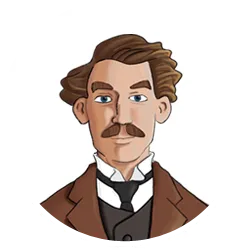
The Reverend Henry Wood Simpson was born in Grasmere, Westmorland, England, on 7th October 1874, the son of John Curwen and Frances Maria Simpson (née Sheppard). His father was a clergyman, and Henry was the second youngest of five children. He also had an older step-brother from his father’s first marriage which ended with the death of his father’s first wife in 1860.
Henry was educated privately and at Keble College, Oxford, where he obtained a third class degree in History in 1897 and a Master of Arts degree in 1900. He shot for Oxford University at the National Rifle Competition at Bisley in 1896 and 1897.
He entered Ely Theological College in 1899 and was ordained deacon in 1900 and priest
in 1901, in the Diocese of Lincoln. He was appointed Curate of the Church of All Saints, Gainsborough, Lincolnshire, in 1900, and in 1908, left there to take up missionary work as Rector of Roseland, British Columbia, Canada.
Whilst still in this position, he decided to return to Great Britain, in the spring of 1915, probably because of the war. As a consequence, he booked passage as a second cabin passenger on the Lusitania which left New York harbour for the very last time, just after mid-day, on 1st May 1915.
When the liner was torpedoed, six days later, he was lucky enough to be counted amongst the survivors and upon being rescued from the sea and landed at Queenstown, he was able to recount his experiences to a reporter from The Cork Examiner: -
“The explosion was a big one and took place soon after being struck. I was in the saloon at the time we were struck and the first thing I did was to put on my lifebelt and handed the others out to the passengers. Many of those ran on deck and left the lifebelts behind. When I got on deck, the ship had a great list to the right-hand side, and a quarter of an hour later, she disappeared. The people were just as calm as they were the day before. They got out their things and dressed themselves.
When the ship was settling down, we knew that all was over with the Lusitania. I was not long in the water, when I got hold of an upturned boat, and when, after much difficulty, we got her righted, we filled our boat with those who were struggling in the water.
Looking towards the south, we saw some object. We tried to hail it by putting a pair of trousers on an oar, but it passed by. The trawlers soon came along and they took us on board.”
The trawler which rescued The Reverend Simpson from the upturned lifeboat was H.M.S. Indian Empire a former fishing trawler, taken up for Royal Naval use as a patrol boat.
His experiences on the boat are also described in the book, The Last Voyage of the Lusitania, by Adolf and Mary Hoehling: -
The Reverend H.M. Simpson, of British Columbia, minus clerical collar and coat, had pulled an oar of his collapsible, like one inspired, pausing only to assist survivors out of the water. One of them was a most durable little boy - Bobbie Kay, of New York, who was flushed with measles that had broken out during the crossing. His mother Mrs. James Kay, had been washed away before his eyes.
Although second cabin passenger Robert Kay lived in New York, he was British born, like his mother Rita, and came from St. Helens, in Lancashire. Through The Reverend Simpson’s intervention, he was able to survive and eventually get to relatives in Lancashire. His mother Rita Kay perished in the sinking and her body was never recovered and identified. The Hoehlings are almost certainly incorrect about Simpson’s being in a collapsible lifeboat as he was in fact on top of an upturned boat! Others known to have been on this same upturned lifeboat are crew member Trimmer Edward Downey and saloon passenger Clinton Bernard.
Despite his ordeal, The Reverend Simpson must have crossed the Atlantic Ocean again
in 1916, for in that year he left his duties at Rossland and was appointed Vicar of Greenwood with Phoenix and Rock Creek, in British Columbia.
On the 26th September 1918, Henry Simpson enlisted in the Canadian Army. As 2735159 Sapper Henry Wood Simpson, he served with the Canadian Engineers, and was based at the 11th Engineer Depot. Curiously, he stated his profession as ‘carpenter’ on his enlistment and never revealed that he was a clergyman! He was demobilized on the 25th November 1918 without ever being posted abroad.
When the war was over, in 1919, he was appointed Vicar of Brompton with Snainton, Yorkshire, a position he only held for a year before travelling to Australia, where he undertook missionary work in the Diocese of North Western Australia from 1920 until 1926. His area covered 500,000 square miles, and he travelled 15,000 miles per year by road, and occasionally by boat and aircraft.
He was then appointed Archdeacon of North Western Australia, a position he held until his death, at Perth, Western Australia, on 1st March 1946, at the age of 71 years. He never married. He left his estate in England of £2,170-2s.-10d. (£2,170.14p) to Bishop John Frewer, who at that time was the Anglican Bishop of North West Australia.
Register of Births, Marriages and Deaths, Australia Death Index 1787 – 1985, 1881 Census of England & Wales, 1891 Census of England & Wales, 1901 Census of England & Wales, New York Passenger Lists 1820 – 1957, Canadian Passenger Lists 1865 – 1935, Fremantle Western Australia Passenger Lists 1897 – 1963, Cunard Records, Canada World War 1 CEF Personnel Files 1914 – 1918, Register of the Alumni of Keble College Oxford, Crockford's Clerical Directory, Keble College Centenary Register 1870-1970, 1938 Who’s Who in Australia, Cork Examiner, Last Voyage of the Lusitania, Retford, Worksop, Isle of Axholme and Gainsborough News, Probate Records, PRO BT 100/345, Graham Maddocks, James Maggs, Geoff Whitfield, Michael Poirier, Jim Kalafus, Cliff Barry, Paul Latimer, Norman Gray.
Copyright © Peter Kelly.