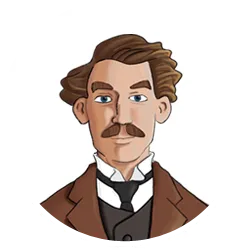
Norman Stones was born in Penistone, Yorkshire, England, on the 18th November 1886, the son of George and Sarah Jane Stones (née Holroyd). His parents managed the Man and Saddle Hotel, Dewsbury, Yorkshire, and Norman was the middle child of the three children in the family. Both of his parents had been married and widowed, and Norman’s father had three children from his first marriage.
In 1910, his father died, and by 1911, he and his mother and sister were residing at 3. Tarn Villas, Ilkley, Yorkshire. It is likely that met his future wife, Hilda Mary Joy while living here. Norman had studied for an arts degree at Leeds University, graduating in 1909, and had been in the Officer Training Corps at the university.
In October 1911, he crossed the Atlantic Ocean to Canada, where he intended to try his hand at farming. According to A.A. and M. Hoehling in The Last Voyage of the Lusitania, he was part of General Pershing’s expedition to defeat Pancho Villa on the American/Mexican border. However, this would seem unlikely, as Pershing’s main campaign took place while Norman Stones was back in Great Britain!
He was granted land near Van Anda, Texada Island, British Columbia, Canada, where he raised poultry and grew fruit, and Hilda Joy later joined him there from Yorkshire so
that the two could get married in Vancouver on the 11th July 1912.
In early 1915, the couple decided to return to Yorkshire as Hilda’s mother was in ill-health, and as a consequence, they boarded the Lusitania at the Cunard berth at Pier 54 in New York, before she sailed on her last ever Trans-Atlantic voyage, just after mid-day, on 1st May 1915.
This sailing was delayed from her scheduled 10.00 a.m. departure time, because she had to wait to embark passengers, crew and cargo from the liner Cameronia which the British Admiralty had requisitioned for war service as a troop ship at the end of April. Then, six days later, on the afternoon of 7th May, the Lusitania was torpedoed twelve miles off the coast of southern Ireland by the German submarine U-20, and sank just eighteen minutes later. At that stage of her voyage, she was only 250 miles from the safety of her home port.
According to A.A. and M. Hoehling in The Last Voyage of the Lusitania, after the ship was hit, Norman Stones was seen stripping his wife down to her stockings and putting a lifebelt around her so that she could survive better in the sea: -
In the brilliant sunshine, and with the privacy of Times Square, Stone (sic) did not desist until Mrs. Stone, unprotesting, was stripped down to her stockings. Then he fastened her lifebelt securely around her, lessening to some degree her nakedness. .....
Now Stone started ripping the canvas off a nearby collapsible boat, something which the men thought should have been done long before.
Those around him were impressed, because he appeared to know what to do, but it did not help to save his wife, for although he was subsequently rescued from his ordeal, Hilda Stones did not survive the sinking, despite his attempts to ensure her safety. No trace of her was ever found, afterwards, dead or alive.
Having been rescued from the sea, Norman Stones was landed at Queenstown, from where he later took a train for Dublin and then a boat to Holyhead in Wales. From there, he took a train to Birkenhead on the opposite side of the River Mersey and finally arrived, by Mersey ferry in the early hours of 10th May in Liverpool.
He eventually reached Ilkley, where he gave an interview to a reporter from the Yorkshire Post, which was printed in the edition of Wednesday, 12th May, and re-printed in The Ilkley Gazette on Friday, 14th May. During the course of the interview, Norman Stones gave a lengthy and graphic account of his experience: -
Mr. Stones, in the course of a conversation with a member of the Yorkshire Post staff, said that in New York before the Lusitania sailed the warning advertisements from the German Embassy in Washington were simply regarded as so much German bluff. They made a beautiful passage, with fine sunny weather and calm seas throughout. On the morning of Friday last, there was a haze, which did not lift until about half past eleven, when the Irish hills were revealed. Describing his experiences after this Mr. Stones said: “We had just had lunch with the first sitting down, and had come up on deck. My wife and I were looking over the side from C deck when I saw the track of a torpedo. It appeared to make a white, creamy track, apparently about six inches wide, and when I first saw it it was between 200 and 300 yards away from the ship. I saw no
watched the track of the torpedo as if fascinated, and saw it strike the ship between the funnels. We were second-class passengers, and were more or less confined to the stern of the ship. We were standing near to the railing dividing us from the saloon passengers, and would be at least 50 yards away from where the torpedo stuck the ship. We heard the explosion and it was nothing very terrifying; we saw a cloud of spray thrown high into the air, and the next we knew was that water and wreckage were falling into the sea near us and on the decks above us. As we were not on the top deck we were protected from the falling debris. The torpedo did not make a very big noise, and did not shake the ship very much. All we felt was a slight tremor. The ship, however, immediately began to heel over to the starboard side, and so far as I know she never righted herself. I did not hear a second explosion like the first, and am inclined to believe that only one torpedo was fired. The ship certainly gave an extra lurch shortly afterwards, but it appeared to me to be due to an internal explosion or the shifting of the cargo.
THOUGHT THE SHIP WOULD FLOAT AN HOUR.
“At the time of the attack there were few passengers on deck, but immediately following the explosion there was a rush of passengers to the deck, and at first most of them crowded on to the port side, which was the highest out of the water. My wife and I walked over to the port side. There was quite a lot of excitement, but no panic – no fighting or anything of that sort. The stewards were the best of the crew in my opinion. They certainly did not show any panic; if any portion of the crew was inclined to be panicky or excited it was the firemen and trimmers, who came up from below. The stewards went round quietly serving out lifebelts.
“In regard to the launching of the boats, there appeared to be a complete lack of system. Near to us at the stern on the port side no boat was launched, except one which fell into the water bow first. Officers and members of the crew went round saying that there was no immediate danger, and that the ship would float for at least an hour. In consequence of this a number of passengers made no effort to get lifebelts and were probably taken by surprise when the end came.
THE LAST SEEN OF MRS. STONES.
Particularly sad was Mr. Stones’s story of the last moments with his wife. He had provided both of them with lifebelts, and had planned that they should swarm down the full ropes of the wrecked boat on the port side, that he should swim with his wife clear of the ship, and trust to getting hold of some wreckage or being picked up by a boat. The situation had developed with such alarming suddenness that they were only just able to get over the side and down to the water. Mrs. Stones went first. Before she went over the side she took a purse containing some bank notes from her handbag and gave them to her husband to put into his pocket. These sea-soaked and stained notes were straightened out in Leeds on Monday. Mrs. Stones was perfectly calm and confident. She climbed down the rope, and then jumped from the hull of the ship into the sea. Mr. Stones followed, and just at that second the vast hull of the Lusitania took a plunge and sank. Both were drawn down into the vortex. Mr. Stones, who is a practised swimmer, and was able to hold his breath under water, was conscious of wreckage floating
past him. He came to the surface for a second but sank again. The second time he came up the disturbance had ceased, and he was able to look round. “I never saw my wife again,” he said. “There was no sign of the ship, but the water was full of drifting struggling bodies and wreckage. I got hold of a folded deck chair, and hung on to that for about half an hour, swimming and floating, and looking for my wife. At the end of that time I drifted near an upturned boat, to the bottom of which about six men were clinging. I joined them, and we drifted about for hours until we were picked up by the steam trawler Indian Empire and taken to Queenstown. At the finish we had about 20 persons clinging to the upturned boat.”
A DISTRESSING SCENE.
According to Mr. Stones, the scenes in the water were distressing in the extreme. A circle of roughly two miles in diameter was strewn with wreckage and with persons dead, dying, or struggling to preserve their existence. Fortunately, the sea was calm, the sun was shining, and the water was not particularly cold. Mr. Stones comments on the fact that although the trawler, only an eight-knot boat, landed them in Queenstown two hours after they were picked up, it was four hours after the accident before fast destroyers arrived on the scene. In that time a destroyer would have travelled a hundred miles, and rescued passengers were inclined to ask the reason for this delay. There is no doubt that the confident attitude of the officers and crew, and their statement that the ship would float for at least an hour – excellent though the intention was – blinded passengers to the imminence of the danger. “We should have been over the side before,” said Mr. Stones, “if it had not been for that statement, and we probably should not have been sucked down by the ship.”.
Norman returned to Leeds University Officer Training Corps, and on the 25th August was commissioned as a 2nd Lieutenant and assigned to the 2/9th Battalion of the Manchester Regiment. He was sent to France with his regiment in January 1917, and in November 1917, while an acting Captain, he was awarded the Military Cross. The citation, published in the supplement to the London Gazette of the 6th April 1918 stated: -
For conspicuous gallantry and devotion to duty. At one period of the attack he realised he would be more useful on the right than on the left flank, and executed a clever movement to achieve this object. His company, as a result, played a prominent part in the operations.
It is not known exactly when or where this event took place. Norman Stones survived the war, with the rank of Captain. He was acting as a Major in his regiment when he was demobilised.
In 1917, while on furlough, he married Kathleen Pansy Johnstone in Marylebone, London, and they had one child, a son named George, born in 1921.
Norman Stones must have returned to Van Anda for a period as he submitted a claim with the Canadian Commission seeking compensation for the loss of his wife, Hilda, and their money and personal possessions in the sinking of the Lusitania. In May 1927, the Commission awarded him $4,000 as compensation for the loss of his wife, and a further $3,500 for the loss of the couples money and personal effects.
Norman Stones returned to England where he was employed as a civil service clerk, and
his wife, Kathleen ran boarding kennels. In 1939, at the beginning of the Second World War, he and his wife and son were residing at “The Beeches”, High Street, Cowley, Uxbridge, Middlesex. During the Second World War, Norman was a volunteer Air Raid Warden.
Norman Stones died in Exmoor, Somerset, on the 7th September 1964, aged 77 years.
Register of Births, Marriages and Deaths, West Yorkshire England Church of England Births and Baptisms 1813 – 1910, British Columbia Canada Marriage Index 1872 – 1935, 1891 Census of England & Wales, 1901 Census of England & Wales, 1911 Census of England & Wales, 1939 Register, Canadian Passenger Lists 1865 – 1935, Cunard Records, Canadian Claims Case No. 891, London Gazette, The Ilkley Gazette, Yorkshire Observer, Yorkshire Post, Last Voyage of the Lusitania, PRO BT 100/345, UniLiv D92/2/72, Deaths at Sea 1871 – 1968, Graham Maddocks, Geoff Whitfield, Michael Poirier, Jim Kalafus, Cliff Barry, Paul Latimer, Norman Gray.
Copyright © Peter Kelly.