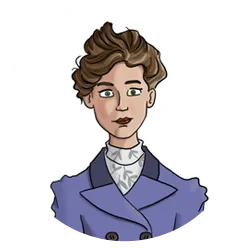
Dora Mills was born in Mossley, Lancashire, England, on the 15th June 1865, the daughter of Joseph and Mary Mills (née Hornby). She was one of ten known children in her family and her father, who died in 1875, was a cotton winder in the local cotton industry. Following the death of her father, her mother remarried in 1879 – her stepfather being a man named William Knight, who was widowed, like her mother.
She worshipped at Mossley Methodist Church and was a teacher at the Sunday School there. She worked in a local cotton mill.
On the 5th January 1884, she married James “Jim” Roberts in Ashton-under-Lyne and they had four children – three sons and a daughter. Her daughter died in 1891 and her eldest son died 1893. Her husband, Jim Roberts, died in February 1892.
On the 23rd January 1893, she married John Charles Wolfenden, who, like herself, came from Mossley, and they had lived on the same street as children. They had two children - Bertha, born in 1896, and Therza, born in 1901. Therza died in 1904.
In April 1908, her husband, and her brother, Joseph, boarded the Saxonia at Liverpool and crossed the Atlantic Ocean in search of better lives for themselves and their families. On landing at Boston, Massachusetts, in the United States of America, they continued overland to Central Falls, Rhode Island, where they had a relative to assist them in finding employment.
Once her husband secured work as a dyer in a local cotton mill, and found a home for himself and his family at 623. Dexter Street, Rhode Island, he sent for Dora and their surviving daughter, Bertha, to join him. They also crossed the Atlantic Ocean on the Saxonia, arriving in October 1908.
By the time the 1910 U.S. Federal Census was recorded, it would appear that Bertha had died, and in October 1913, when her husband applied to become a naturalized U.S. citizen, he stated that he had no children, which would appear to confirm her death. Her
husband became a U.S. citizen on the 31st January 1914, and as a result, Dora also qualified for citizenship.
In the spring of 1915, perhaps because of the Great War, they decided to return to England for good and settle in Ashbourne. Consequently they booked as second cabin passengers on the May sailing of the Lusitania which was scheduled to leave New York at 10.00 a.m. on 1st May 1915. Having arrived at the Cunard berth at Pier 54 in New York city, they couple boarded but then had to wait until 12.27, before the liner actually sailed as she had to embark passengers, some crew and cargo from the Anchor Lines vessel Cameronia, which had been requisitioned by the British Admiralty as a troop ship, at the end of April.
When the liner was torpedoed by the German submarine U-20, six days later, on the afternoon of 7th May, although John Wolfenden was killed, his wife survived, and having been rescued from the sea, she was landed at Queenstown, from where she eventually made it to her son Arnold’s house at St. John Street, Ashbourne. He, however, was not there. He had left for Liverpool on Friday, 7th May, to meet her and his stepfather off the boat and having heard of the sinking whilst there, stayed until Sunday hoping for news, before returning home, where a joyous reunion was effected.
Dora Wolfenden later related her experience of the sinking, which was published in The Stalybridge Reporter on 15th May 1915. She stated: -
We had no idea of any danger until we had just finished lunch shortly after 2 o’clock on Friday, May 7th. My husband who had just shaved, was in his shirt sleeves when the first explosion occurred. We joined in the general rush for the deck.
Just as I was getting on deck, my foot slipped and I fell back into the bottom. My husband returned and helped me on to the deck, which we reached just as the last boat was being lowered. Within two or three minutes of the first explosion a second occurred, and everyone felt that the ship was doomed. I said to my husband, “We’re going down.”
I wanted to stay with him, but he pressed me to go, and at last threw me over into the boat, where the crew safely caught me. Neither of us had a life-belt; there was no time to get one. I kept calling for my husband to come, but he refused as there were still women and children to be saved. By this time the ship had listed very heavily, and the deck sloped as steeply as “Jacob’s ladder” (a very steep bank in Mossley). My husband waved his hand to me, and said “Good-bye,” and then disappeared with the ship.
The crew of our boat had barely time to cut the ropes before the vessel went down. Fortunately there was very little suction, or we might have been drawn down with it. I had a full view do the ship as it disappeared. We were so near that one of the great funnels, which broke loose, toppled right over our boat and sank on the other side. It covered us with soot and the water which it threw up drenched us to the skin.
The surface of the water immediately became covered with luggage, wreckage and struggling men women and children. The shrieks of the latter were terrible. The amount of surrounding wreckage was so great and our boat so overcrowded that any attempt at rescuing others was out of the
question. Our boat scarcely made any progress for about three hours. Then we got assistance from another boat, to which I and others were transferred. After sailing some distance, we were transferred to a fishing smack and then to a motor boat called the Silver Cloud, landing at Queenstown at 10.30 on Friday night.
We had sat in open boats for over eight hours, drenched to the skin. We had lost everything, and were taken to an hotel and supplied with a change of clothes. On Saturday morning I went to view the dead bodies which had been brought ashore. It was a terrible time, and my husband was not amongst them.
We left for Dublin by the 10.30 a.m. train on Saturday, and were taken to an hotel there. We were to leave by the midnight boat.
Many of the women and children were hysterical, and were afraid to go on the water again. They had to be pushed on board. We made a good passage, arriving at Holyhead in three hours. Although I was never actually in the water, I was wet through, and badly bruised through being shaken about in the small boat.
Dora and John Wolfenden lost $400.00 when the Lusitania foundered and in the summer of 1915, Dora Wolfenden successfully applied to The Lusitania Relief Fund, administered by The Lord Mayor of Liverpool, for a financial award for the ordeal she had suffered. On 4th June, she was granted the sum of £4-0s-0d., and £0-10s-0d. (£0.50p.) per week, increased to £0-12s-6d. (£0.62½p.) from December 1915.
The fund had been set up shortly after the sinking by the Lord Mayor and members of the Liverpool business community, to help surviving second and third class passengers and the relatives of second and third class passenger dead who had suffered financial loss. It was thought at the time that saloon passengers would not need this help.
Following her survival, Dora Wolfenden resided at 118. Stockport Road, Mossley, Lancashire, but died less than three years after her experiences on the Lusitania. She died on the 15th March 1918, aged 52 years, and left her estate of £168-3s.-3d. (£168.16p.) to her son, Arnold Roberts, who at the time of her death was serving as a sapper with the Royal Engineers. She was buried in Mossley Cemetery near her children, Joseph Mills Roberts and Florence Hannah Roberts, who had died in the 1890’s, as previously mentioned.
Register of Births, Marriages and Deaths, Manchester England Non-Conformist Births and Baptisms 1758 – 1912, Manchester England Church of England Marriages and Banns 1754 – 1930, 1871 Census of England & Wales, 1881 Census of England & Wales, 1891 Census of England & Wales, 1901 Census of England & Wales, 1910 U.S. Federal Census, 1915 Rhode Island State Census, Massachusetts Passenger Records 1820 – 1963, Cunard Records, Ashbourne Telegraph, Oldham Evening Chronicle, Stalybridge Reporter, (Photo), Staffordshire Weekly Sentinel, Liverpool Record Office, Probate Records, UniLiv D92/2/411, UniLiv D92/2/11, Deaths at Sea 1871 – 1968, Graham Maddocks, Geoff Whitfield, Michael Poirier, Jim Kalafus, Cliff Barry, Paul Latimer, Norman Gray.
Copyright © Peter Kelly.