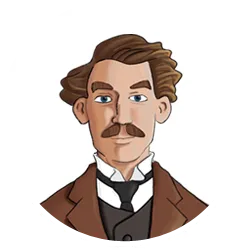
George Groves was born in Saxilby, Lincolnshire, England, on the 8th August 1846, the son of James and Susan Groves (née Nelson). His father was an agricultural labourer, and the family resided at East Turnpike, Saxilby.
In 1870, he immigrated to the United States of America where he became a farmer in Mayfield, DeKalb County, Illinois. It is likely that he intended to stay there for the rest of his days, as he sought and was granted United States citizenship in 1886. On the 13th February 1883, he married Sarah Crampton, a widow, who had been born in England, and whose husband died in DeKalb County in 1880. There were no children as a result of their union, Sarah being fourteen years older than George, and being aged 53 when they married. Her maiden name might have been Conkins.
George and Sarah returned to England for a holiday, remaining there for a few months, and then, on the 26th December 1902, Sarah died. Her four children from her first marriage had predeceased her.
In 1905, George retired from farming and returned to England, residing with his married sister, Mrs. Sarah Ann Parkinson, at 14. Fawcett Street, Gainsborough, Lincolnshire.
On the 20th March 1915, he boarded the Lusitania at Liverpool on the first part of his journey to Illinois where two of his brothers, Henry and Joseph, owned farms. All three brothers had become naturalized citizens of the United States. It is not known whether George was just going on a holiday to see them, or whether he had business to conduct in Illinois. He had booked a third class return ticket before he departed from Liverpool.
Having visited his brothers, he proceeded on his return journey to Gainsborough, and arrived at the Cunard berth at Pier 54 in New York on the morning of 1st May 1915, in time for the
Lusitania’s scheduled sailing and would have had his last glimpse of his once adopted country just after mid-day, when the liner finally left port. The delay was caused because she had to wait to embark passengers, crew and cargo from the liner
Cameronia which the British Admiralty had requisitioned for war service as a troop ship at the end of April.
Then, six days out of New York on the afternoon of 7th May, and within sight of the coast of southern Ireland, the
Lusitania was torpedoed and sunk by the German submarine U-20. At that time, she was only about 250 miles away from her destination. George Groves was killed as a result of this action. He was aged 68 years.
His body was never recovered and identified afterwards and consequently, he has no known grave.
When his will was proven at London on 5th August 1915, administration was granted jointly to William Hind, baker and William Pye, saddler. His effects amounted to £5,537-10s-1d, (£5,57.50p).
Henry Groves lodged a claim with the Mixed Claims Commission after the War, seeking compensation for the loss of his brother. The Commission declined to make any award to him as he was not deemed to be in any way dependant upon his late brother. Documents lodged with the Commission state that in his will, George bequeathed most of his estate to his sister, Sarah Parkinson and her family. It is believed that they benefited to the tune of $25,000. Two of his other brothers residing in England also benefited from the will, James receiving $2,500, and Thomas receiving $1,250. Neither Henry nor Joseph was mentioned in the will, which reinforced the belief by the Commission that neither brother residing in America was dependant on George.
Register of Births, Marriages and Deaths, England Select Births and Christenings 1538 – 1975, DeKalb County Illinois Marriages 1864 – 1962, 1851 Census of England & Wales, 1861 Census of England & Wales, 1880 U.S. Federal Census, 1900 U.S. Federal Census, 1911 Census of England & Wales, U.S. Passport Applications 1795 – 1925, New York Passenger Lists 1820 – 1957, Cunard Records, Mixed Claims Commission Docket No. 222, Grantham Journal, Hull Daily Mail, Probate Records, PRO BT 100/345, UniLiv D92/2/161, Deaths at Sea 1871 – 1968, Graham Maddocks, Geoff Whitfield, Michael Poirier, Jim Kalafus, Cliff Barry, Paul Latimer, Norman Gray.
Copyright © Peter Kelly.