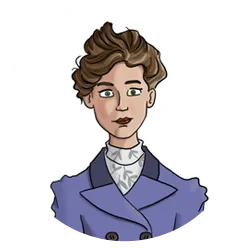
Clara Dewhurst was born on the 27th January 1887 in Crawshaw Booth, Lancashire, the daughter of Thomas and Ann Dewhurst (née Bielby). Her father was an engineer in a cotton mill, and the family home while she was a child was at Irwell Vale, Bury, Lancashire.
The family later moved to 1. East Avenue, Barnoldswick, in the West Riding of Yorkshire, and Clara, along with most of her siblings, became a cotton weaver in one of the local cotton mills.
On the 23rd July 1906, Clara married Robert ‘Bob’ Hebden in St. Mary’s Church, Bury, Lancashire. Bob was also a cotton weaver, and both were employed by Messrs. Whiteoak and Co., at their Westfield Mill in Barnoldswick. The couple established their home at 9. Hartley Street, Barnoldswick.
In May 1908, Clara gave birth to the couple’s only child, a son they named William, but he, unfortunately, died just over three years later, on 19th September 1911. He was buried in the local graveyard, next to the Church of St. Mary-le-Gill, known locally as ‘Gill’s Church‘.
In 1913, the couple emigrated to the United States of America and settled in New Bedford, Massachusetts, where they both continued to work in the textile trade. In the spring of 1915, however, they had decided to return home to set themselves up in business together and as a consequence, they left New Bedford at the end of April and took a train to New York.
Once there, on the morning of 1st May, they boarded the Lusitania as third class passengers, at Pier 54, and said good-bye to America just after mid-day, as the liner slipped her moorings there, for the very last time. They did not inform their families in Barnoldswick of their intended return as they wanted it to be a surprise.
Just six days later, Clara Hebden lost her life after the vessel was torpedoed, although her husband Robert was saved. She was in her 28th year.
The first intimation that Clara Hebden’s mother had of her fate was contained in a telegram sent from Queenstown by Bob Hebden, after he had been landed there, which simply said: -
BOB PICKED UP; HEARD NOTHING OF CLARA YET!
The slight hope that this uncertainty gave, however, was dashed when Clara Hebden’s body was recovered from the sea, and having been landed at Queenstown, it was given the reference number 114, in one of the temporary mortuaries there, before positive identification of it was made.
This painful duty was performed by Bob Hebden and he was given property recovered from it whilst still in the town. At that time, he gave his address as 35, Westgate, Barnoldswick, which was the address of his own mother, to whom he wrote on Tuesday 11th May from the safety of The Westbourne Hotel in Queenstown. His latter pathetically stated: -
Just a line to let you know we were on the Lusitania. I am sorry to say Clara went down, and I was almost gone. I was picked up. The sight was awful.
They didn’t give the passengers a chance to save their lives. It went down in a quarter of an hour from being torpedoed. I am bringing the body back home. I shall start from Dublin, then sail to Holyhead by the midnight boat. You can make arrangements about the grave. There is another lady bringing a body on the same boat to Nelson.
The sight here is awful - thousands of people - broken hearted, some claiming wives, some husbands, some daughters and sisters or brothers. I shall be in Tuesday afternoon if everything goes well.
The lady bringing a body on the same boat to Nelson, was Elizabeth Duckworth of Blackburn, Lancashire, and the body was that of Mrs. Alice Scott, who had also perished in the sinking.
Upon his return to Barnoldswick, Bob Hebden was interviewed by a reporter from the local newspaper
The Craven Herald and Wenslydale Standard, in which he described the sinking and the fact that when the ship was struck, Clara Hebden was not with him, but with another lady and he stated that the next time he saw her, was in a mortuary in Queenstown!
Clara Hebden's body was later returned to Barnoldswick for burial, and her coffin arrived at the town station just before noon on Tuesday 11th May where it was met by a hearse. It was then transported to her mother’s house in Federation Street where it lay in state until the funeral. Whilst there, many of her former mill working friends came to view the body to pay their last respects to their former friend and colleague. One account by the daughter of a friend of Mrs. Dewhurst, written in June 2000, states that the corpse was wearing a fur coat!
The brass plate on the lid of the coffin bore the simple inscription: -
CLARA HEBDEN
DIED MAY 7TH 1915
AGED 28
On the afternoon of 13th May 1915, The Reverend F.W. Patten, M.A., vicar of the church of St. Mary-le-Gill, conducted a short service at the house, before committing the body for burial in the same grave where her little son had been buried, nearly four years earlier. The funeral service at the graveside, led by her husband Bob, as chief mourner, was attended by many local people and two other survivors of the sinking.
These were fellow third class passengers Elizabeth Duckworth, whom Bob Hebden must have met on the boat from Dublin to Holyhead, and eight year old Arthur Scott from Nelson, Lancashire, the son of Alice Scott, whose body had accompanied that of Clara Hebden on the journey back to Lancashire. The two mourners had shared a cabin together on the trans-Atlantic crossing, together with Alice Scott. Presumably, either or both of the survivors must have got to know Clara Hebden on the crossing. Like Mrs. Hebden, Elizabeth Duckworth was also a textile worker!
Clara Hebden’s body still lies in the graveyard next to Gill Church today, in section 5/L/5, but the only inscription on the headstone refers to her son. It states: -
In Loving Memory of
WILLIAM HEBDEN
THE BELOVED SON OF ROBERT AND CLARA HEBDEN
OF BARNOLDSWICK
DIED SEPT. 19TH 1911 AGED 3 YEARS AND 4 MONTHS.
“Not our will, but thine, O Lord.”
As this inscription fills the available space on the stone, there is no room for any details of his mother or her fate.
The cost of transporting Clara Hebden’s body from Queenstown to Barnoldswick came to £15-16s-0d., (£15.80) and this was later claimed back by Robert Hebden from The Lusitania Relief Fund, of Liverpool, via The Cunard Steam Ship Company.
The fund had been set up by The Lord Mayor of Liverpool and other local dignitaries of the business world after the sinking, to give financial aid to survivors and relatives of the dead of the second and third classes on board ship. It was thought that saloon class passengers would have sufficient wealth not to need any help!
Her husband, Bob Hebden later joined the Army - possibly to avenge the death of his wife, and as 29/618 Private Robert Hebden of the 12th Battalion, The Northumberland Fusiliers, he was killed in action on 2nd April 1917, whilst serving in France. By that time, he had married again and was living with his new wife at 41, Church Street, Barnoldswick.
The Westbourne Hotel in Queenstown where Bob Hebden stayed is still there today although it is now a nightclub named The Cellar, in the renamed Cobh.
Register of Births, Marriages and Deaths, Manchester England Church of England Births and Baptisms 1813 – 1915, Lancashire England Church of England Deaths and Burials 1813 – 1986, 1891 Census of England & Wales, 1901 Census of England & Wales, 1911 Census of England & Wales, Massachusetts Passenger Lists 1820 – 1963, Cunard Records, Craven Herald, Lancashire Daily Post, White Star Journal, Craven’s Roll of Honour, British Regiments 1914-18, 12th Northumberland Fusiliers War Diary, UK Army Register of Soldier’s Effects 1901 – 1929, Commonwealth War Graves Commission, Liverpool Record Office, PRO BT 100/345, Graham Maddocks, Dennis Cairns, Peter Threlfall, Geoff Whitfield, Michael Poirier, Jim Kalafus, Cliff Barry, Paul Latimer, Norman Gray.
Copyright © Peter Kelly.