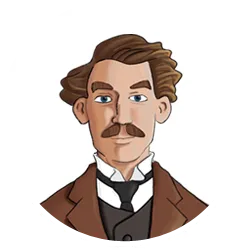
George Hook was born in Stone in Oxney, Tenterden, Kent, England, on the 6th July 1869, the second of nine known children of George and Frances Sarah Hook (née King). His father was an agricultural labourer.
On completing his education, he found work as a labourer in a timber yard in Hinxhill, Kent, where his family had moved to, but he later left his family to live and work in Croydon, Surrey.
In Croydon, he was working as a builder’s machinist, and boarded at 27. Dering Road. Also boarding at the same address was a woman named Edith Ellen Barter. George and Edith married in 1901, and had two children, Elsie May, born in 1903, and Frank, born in 1904.
In 1907, the entire family immigrated to Canada, and George found work in a metal foundry in Toronto, Ontario. The family established their home at Millicrest Street. In the autumn of 1913, however, his wife had died, leaving him with their two children,. George engaged Englishwoman Annie Marsh, as his housekeeper. She had originally come from Kent, and lived in Toronto with her husband, Thomas, and her infant son of the same name.
By the spring of 1915, however, he decided that he could earn his living just as easily in his native land and deciding to return to England, he sold up in Toronto, intending to buy second cabin tickets for himself and his children on the
Lusitania. However, at the same time the Marsh family also decided to return home on the Cunarder, and as they had already bought third class tickets, George Hook decided to do the same, so that they could all travel together.
The two families set off from Toronto at the end of April 1915 and joined the liner at her berth in New York, in time to catch her sailing which began on the early afternoon of 1st May. In order to make the cost of the crossing still cheaper, George Hook had obtained a half fare ticket for Elsie, by stating that she was actually a year younger than she really was!
During the voyage across the Atlantic, he and his family enjoyed the relaxed atmosphere, and as well as having the Marsh family as travelling companions, made particular friends of two fellow third class passengers, Gerda Neilson and Jack Welsh.
Six days later, when the vessel was torpedoed the family was temporarily separated, but soon gathering his two children together, George Hook decided that they should not try and get into the already overcrowded boats and instead, as the liner got lower and lower in the water, he made them jump into the sea with him.
Almost immediately, Frank was separated from the other two who were eventually rescued and landed at Queenstown. When there was no initial sign of him in the town and fearing the worst, they spent three whole days searching the mortuaries there, and were eventually joyously reunited with the boy in Queenstown Hospital. Although injured as he had jumped into the sea, by a falling lifeboat, Frank too, had been rescued and would eventually make a complete recovery. Tragically, however, only Annie Marsh survived from that family, her husband and son both perishing! George Hook was aged 47 years at the time of the sinking.
While his son, Frank, recovered from his injuries in hospital, George and his daughter, Elsie, stayed at Hennessy’s Hotel in Queenstown, and while there, he received a letter from Mrs. Gertrude Prichard, seeking information about her son, Richard Preston Prichard, who had been a second class passenger on the Lusitania, and of whom nothing had been hear of in the aftermath of the sinking. He replied to her on the 22nd June: -
Dear Madame,
I am sorry I cannot give you much information about your son as I came 3rd class and was not often on 2nd class decks. I had a conversation with him on the second day out from New York. I had took (sic.) my daughter up on to the 2nd class deck and she went to sleep there and your son came along and said your little girl looks very ill and asked if I had a rug to put over her as I ought to be covered up. I told him mine was at the other end of the ship. So he went and fetched his and wrote on an envelope his name and number of his cabin so as I could take it to his cabin when I had finished with it. I can remember what a job I had to find his cabin when I took it back. I never saw him after that. I am sure if your son was in his cabin at the time the torpedo struck us that he would have plenty of time to get on deck. I saw lots of people without belts on just before we went under and I feel sure that all realized that the ship could not float long and my opinion is that too many tried to get into the boats when there was no chance to get them away and were drawn down when the ship went under. I saw lots of dead and injured in the water before we were picked up for we were in the water an hour before we got on to an upturned boat. I do not know the address of any of the 2nd class passengers. Wishing I could help you more than I am able to.
I remain yours
Sincerely George Hook
The three members of the Hook family eventually made it to England, as did Annie March, and Gerda Neilson and Jack Welsh, who having met for the first time on board the
Lusitania, fell in love so completely that they would marry not long after their return to England, on 13th May 1915!
George Hook worked as a saw doctor for many years after the sinking, and by the 1940’s, he was living at 19. Oban Road, Barking, Essex. Then, on the 13th July 1948, at the age of 79 years, he boarded the P & O liner,
Brent Empire, at Glasgow, bound for Sydney, Australia. Also on board were his daughter, Elsie, and her husband and children.
George Hook died in Williamstown, Victoria, Australia, in August 1963, aged 94 years.
Register of Births, Marriages and Deaths, England Select Births and Christenings 1538 – 1975, Australia Death Index 1787 – 1985, 1871 Census of England & Wales, 1881 Census of England & Wales, 1891 Census of England & Wales, 1901 Census of England & Wales, 1911 Census of Canada, 1939 Register, Canadian Passenger Lists 1865 – 1935, UK Outward Passenger Lists 1890 – 1960, Cunard Records, Cheshire Observer, Seven Days to Disaster, Australia Electoral Rolls 1903 – 1980, IWM 62, PRO BT 100/345, Graham Maddocks, Geoff Whitfield, Michael Poirier, Jim Kalafus, Cliff Barry, Paul Latimer, Norman Gray.
Copyright © Peter Kelly.